
OPINION | DEMOCRACY & JUSTICE
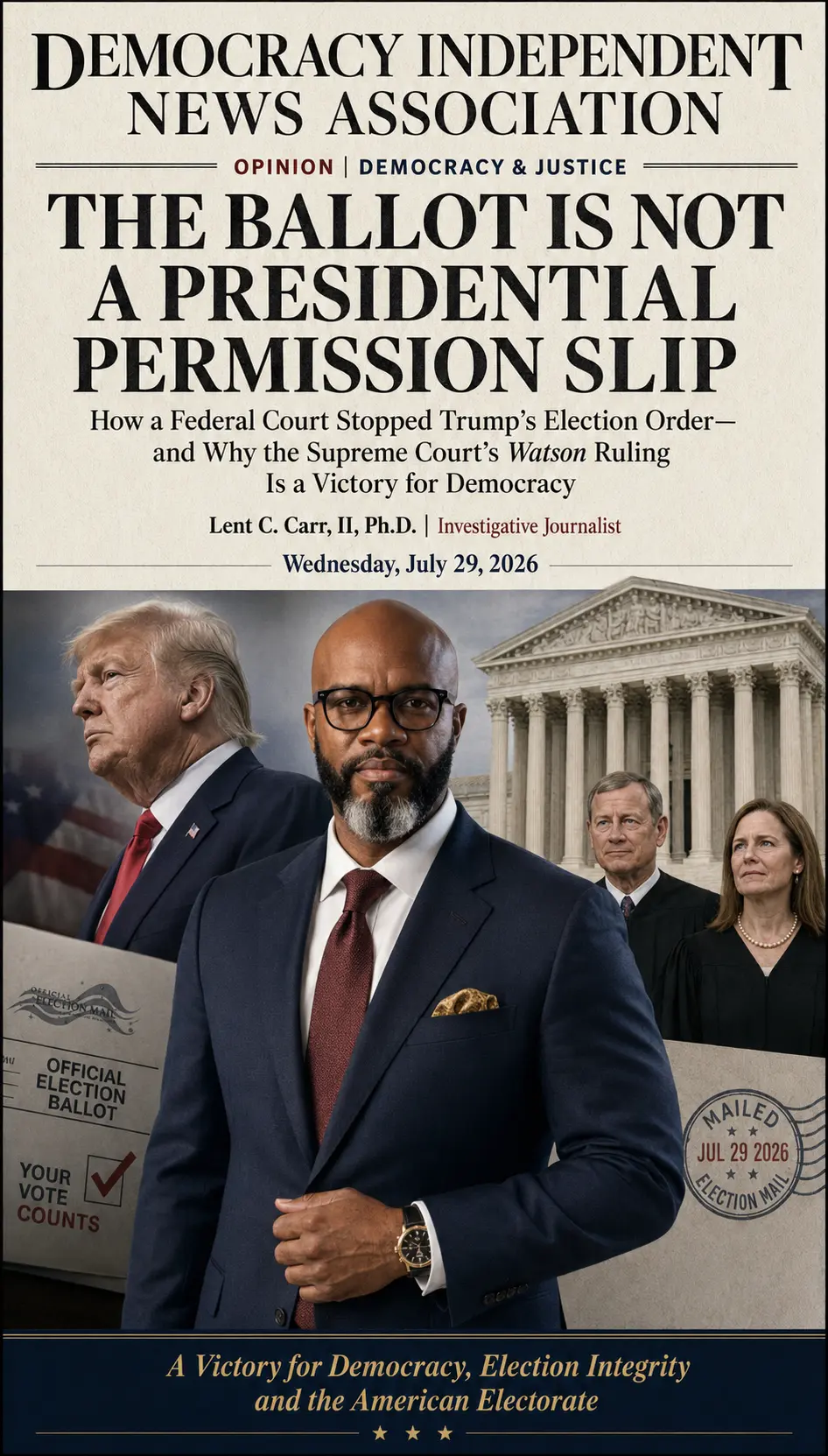
A ballot lawfully cast by Election Day does not become illegitimate merely because it travels through the mail or is counted after the polls close. The ballot is not a presidential permission slip. It is the instrument through which the American people grant—or withdraw—permission to govern.
The conflict examined in this original DINA edition began with an executive effort to impose new federal conditions on election administration. The constitutional problem was not the slogan “election integrity.” Every eligible vote should be secure, traceable and counted according to law. The problem was power: who may write the rules, by what process and under what authority?
Article I’s Elections Clause begins with the states and gives Congress—not the President—the power to make or alter rules for congressional elections. The executive branch enforces enacted law. It does not acquire a free-standing authority to redesign registration systems, ballot deadlines or the machinery used to count lawful votes.
A court’s duty is not partisan
When a federal court stopped the challenged order, it did not declare that election safeguards are forbidden. It held that safeguards must come from lawful authority and must respect the constitutional allocation of power. Courts do not become anti-democratic when they restrain a President. Judicial review is one of the methods by which constitutional democracy prevents temporary officeholders from converting political preference into unilateral law.
The ruling also recognized a practical truth. Election administration is not a campaign rally. Registration databases, county boards, absentee envelopes, military ballots, cure procedures and certification calendars operate through detailed statutes and public rules. Sudden federal commands can generate confusion, unequal treatment and avoidable disenfranchisement.
What the Watson ruling means
The Supreme Court’s Watson ruling reaffirmed the principle that a ballot cast in accordance with state law remains a lawful vote even when ordinary counting or delivery rules extend beyond Election Day. That holding protects voters from losing their voice because of administrative timing beyond their control.
Election Night is a media event. Certification is a legal process. No serious democracy promises that every provisional ballot, military ballot and mail ballot will be examined before midnight. Accuracy requires time, uniform standards and transparent review.
The constitutional lesson is larger than one case. A President may advocate legislation. Congress may legislate within its authority. States may administer elections under state and federal law. But no President owns the electorate, and no party may redefine a lawful vote merely because counting it becomes politically inconvenient.
Election integrity includes access
Integrity is not achieved by counting fewer lawful ballots. It is achieved through accurate voter rolls, secure systems, bipartisan observation, documented chain of custody, meaningful audits and fair notice before rules change. Access and security are not enemies. Each is part of the same democratic obligation.
Voter fraud should be investigated and prosecuted where evidence exists. Administrative errors should be corrected. But allegations must be proved, not repeated until they become political folklore. A constitutional republic cannot be governed by suspicion alone.
The American electorate is the sovereign
The defining question is whether public officials serve the electorate or attempt to select it. The people authorize government through the ballot. Government therefore bears a heightened duty not to manipulate the rules for partisan advantage.
The federal court’s injunction and the Supreme Court’s ruling stand for a democratic proposition: lawful votes belong to the voters who cast them. They are not favors granted by a President, and they do not expire when an election-night broadcast ends.
The ballot is not a presidential permission slip. It is the people’s permission slip to government—and it must be honored.
Archive note: This canonical web edition preserves the argument and publication record of DINA’s July 29, 2026 opinion article.