
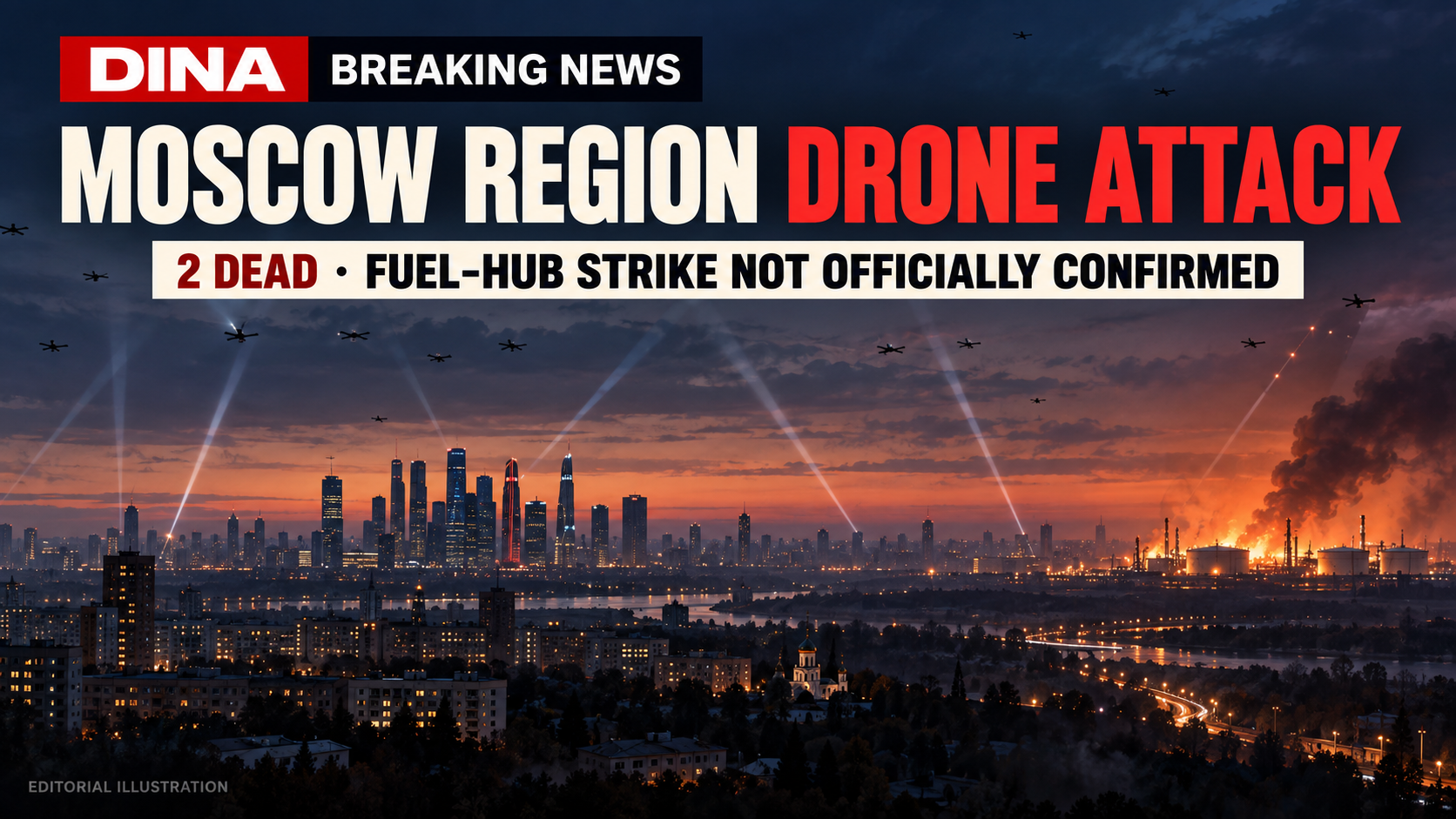
Breaking news · Russia–Ukraine war · Moscow region · Civilian protection · Energy infrastructure · DINA analysis
MOSCOW REGION, Russia — Two people were killed and nine others were injured during a massive overnight drone attack on Moscow and the surrounding region, according to Russian regional officials. Moscow Mayor Sergei Sobyanin said more than 650 Ukrainian drones were launched toward the capital, while Russia's Defense Ministry separately claimed that air defenses intercepted nearly 900 drones across Russia, occupied Crimea and the Sea of Azov.
Those figures are Russian government claims and have not been independently verified. Ukraine had not publicly commented on the operation by the time of the initial reports.
Russian military bloggers and Ukrainian-linked social-media accounts also reported that the Volodarskaya oil-storage and distribution facility was struck and published video said to show a large fire. Reuters could not verify the footage, and Russian authorities had not officially confirmed a hit at the facility. DINA therefore does not report the fuel-hub strike as established fact.
What is confirmed—and what remains an allegation
- Confirmed by the Moscow region government: Governor Andrei Vorobyov said two people were killed, including a 71-year-old man recovered from a damaged home and a 20-year-old man found in another village. Nine people were reported injured.
- Confirmed by regional officials: homes, apartments and vehicles were damaged, and power-restoration work was underway in villages near Domodedovo.
- Russian official claim: Sobyanin said more than 650 drones were directed toward Moscow; Vorobyov said 185 drones were destroyed or suppressed over the Moscow region.
- Broader Russian military claim: the Defense Ministry said nearly 900 drones were intercepted across multiple regions and occupied territories. Independent observers have not verified that total.
- Reported but not officially confirmed: a strike and fire at the Volodarskaya fuel-storage hub. Reuters said it could not immediately authenticate the circulating video.
- Not established: the complete Ukrainian target list, the number of drones that reached intended targets, the precise causes of each death and injury, or the operational effect on Moscow's fuel network and airports.
A strategic fuel hub is at the center of an unresolved claim
The Volodarskaya facility is described in public reporting as a major storage and distribution point for diesel, gasoline and jet fuel. It is connected to Moscow's main refinery and supplies the capital's three largest airports.
That strategic role makes the reported fire consequential—but it also raises the verification standard. A distant blaze or social-media video does not, by itself, prove which structure burned, what caused the fire, whether storage tanks were penetrated or whether fuel deliveries were interrupted.
Russian authorities should disclose incident coordinates, fire-service logs, environmental readings, inventory losses, pipeline status and any aviation-fuel disruption. Ukraine should state whether the facility was an intended military objective and identify the legal and operational basis for the attack.
Civilian deaths remain central
The confirmed deaths and residential damage cannot be reduced to an infrastructure story. Under international humanitarian law, parties must distinguish military objectives from civilians and civilian objects, take feasible precautions and avoid attacks expected to cause excessive civilian harm in relation to the anticipated military advantage.
Those duties apply regardless of Russia's continuing attacks on Ukrainian cities or Ukraine's stated strategy of striking the energy system that supports Moscow's war effort. One side's violations do not excuse unlawful conduct by the other.
Why it matters
The attack demonstrates Ukraine's expanding ability to send large numbers of long-range drones toward Russia's political and logistical center. Even when intercepted, attacks of this scale can disrupt airports, electricity, emergency services and civilian movement while forcing Russia to concentrate air defenses around the capital.
If the Volodarskaya hub was struck and materially damaged, the impact could reach military logistics, commercial aviation and regional fuel distribution. That conclusion cannot be drawn until officials or independently verifiable evidence establish what happened at the site.
DINA analysis: scale does not substitute for verification
DINA analysis: The scale of the Russian claims is extraordinary, but wartime interception totals and target claims are inherently difficult to audit. Russia has incentives to emphasize defensive success and civilian harm. Ukraine has incentives to emphasize the reach and economic effect of its campaign. DINA will not adopt either narrative without corroboration.
The strongest accountability frame is not a scoreboard of drones launched or destroyed. It is whether commanders selected lawful targets, minimized foreseeable civilian harm and disclosed enough evidence for independent investigators to reconstruct the operation.
This attack also deepens an escalation cycle: Russia has intensified attacks on Kyiv and Ukrainian infrastructure, while Ukraine has pledged to continue striking Russian refineries and fuel logistics. The civilian and economic consequences now extend far beyond the front line.
Urgent follow-up and records requests
- Request the Moscow region's complete casualty, property-damage, fire-response and emergency-dispatch records.
- Seek official coordinates and damage assessments for every confirmed drone impact.
- Obtain incident and environmental reports from Transneft and operators of the Volodarskaya facility.
- Request airport-delay, cancellation and aviation-fuel-supply data for Sheremetyevo, Domodedovo and Vnukovo.
- Ask Ukraine's General Staff and security services whether they carried out the operation and which facilities were intended targets.
- Archive original, time-stamped video and commission independent geolocation before attributing any fire to a specific depot.
- Seek satellite imagery and thermal-fire data capable of establishing the location, duration and extent of any fuel-facility damage.
- Track Russian retaliatory claims and independently document resulting civilian deaths, injuries and damage in Ukraine.
Sources
- Reuters — Two killed in Moscow-region drone attack; reported fuel-hub strike not officially confirmed
- Associated Press — Russia claims nearly 900 drones intercepted as Moscow-region fuel depot reportedly burns
- Government of the Moscow Region — Official casualty and damage statement
- Reuters — Russia vows intensified strikes after Ukraine pledges further refinery attacks