
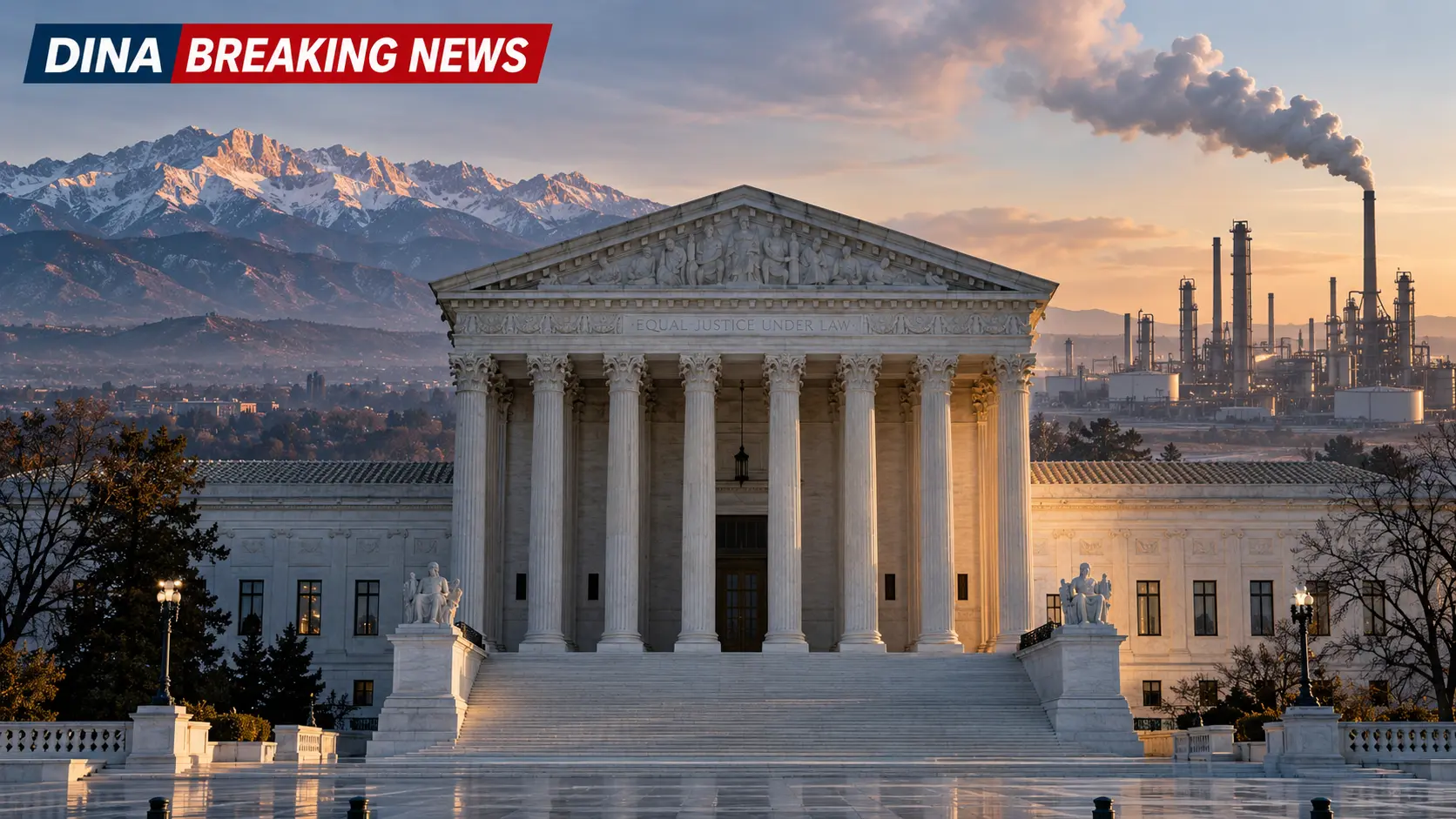
Breaking news · U.S. Supreme Court · Climate accountability · Federalism · DINA analysis
WASHINGTON — The U.S. Supreme Court opens its new term Monday with a case that could determine whether Boulder, Colorado, may pursue state-law claims seeking climate-related damages from ExxonMobil and Suncor Energy—or whether federal law shuts the courthouse door before the allegations are tested.
The Court's official docket sets argument in Suncor Energy (U.S.A.) Inc. v. County Commissioners of Boulder County, No. 25-170, for 10 a.m. Eastern on October 5. The justices agreed to consider whether federal law precludes state-law claims for injuries allegedly caused by interstate and international greenhouse-gas emissions. They also directed the parties to address whether the Court has statutory and constitutional jurisdiction to decide the case at this stage.
No ruling has been issued. Monday's proceeding is oral argument, and a decision is expected by the end of the Court's term.
What is confirmed
- Confirmed by the Supreme Court docket: the case is No. 25-170 and is scheduled for oral argument Monday, October 5, 2026.
- Confirmed procedural posture: the Colorado Supreme Court allowed the local governments' lawsuit to continue. Exxon and Suncor asked the U.S. Supreme Court to reverse that decision.
- Confirmed allegation—not an adjudicated fact: Boulder city and county officials allege the companies misled the public about fossil-fuel risks and should help pay past and future climate-related costs.
- Confirmed defense: the companies deny wrongdoing and argue that federal law, including the Clean Air Act, displaces the state-law claims.
- Confirmed government position: the Trump administration filed a brief supporting the companies' preemption argument.
- Confirmed recusal: Justice Samuel Alito will not participate. The Court has not publicly stated a reason. Reuters reports that Alito owns stock in several oil and gas companies, but not Exxon or Suncor.
A lawsuit about who pays—not a trial on the evidence
Boulder County and the City of Boulder filed the case in 2018. They seek unspecified monetary damages for costs they attribute to climate change, including infrastructure repairs, emergency management, environmental damage and public-health harms.
The Supreme Court is not scheduled to decide whether the companies actually deceived the public, how much any alleged conduct contributed to a particular disaster or how much money Boulder should receive. The immediate dispute is whether Colorado law may supply the cause of action at all and whether the justices have authority to review the lower court's ruling now.
That distinction matters. A ruling for the companies could end this case—and potentially undermine dozens of similar suits—without a trial on the truth of Boulder's allegations. A ruling for Boulder would permit the litigation to proceed; it would not establish liability.
Why the decision could reach far beyond Colorado
Exxon and Suncor told the Court that nearly 60 state and local governments have filed similar climate-liability cases. Those lawsuits vary, and any later effect would depend on the wording of the opinion, but both sides agree that Monday's case is a major test.
The companies argue that allowing state courts to impose liability for global emissions could let individual jurisdictions regulate conduct far beyond their borders. Boulder argues that its claims target alleged deception and local injury under ordinary state law, not a state-created emissions policy for the world.
For communities, the practical issue is whether taxpayers alone absorb mounting costs for roads, water systems, wildfire response, heat, flooding and public health—or whether courts may consider shifting some costs to fossil-fuel companies under state law.
DINA analysis: accountability and federalism meet at the courthouse door
DINA analysis: The case is framed as climate litigation, but its institutional stakes are broader. It asks who decides whether a state-law case may proceed: state courts applying their own law, Congress through the Clean Air Act, or federal judges applying federal preemption.
A progressive accountability view favors giving communities a forum to test evidence about alleged deception and public costs. But that is an editorial judgment, not a statement that liability has been proved. The neutral legal question is whether federal law leaves room for those state causes of action.
Alito's recusal leaves eight justices. A 4-4 split would affirm the Colorado judgment without creating a controlling national precedent, though the Court could also resolve the jurisdictional issue without reaching the preemption merits.
Accountability questions to follow
- Does the Court focus on the merits of federal preemption or on whether it has jurisdiction over a non-final state-court decision?
- Which alleged conduct do the justices treat as central: production and global emissions, marketing and deception, or both?
- Will the Court issue an opinion narrow enough to preserve other state consumer-protection or fraud claims?
- What is the documented basis for Justice Alito's recusal, and will the Court disclose more than the fact of his nonparticipation?
- Which organizations financed amicus briefs and public campaigns on either side, and what interests do they represent?
Urgent follow-up and records work
- Archive the oral-argument transcript and audio as soon as the Court posts them.
- Compare the justices' questions with the parties' merits briefs, the United States' brief and the Colorado Supreme Court ruling.
- Request from Boulder its itemized climate-damage estimates, contracts, adaptation plans and records supporting claimed costs.
- Review the companies' public climate statements, internal records already made public in other proceedings and the precise allegations in the complaint—without treating allegations as findings.
- Track related litigation nationwide to identify which claims would actually be affected by the eventual opinion.
Sources
- U.S. Supreme Court — official docket, No. 25-170
- U.S. Supreme Court — questions presented
- U.S. Department of Justice, Office of the Solicitor General — United States brief
- Boulder County — notice of Supreme Court argument
- Reuters — Supreme Court term opens with climate-liability case
- Associated Press — preview of the Boulder climate case