
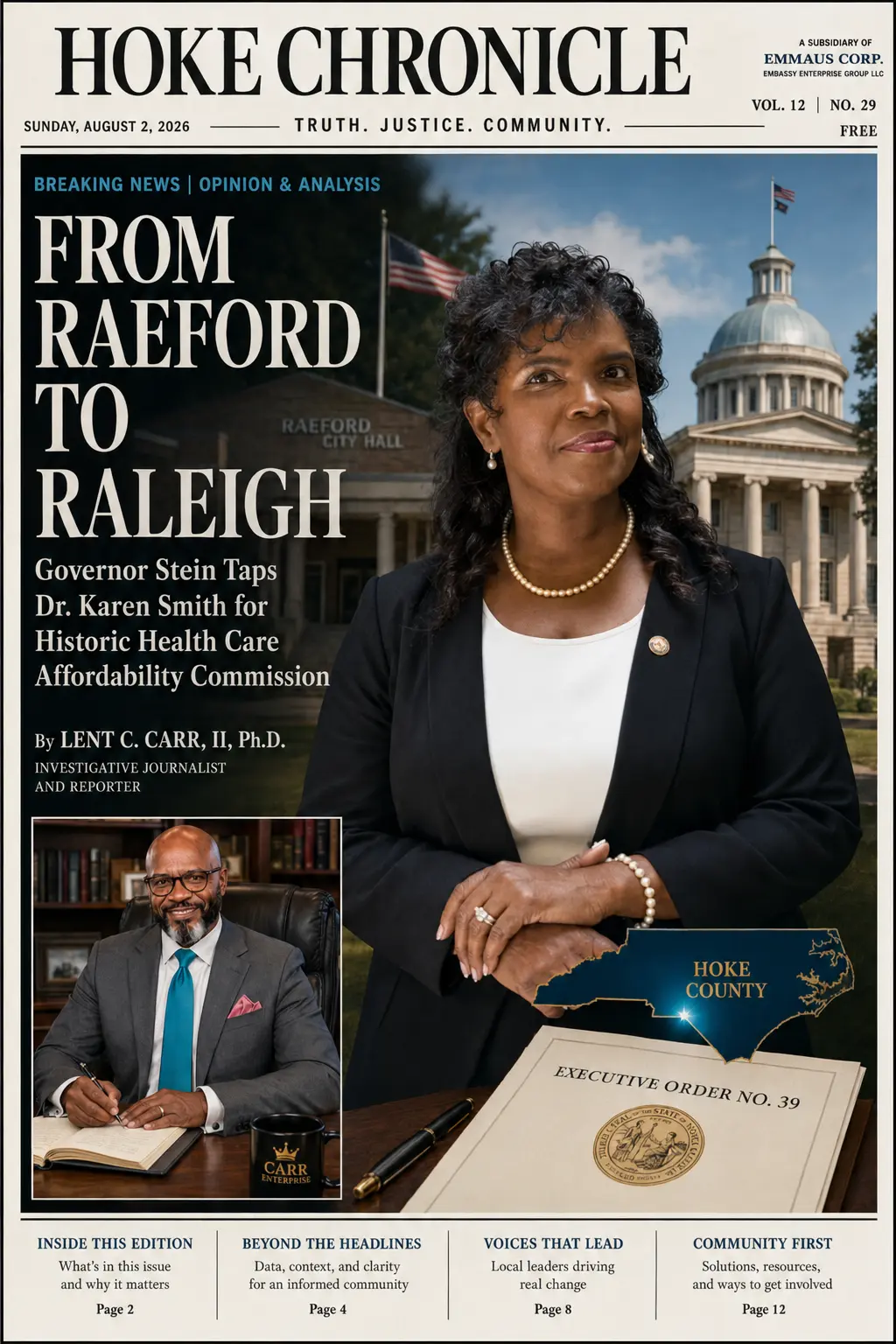
RAEFORD, N.C. — Dr. Karen L. Smith has spent more than three decades treating patients in Hoke County who routinely face an impossible calculation: whether they can afford care at all. Now, she has been asked to help reshape how North Carolina confronts that very problem.
Governor Josh Stein has appointed the Raeford family physician, M.D., FAAFP, to the North Carolina Health Care Affordability Commission, a statewide body charged with identifying the forces driving medical costs and recommending reforms to improve access, transparency and competition.
The commission brings together physicians, hospital leaders, insurers, researchers, employers, patient advocates and lawmakers, and is co-chaired by State Treasurer Brad Briner and NCDHHS Secretary Dr. Devdutta Sangvai.
For Hoke County, the appointment carries particular weight. Dr. Smith is not entering the debate as an outside expert, but as a rural physician whose daily practice reflects the system’s pressures in real time—patients choosing between prescriptions and groceries, delaying care because of transportation barriers, or forgoing treatment until conditions become emergencies.
Her presence ensures that when North Carolina debates health care affordability, rural communities like Raeford are not merely studied—they are represented.
Governor Stein established the commission on June 30 through Executive Order No. 39. Its mandate includes examining cost drivers, expanding primary care access, improving price transparency, addressing workforce shortages and evaluating payment models.
The commission held its first public meeting in Raleigh on July 21 and must deliver initial recommendations by January 21, 2027. The official schedule includes additional meetings in October, November and January.
The timeline is short. The problem is not.
The Raeford physician behind the appointment
For more than 30 years, Dr. Smith has practiced full-spectrum family medicine in Hoke County. She opened her independent Raeford practice in 2003 and also serves as medical director and supervising physician for the Hoke County Health Department.
Her clinic on West Prospect Avenue operates on a simple principle: no patient is turned away solely for inability to pay, with a sliding-fee scale based on income and family size. In a county where cost is the leading barrier to care, that policy is not symbolic—it is structural.
Dr. Smith earned her undergraduate degree in biology from Duke University and her medical degree from Hahnemann University School of Medicine, now part of Drexel University’s medical lineage. She completed her residency through the Duke/Southern Regional Area Health Education Center Family Medicine Residency Program in Fayetteville.
Her career has extended well beyond rural practice. She has testified before Congress on health information technology, served as president of the North Carolina Academy of Family Physicians, participated on state advisory bodies and served on the American Academy of Family Physicians’ Board of Directors.
In 2016, she was named the 2017 National Family Physician of the Year by the American Academy of Family Physicians—the organization’s highest individual honor—recognizing her clinical excellence, rural service and early adoption of electronic health systems in independent practice. The award was given to only one physician nationwide that year.
In 2025, she captured the stakes of public policy in a single line while standing with Governor Stein during a Medicaid funding dispute: “Medicaid is a lifeline from the very beginning right down to the end of life.” That statement reflected not ideology, but lived experience in a rural practice where policy decisions directly determine whether patients receive care.
A commission separated from its predecessor by 49 years
The historical symmetry surrounding this appointment is striking.
Governor Stein signed Executive Order 39 on June 30, 2026. North Carolina’s General Assembly created the Legislative Commission on Medical Cost Containment on July 1, 1977.
The two actions are separated by one day short of 49 years.
Dr. Smith has circulated materials placing the new executive order alongside the 1977 commission’s interim report—a reminder that North Carolina’s struggle with health care affordability is not new, but ongoing.
The 1977 legislation warned that rising medical costs threatened access to care and directed a statewide study of Medicaid, insurance and system-wide spending pressures.
Its findings, delivered in an interim report, identified cost growth driven by technology, treatment intensity, facility expansion, payment incentives and administrative fragmentation. It ultimately led to North Carolina’s Certificate of Need law in 1978.
While health policy has evolved significantly since then, the core challenge identified nearly half a century ago—rising costs outpacing access—remains unresolved.
Today’s crisis is larger—and closer to home
Executive Order 39 notes that U.S. health spending now approaches one-fifth of the national economy, with average annual spending near $16,500 per person and more than $1,500 in out-of-pocket costs.
North Carolina has expanded Medicaid coverage to more than 730,000 residents since 2023 and has erased more than $6.5 billion in medical debt for over 2.5 million people through statewide initiatives. All 99 eligible hospitals participated.
But debt relief addresses consequences, not causes. The commission is tasked with confronting the underlying structure of pricing, reimbursement and access.
That is where Dr. Smith’s experience becomes central.
Hoke County is the evidence
The 2024 Hoke County Community Health Needs Assessment shows a county under sustained strain.
It reports 61.4 primary-care providers per 100,000 residents, compared with 101.1 statewide, and significantly lower access to mental health providers. It also finds that 82 percent of residents cite cost as a barrier to care, with additional barriers including lack of insurance and long wait times.
Geographic isolation compounds the problem: no residents live within a half-mile of public transit.
The consequences are measurable. Hoke County’s life expectancy is 73.8 years, compared with 76.6 statewide, alongside higher rates of chronic disease, preventable hospitalization and emergency-room use.
In Hoke County, affordability, access and outcomes are not separate issues—they are a single chain of cause and effect.
Dr. Smith has spent her career working at the center of that chain.
An advisory seat with a formidable responsibility
Dr. Smith serves as an advisory, non-voting member of the commission, alongside 18 other experts. Voting authority rests with state officials and legislators.
But influence in such bodies is not limited to formal votes. Advisory members shape the evidence considered, the questions asked and the priorities elevated.
For Dr. Smith, that means ensuring rural health care is not peripheral to the discussion of affordability—but central to it.
The Carr standard: recommendations must become results
This newspaper will continue to evaluate whether the commission produces actionable reform rather than symbolic consensus.
North Carolina has studied health care costs before. The question now is whether it will act decisively on what it already knows.
Hoke County’s honor—and assignment
Dr. Karen Smith’s appointment is a recognition of her career—and a test of whether lived rural experience can meaningfully shape statewide policy.
She now carries Hoke County’s realities into a room where those realities will be translated into recommendations that may determine the future of health care in North Carolina.
The measure of success will not be the commission’s formation, but its outcomes: whether care becomes more accessible, whether costs become more transparent, and whether rural patients are no longer forced to choose between health and financial survival.
In 1977, North Carolina warned of a system under strain. In 2026, it has returned to that warning with renewed urgency.
This time, Raeford has a voice at the table.
Congratulations, Dr. Karen L. Smith.
Raeford is proud—but history is waiting.