
Breaking News · U.S.–Iran Conflict · United Kingdom · Military Security · RAF Mildenhall · RAF Lakenheath · State Threats · Accountability · DINA Analysis
Verification status: A U.S. official confirmed to The War Zone that enhanced force-protection measures are in effect at RAF Mildenhall and RAF Lakenheath in England. Multiple U.S. aircraft moved from Mildenhall on Monday. The Wall Street Journal, citing people familiar with the matter, reported that the movement followed a threat from Iran. Neither the Pentagon, U.S. European Command nor the British government has publicly confirmed that Iran caused the Mildenhall moves. DINA therefore treats the security increase and aircraft dispersal as confirmed reporting, and the Iran attribution as an unconfirmed allegation.
RAF MILDENHALL, England — November 10, 2026: U.S. forces raised security at two American-operated bases in England and dispersed aircraft from RAF Mildenhall, while officials withheld the reason and a newspaper report attributed the response to a threat from Iran.
The confirmed operational facts are narrower than the first wave of headlines. A U.S. official told The War Zone that “enhanced force protection measures” were in effect across RAF Mildenhall and RAF Lakenheath. Open-source flight tracking recorded KC-135 refueling tankers and other aircraft leaving Mildenhall for Germany, Scotland and another British base.
The Wall Street Journal reported, based on unnamed people familiar with the matter, that two tankers diverted to Germany Monday morning and several other tankers moved later because of an Iranian threat. Reuters published the report but said the precise nature of the threat remained under discussion among U.S. officials.
Britain's Ministry of Defence told Reuters that it does not routinely comment on another nation's military activity and that aircraft and other assets move regularly for operational reasons. The Pentagon and U.S. European Command did not immediately respond to Reuters. No public threat bulletin, incident report or attribution statement tied Iran to the Mildenhall movements by DINA's verification cutoff.
What actually happened
Unusual aircraft movements began Monday at RAF Mildenhall, which hosts the 100th Air Refueling Wing and the 352nd Special Operations Wing. The Air Force identifies the 100th as the only permanent U.S. air-refueling wing in the European theater. Its official fact sheet lists 15 KC-135 aircraft and 27 combat-ready aircrews supporting contingency, special-operations and training missions.
The War Zone reported that at least two U.S. bases—Mildenhall and nearby RAF Lakenheath—were operating under enhanced security protocols. The official who confirmed the posture did not state what triggered it, how long it would remain or whether it was connected to Iran.
Flight-tracking accounts described several KC-135s moving to Spangdahlem Air Base in Germany or Prestwick in Scotland and CV-22 aircraft moving from Mildenhall to Lakenheath. Flight-tracking data can establish a public aircraft movement; it cannot establish the classified intelligence, command judgment or legal basis behind that movement.
The Iran link is reported—not confirmed
The Journal's sources attributed the dispersal to a threat from Iran but reportedly differed over whether the threat was imminent or more general. The public record does not disclose a threatening communication, surveillance evidence, intelligence assessment, suspect, target package or law-enforcement referral connected to Mildenhall.
That absence does not prove there was no threat. Governments routinely limit disclosure during protective operations. It does mean the Iran link should not be presented as an established fact until an accountable government source confirms it or verifiable evidence emerges.
The background raises the stakes without proving the new allegation. On October 12, the British government publicly attributed a September incident at RAF Fairford to activity “highly likely” coordinated in Iran and almost certainly directed by the Islamic Revolutionary Guard Corps. The United Kingdom and United States joined a multinational statement condemning Iranian state threats. Iran denied involvement.
The prior Fairford attribution is relevant context, but it is not evidence that the same actor caused Monday's Mildenhall security response.
Why it matters
Air-refueling aircraft extend the range and endurance of U.S. and allied missions. Concentrating tankers at one base creates efficiency but also vulnerability. Dispersing aircraft can reduce exposure to a potential attack, while complicating maintenance, crew scheduling and rapid mission generation.
The security increase also matters beyond the flight line. American bases operate on British territory, depend on U.K. law enforcement and civil authorities, and sit near civilian communities. A credible foreign-state threat could require coordinated protection, public-safety planning and diplomatic action even when operational details remain classified.
For readers following the U.S.–Iran conflict, the development is a warning against treating President Donald Trump's statement that the war is “militarily effectively over” as a verified end to the risk. Diplomacy may be reducing large-scale combat, but overseas bases can remain exposed to covert, proxy or retaliatory activity.
DINA analysis
Independent accountability analysis: The most defensible conclusion is that U.S. commanders considered the risk serious enough to raise security at two bases and move aircraft, but the available record does not establish who created that risk.
Two opposite errors would mislead the public. Treating the Journal's Iran attribution as proven would outrun the evidence. Treating the movements as routine would ignore a U.S. official's confirmation that enhanced force protection is in effect.
The responsible reporting line is therefore precise: security was raised; aircraft dispersed; the reason remains officially undisclosed; and an Iran connection is a credible but unconfirmed report. That distinction should remain in headlines, alerts and future updates unless primary evidence changes it.
Strongest accountability angle
The United States and United Kingdom should disclose enough information to let Parliament, Congress and affected communities distinguish a specific hostile-state threat from a precautionary posture—without revealing sources, methods, aircraft locations or defensive vulnerabilities.
At minimum, officials should say whether the response followed threat intelligence, suspicious activity at a base, a wider regional force-protection review or an exercise. If Iran is formally attributed, the governments should identify the evidentiary standard used, the responsible entity and the diplomatic, law-enforcement or military response authorized.
Urgent follow-up and records to seek
- Any releasable U.S. Air Forces in Europe, U.S. European Command or Pentagon statement identifying when force-protection measures changed at Mildenhall and Lakenheath and whether they remain in effect.
- The unclassified portion of any threat assessment, force-protection advisory or commander's risk decision that preceded the aircraft movements.
- U.S.–U.K. notifications or meeting records concerning protective security at shared bases, with operationally sensitive details lawfully redacted.
- Any incident number, police referral, suspicious-activity report or counterterrorism coordination record connected to Mildenhall or Lakenheath on November 9.
- Notices to air missions, airfield operating notices and public flight-safety records that distinguish planned closures or exercises from the security response.
- Congressional and parliamentary briefings concerning alleged Iranian threats to U.S. personnel or military facilities in Britain.
- After the immediate risk passes, the number and type of aircraft dispersed, destinations by region, duration of relocation and operational cost—without publishing live force locations.
Primary sources and reporting
- U.S. Air Force — official 100th Air Refueling Wing fact sheet and mission description
- U.K. government — joint statement on the RAF Fairford attribution and Iranian state threats, October 12, 2026
- U.K. prime minister — House of Commons statement on RAF Fairford, protective security and Iran, October 12, 2026
- Reuters — Mildenhall aircraft movements, U.K. Ministry of Defence response and lack of immediate Pentagon or EUCOM comment, November 10, 2026
- Wall Street Journal — report attributing the aircraft movement to an Iranian threat, November 10, 2026
- The War Zone — U.S. official confirmation of enhanced security and documented aircraft movements, November 9, 2026
- DINA — prior verified reporting on the RAF Fairford attribution and unresolved evidence
- DINA — Trump's “militarily effectively over” statement and the absence of a ceasefire or peace agreement
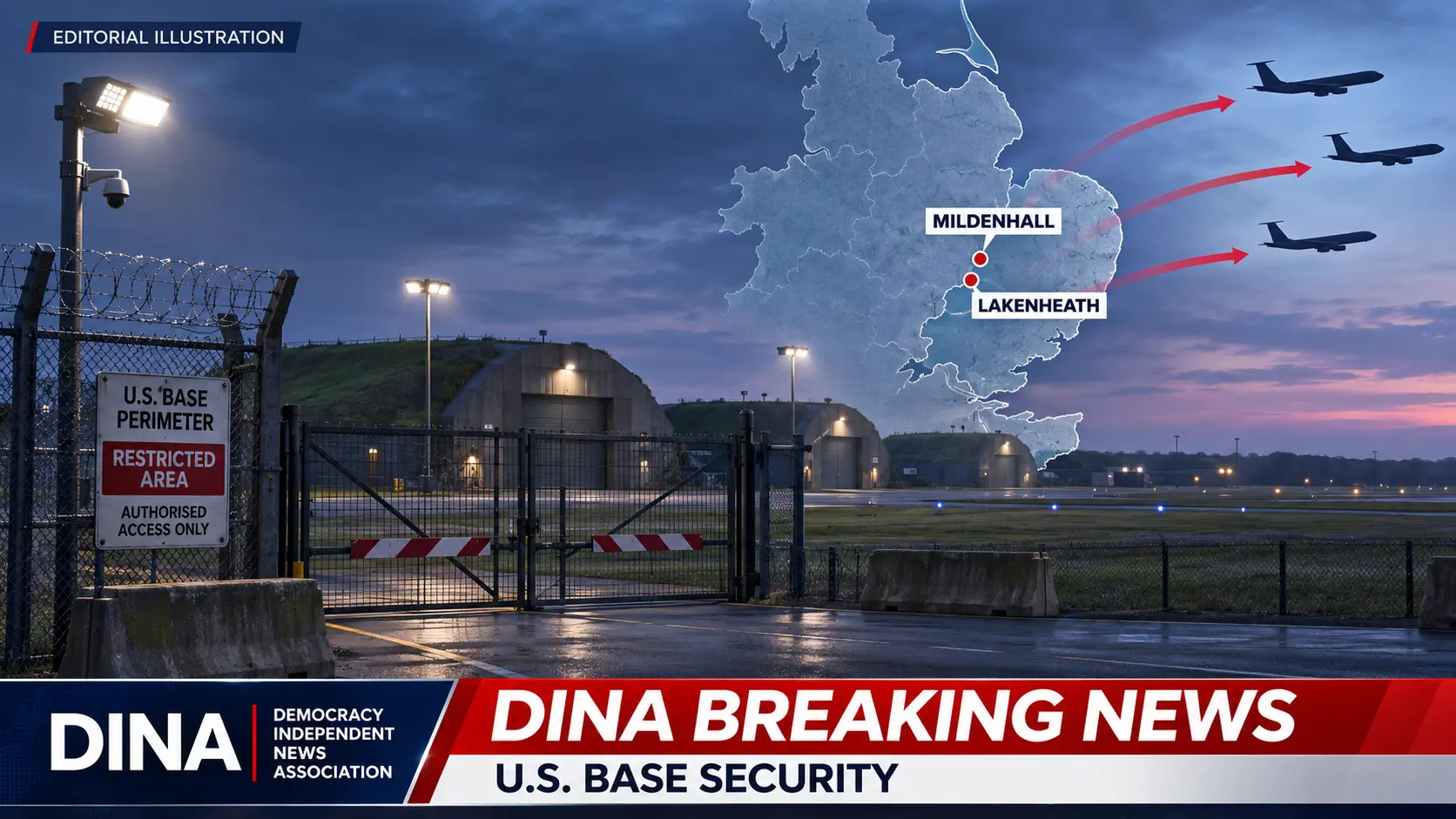
Verification cutoff: November 10, 2026, 1:30 a.m. Eastern. DINA reviewed the direct U.S.-official confirmation reported by The War Zone, Reuters' account and the U.K. Ministry of Defence response, the Journal's attributed threat report, official U.S. Air Force mission records, British government statements about the separate Fairford incident and DINA's prior coverage. The associated image is an AI-generated DINA editorial visualization. It does not depict either base, an actual gate, aircraft movement, threat, suspect, security operation, document or item of evidence.