
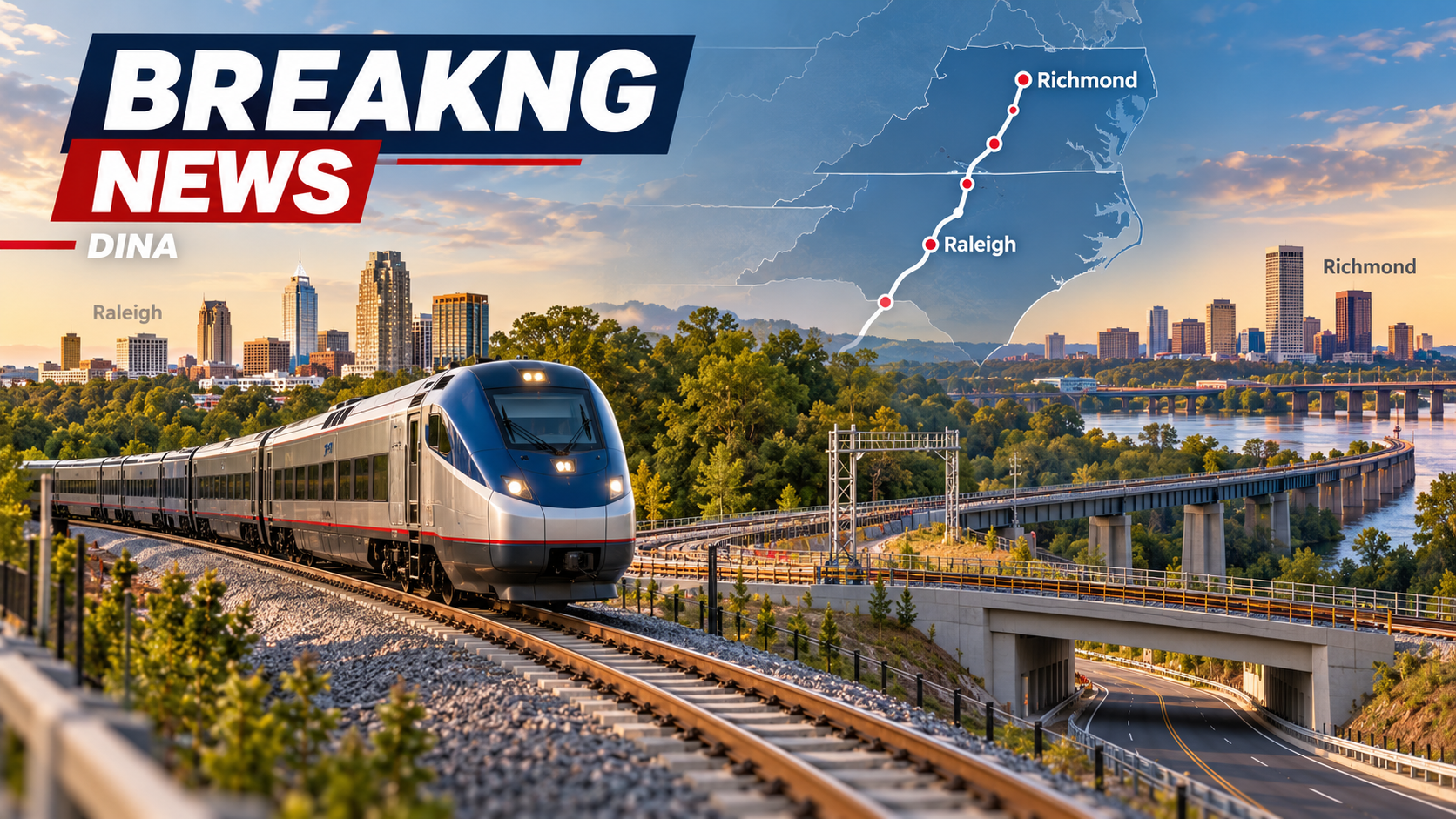
Breaking news · North Carolina · Passenger rail · Public infrastructure · Federal spending · DINA analysis
RALEIGH — October 15, 2026, 7:15 p.m. ET: North Carolina officials announced Thursday that the Federal Railroad Administration is providing $550 million in Federal-State Partnership funding to advance the S-Line passenger-rail corridor between Raleigh and Richmond.
The state says the broader program is designed to cut more than an hour from the Raleigh-to-Richmond trip, support faster and more frequent service and improve connections from North Carolina through Virginia to the Northeast.
What is confirmed: Gov. Josh Stein, Transportation Secretary Daniel Johnson and federal rail officials publicly announced the funding at the Durant Road grade-separation project in Raleigh. The governor's release identifies the amount and program but does not attach the executed award agreement, a project-level budget, the state or local matching obligations, or a schedule showing which construction packages the new money will fund.
What the S-Line project includes
The S-Line is an existing freight corridor connecting Richmond and Tampa. North Carolina and Virginia have been acquiring and improving portions of the route to restore and expand passenger service between Raleigh and Richmond.
NCDOT says the full Raleigh-to-Richmond project involves approximately 162 miles of track and 82 miles of road improvements. Its first major phase is the 18-mile Raleigh-to-Wake Forest segment, which includes more than six grade-separation projects and a second platform at Raleigh Union Station.
The planned corridor is designed to support trains traveling as fast as 110 mph between Raleigh and Petersburg, Virginia, compared with current passenger-rail speeds of 60 to 79 mph. That design standard is not the same as a guarantee that every train will operate at 110 mph or that service will begin on a particular date.
Thursday's event was held at the Durant Road project, where crews are replacing an at-grade crossing with a bridge. The state expects the bridge itself to be completed in November 2026 and final restoration work to conclude in July 2028. Officials say the separation will reduce conflicts among trains, vehicles, pedestrians and cyclists.
The larger funding record
The $550 million announcement builds on several earlier federal commitments. NCDOT reports a $48 million federal grant in 2020 to purchase the corridor from Raleigh to Ridgeway, a $58 million grant in 2022 for survey and preliminary engineering, and a $1.09 billion Federal-State Partnership award in 2023 for design, right-of-way acquisition and construction of the Raleigh-to-Wake Forest segment.
Because multiple awards overlap the same corridor and program, the public accounting should identify whether Thursday's $550 million is a new obligation, a later installment of a previously selected award, or funding for a separate package. The governor's announcement calls it Federal-State Partnership funding but does not provide the award number or executed agreement needed to reconcile it with prior commitments.
Why it matters
North Carolina's population growth is placing increasing pressure on highways and airports. A reliable passenger-rail alternative could expand access to jobs, universities and health care while creating a stronger north-south connection to Virginia and the Northeast Corridor.
The investment also carries land-use consequences. New stations, mobility hubs and faster service can raise nearby property values and attract development, but they can also create displacement pressure. Communities along the route need early access to right-of-way plans, property-acquisition schedules, station-area zoning proposals and affordable-housing safeguards.
The project does not directly serve Hoke County or Raeford. Its statewide importance lies in whether North Carolina can build a more connected passenger-rail network and whether future improvements extend beyond the Triangle to communities in the Sandhills and southeastern North Carolina.
DINA analysis
This section is independent analysis, not a government finding. The announcement is substantial, but a dollar figure is not the same as a delivered transportation benefit. The accountability measure is whether the funding becomes completed track, bridges, stations and reliable service on a public schedule and within a disclosed budget.
North Carolina should publish one consolidated ledger for the S-Line showing every federal, state and local award; obligation and expenditure dates; matching requirements; contract recipients; change orders; right-of-way costs; milestone dates; and the portion of the corridor each award supports. Without that reconciliation, residents cannot tell whether successive announcements represent new resources or different descriptions of the same funding stream.
Officials should also publish service commitments—not only construction targets. Readers need to know the expected opening date, daily round trips, projected fares, travel times, operating subsidy, accessibility standards and how freight traffic will affect passenger reliability.
Strongest accountability questions
- What is the Federal Railroad Administration award number, and is the $550 million fully obligated or still subject to conditions?
- Which construction, design, right-of-way and station packages will receive the money?
- What state or local match is required, and where has that match been appropriated?
- How does this award relate to the $1.09 billion Federal-State Partnership award announced in 2023?
- What is the current total program cost, including inflation, contingencies and long-term operating expenses?
- When will passenger service begin, and what frequency, fare and travel-time commitments will apply?
- Which properties may be acquired, and what anti-displacement protections will apply around stations and mobility hubs?
Urgent records and follow-up requests
- Obtain the executed FRA grant agreement, award identification number and all amendments.
- Request the current program-management plan, master schedule, risk register and cost estimate.
- Request a crosswalk reconciling the 2020, 2022, 2023 and 2026 federal awards.
- Obtain active and planned contracts, bidders, scoring records, change orders and disadvantaged-business participation data.
- Request right-of-way maps, acquisition schedules, relocation plans and station-area development agreements.
- Track monthly expenditures and milestone changes through NCDOT and FRA records rather than relying only on ceremonial announcements.