
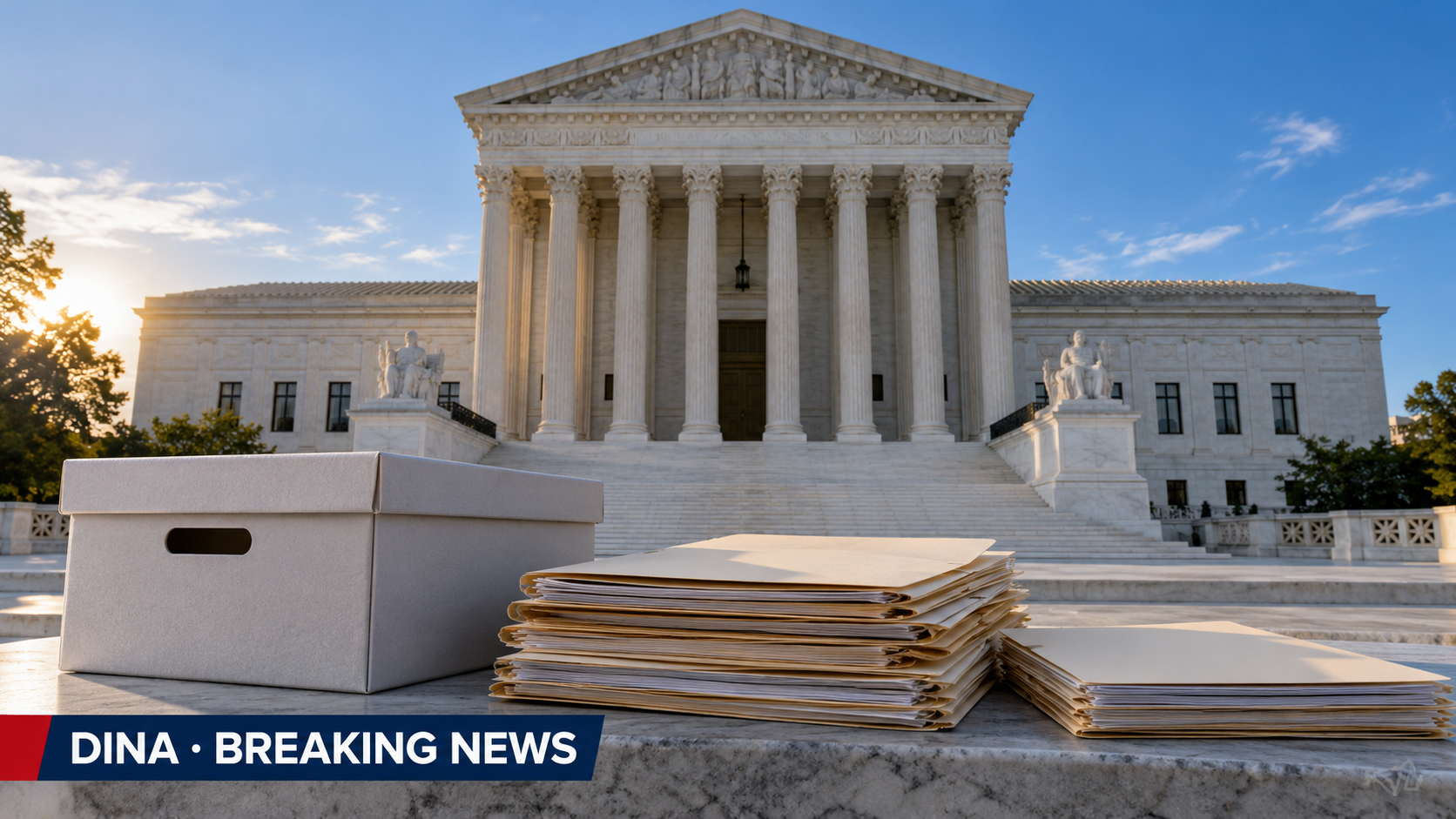
Breaking news · U.S. Supreme Court · Freedom of Information Act · Executive power · Public records · DINA analysis
WASHINGTON — The U.S. Supreme Court agreed Tuesday to hear the Trump administration’s challenge to court-ordered discovery in a public-records lawsuit involving the U.S. DOGE Service, placing the reach of the Freedom of Information Act and the confidentiality of presidential advisers before the justices.
The Court’s official docket in U.S. DOGE Service v. U.S. District Court for the District of Columbia, No. 25-1103, records a one-line action on October 13: “Petition GRANTED.” The Court did not explain its reasoning, rule that DOGE is exempt from FOIA or decide that the requested records must be released.
The case is expected to be argued during the current term, with a decision by the end of June, according to Reuters and the Associated Press.
What the justices agreed to decide
The government’s petition asks whether lower courts failed to follow the Supreme Court’s earlier instruction to narrow discovery in light of separation-of-powers concerns. It also asks whether a court may authorize broad discovery against an Executive Office advisory body to determine whether that body is itself an “agency” covered by FOIA.
The dispute began after Citizens for Responsibility and Ethics in Washington, or CREW, sought records about DOGE’s structure and operations. The administration says the U.S. DOGE Service is a presidential advisory body whose sole function is to advise and assist the president, placing it outside FOIA under existing precedent.
CREW argues that DOGE exercised substantial independent authority across the federal government and that limited discovery is necessary to test whether the administration’s advisory-body description matches what DOGE actually did.
U.S. District Judge Christopher Cooper concluded in 2025 that DOGE was likely an agency covered by FOIA and authorized discovery bearing on that threshold question. The remaining requests include information about DOGE directives, employee roles, data-access plans and a deposition of acting administrator Amy Gleason. The D.C. Circuit declined to halt that discovery after the Supreme Court previously required that it be narrowed.
Confirmed fact: the petition has been granted, and the justices will review the discovery dispute. Government position: the discovery intrudes on confidential presidential advice and raises separation-of-powers concerns. CREW’s position: public evidence shows DOGE may have exercised authority beyond advice, making records and limited discovery necessary. Neither side’s legal position has been adopted in a final Supreme Court merits ruling.
Why it matters
The case could determine how journalists, watchdogs and the public establish whether a White House entity is subject to FOIA when the executive branch calls it advisory but its conduct may resemble that of an operating agency. A broad ruling could affect future presidents who place powerful initiatives inside the Executive Office of the President.
DOGE moved quickly in 2025 to support cuts to federal staffing, contracts, grants and agency functions. Reuters reported that DOGE claimed tens of billions of dollars in savings, while outside experts struggled to verify portions of those claims. Federal auditors later found that some reported savings were incorrect, unsupported or attributed to terminations already underway, Reuters reported.
Those findings are relevant context for public oversight, but they are not the legal question now before the Court. The justices are reviewing whether and how courts may obtain information needed to decide DOGE’s status under FOIA—not auditing every DOGE claim or deciding the wisdom of its policies.
DINA analysis: accountability cannot depend on a label
DINA analysis: The central accountability question is functional: did DOGE merely recommend, or did it direct, control or independently implement government action? The answer should turn on admissible evidence and governing law, not on the administration’s preferred label or critics’ assumptions.
At the same time, discovery into presidential communications can implicate legitimate separation-of-powers interests. Courts can protect those interests by requiring narrowly tailored requests, staged discovery, privilege logs and judicial review rather than treating secrecy or unlimited disclosure as the only options.
A ruling that makes it impossible to obtain threshold evidence could create a circular shield: an entity could avoid FOIA because the public cannot prove it exercised independent authority, while the records needed to prove that authority remain hidden because FOIA supposedly does not apply. A ruling that permits unrestricted access to internal presidential deliberations could create a different problem by eroding protected advisory confidentiality.
The strongest public-interest outcome would define a workable evidentiary test: what conduct establishes “substantial independent authority,” what nonprivileged records may be used to apply that test and what safeguards protect genuinely presidential communications.
Urgent follow-up
- Obtain the Court’s eventual merits briefing schedule and identify whether oral argument will occur before or after the current election.
- Request the complete narrowed discovery list, including every category CREW withdrew after the Supreme Court’s 2025 order.
- Ask DOGE and the White House to identify which remaining requests they contend are privileged, confidential or unduly burdensome, rather than objecting only in general terms.
- Seek the government records that define DOGE’s authority, reporting chain and ability to issue directives to departments and agencies.
- Request from the Government Accountability Office the underlying documentation for its findings about unsupported or incorrectly credited DOGE savings.
- Track whether records are preserved while the case is pending, including communications, staffing records, access logs and directives held by DOGE or other agencies.
Sources
- U.S. Supreme Court docket No. 25-1103 — petition granted October 13, 2026
- U.S. solicitor general’s petition for a writ of certiorari — questions presented and government argument
- CREW brief in opposition — respondent’s argument
- Reuters — Supreme Court agrees to hear DOGE records dispute, October 13, 2026
- Associated Press — Court grants review in DOGE public-records case, October 13, 2026