
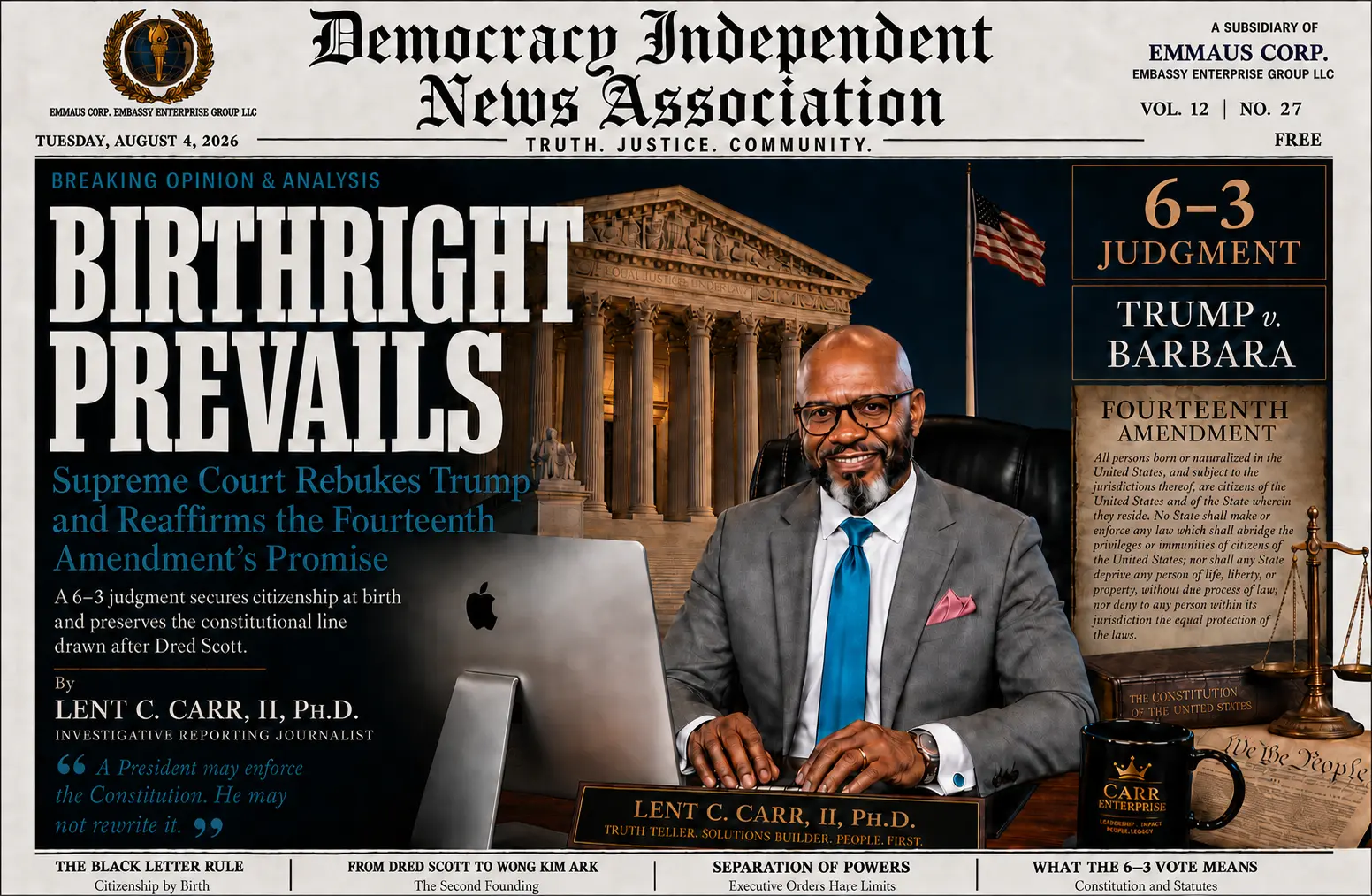
WASHINGTON — The Supreme Court has now formally entered its judgment in Trump v. Barbara, and the constitutional verdict could not be clearer: a President of the United States may enforce the Constitution, but he may not revise its citizenship guarantee by executive decree.
The Court adjudged the case on June 30, 2026. On Monday, August 3, its formal judgment issued, affirming the United States District Court for the District of New Hampshire. The result was 6–3 against President Donald Trump’s attempt to deny citizenship at birth to two classes of American-born children—those whose mothers were unlawfully present and those whose mothers were lawfully but temporarily present, where the father was neither a citizen nor a lawful permanent resident. The executive order never supplied the missing constitutional authority. It supplied only a policy preference dressed in the language of presidential command.
That distinction is the heart of this victory.
Immigration policy may be debated. Border enforcement may be strengthened or relaxed through lawful political processes. Congress may legislate within its constitutional sphere. But the citizenship of a child born under American law is not a bargaining chip to be withdrawn because an administration dislikes the status of the child’s parents. The Fourteenth Amendment speaks of “all persons born or naturalized in the United States, and subject to the jurisdiction thereof.” It does not say “all favored persons.” It does not say “all persons whose parents possess documents preferred by the President.” And, as the Court emphasized, it does not contain the executive order’s words “mother,” “father,” “lawful” or “temporary.”
This is therefore more than an immigration ruling. It is a separation-of-powers ruling, a Reconstruction ruling and a democracy ruling. It is a reminder that constitutional rights do not rise and fall with the occupant of the Oval Office.
What the Court actually decided
President Trump signed Executive Order No. 14160 on January 20, 2025. It asserted that children covered by its two parental-status categories were not “subject to the jurisdiction” of the United States and therefore were not citizens under either the Fourteenth Amendment or the Immigration and Nationality Act.
Parents challenged the order. The federal district court provisionally certified a nationwide class of affected children and entered a preliminary injunction barring enforcement. The Supreme Court then took the extraordinary step of granting certiorari before the First Circuit issued its own judgment.
Chief Justice John Roberts wrote the controlling constitutional opinion, joined by Justices Sonia Sotomayor, Elena Kagan, Amy Coney Barrett and Ketanji Brown Jackson. Those five Justices held that children born in the United States to parents unlawfully or temporarily present are subject to United States jurisdiction and are citizens at birth under the Citizenship Clause.
Justice Brett Kavanaugh supplied the sixth vote to affirm the injunction, but on a narrower ground. He disagreed with the five-Justice constitutional holding; nevertheless, he concluded that the order violated the black-letter federal statute now codified at 8 U.S.C. § 1401(a). Congress used the Citizenship Clause’s language in the Nationality Act of 1940 and reenacted it in the Immigration and Nationality Act of 1952. In Kavanaugh’s view, Congress adopted the settled construction associated with United States v. Wong Kim Ark and the Executive Branch had honored that construction consistently until 2025. A President could not unilaterally manufacture two new exceptions that Congress had not enacted.
That distinction matters. The public shorthand “6–3 for birthright citizenship” is correct as to the judgment. But the broad constitutional rule rests on a five-Justice majority. Kavanaugh agreed with the outcome because the executive order contradicted an Act of Congress. Justices Clarence Thomas, Samuel Alito and Neil Gorsuch dissented; Gorsuch joined Thomas’s principal dissent and also wrote separately, while Alito filed his own dissent.
Under the controlling five-Justice opinion, Congress cannot subtract these American-born children from the Citizenship Clause by ordinary legislation. A future change would require a constitutional amendment or a later Supreme Court willing to abandon this precedent. Kavanaugh alone would have left Congress room to create new exceptions by statute.
The black-letter law Trump tried to outrun
The Administration’s theory failed because it treated the Citizenship Clause as though it were an empty vessel into which a President could pour a new definition of allegiance. The majority instead traced an unbroken legal line.
At English common law, the governing principle was jus soli—the right of the soil. A child born within the sovereign’s dominion generally owed allegiance to the sovereign whose law protected the child at birth. The exceptions were narrow and sovereignty-based: children of foreign diplomats, children born in territory under hostile occupation and, in early American law, children born into tribal nations whose distinct sovereignty the United States recognized.
That rule crossed the Atlantic. Early American jurists applied it, and the celebrated 1844 New York case Lynch v. Clarke recognized citizenship even where the parents were present only temporarily. The question was not whether the parents intended to stay forever. The question was whether the sovereign governed the place and the people within it.
The Administration’s argument turns that logic upside down. A government that claims authority to arrest, prosecute, regulate, detain or deport a person cannot plausibly maintain that the same person is outside its jurisdiction for citizenship purposes. Undocumented presence may be unlawful, but it is not diplomatic immunity. A visitor’s stay may be temporary, but temporary presence does not create a foreign enclave on American soil.
Chief Justice Roberts anchored the Court’s analysis in The Schooner Exchange v. McFaddon, where Chief Justice John Marshall described national jurisdiction within territorial boundaries as full and complete, subject only to narrow waivers associated with foreign sovereignty. Private travelers who came for business or personal reasons remained amenable to American law. Their children, born under that law and within that territory, therefore satisfied both constitutional conditions: birth in the United States and subjection to its jurisdiction.
Dred Scott, bloodline and America’s Second Founding
No honest account of the Citizenship Clause can begin in 1868 without confronting 1857.
In Dred Scott v. Sandford, Chief Justice Roger Taney’s Court transformed racial hierarchy into constitutional doctrine. Although Black people could be born in the country and owe allegiance to its government, the Court declared that people descended from enslaved Africans could not be national citizens. Blood displaced soil. An atextual caste qualification displaced the common-law rule.
The decision shocked the nation and helped propel it toward civil war. Abraham Lincoln denounced it. Frederick Douglass insisted that Black Americans were citizens by birth. After Appomattox, the Reconstruction Congress undertook what scholars rightly call a Second Founding: not merely repairing the prewar Constitution, but correcting its catastrophic failure to secure equal national citizenship.
Attorney General Edward Bates had already rejected hereditary citizenship in an 1862 opinion, declaring that a person born in the country was presumptively a citizen without regard to race or color. Congress then enacted the Civil Rights Act of 1866 over President Andrew Johnson’s veto. Its first section declared citizens “all persons born in the United States and not subject to any foreign power, excluding Indians not taxed.”
The 39th Congress did not stop with a statute. Legislators feared that a future Congress might repeal the Act or that a hostile Court might neutralize it. They therefore placed national birthright citizenship beyond ordinary political reversal. The Fourteenth Amendment, proposed in 1866 and ratified in 1868, declared citizenship in affirmative and universal terms.
This history is decisive. The Citizenship Clause was not drafted merely to win one generation’s policy dispute. It was drafted to prevent government from recreating a hereditary underclass—to foreclose another Dred Scott by denying every branch of government the power to decide that some American-born people are forever outsiders because of ancestry.
Justice Jackson’s concurrence gave this history its proper moral dimension. She explained that the Amendment’s universal application serves its anti-caste purpose. The Government’s position would once again make bloodline determinative: some children born on American soil would inherit exclusion from their parents. That is not a faithful application of Reconstruction. It is a return to the organizing vice Reconstruction was written to destroy.
Wong Kim Ark already answered the central question
Thirty years after ratification, the Supreme Court applied the Clause in United States v. Wong Kim Ark (1898). Wong was born in San Francisco to Chinese parents who remained subjects of the Emperor of China and who could not naturalize under the racist exclusion laws of that era. When federal officials attempted to deny him reentry, the Court held that he was a citizen by birth.
The Trump Administration tried to confine Wong Kim Ark to parents permanently domiciled in the country. The Roberts majority rejected that maneuver because it mistakes facts recited in a case for a limitation on the case’s reasoning. Wong Kim Ark canvassed common law, American practice, Reconstruction and the meaning of jurisdiction. Its rule excluded only the narrow categories historically outside ordinary territorial jurisdiction; it did not create a parental-domicile test.
The majority also exposed the Administration’s evidentiary problem. The Government offered shifting phrases—full allegiance, primary allegiance, sufficient allegiance—without identifying a stable historical rule connecting citizenship at birth to a parent’s domicile. Post-ratification writings from the late 19th century could not override constitutional text adopted in 1868. Nor could isolated, ambiguous floor statements carry more weight than the many explicit statements embracing the traditional rule.
The Administration was not asking the Court to recover forgotten original meaning. It was asking the Court to elevate a losing theory—the logic of the dissent in Wong Kim Ark—over the precedent that has governed for more than a century.
The dissents deserve an answer
The dissenters argued that American citizenship departed from feudal English allegiance and came to depend on domicile, complete political allegiance or the parents’ permanent home. Justice Thomas assembled a formidable historical record and maintained that the Civil Rights Act and Citizenship Clause protected those born and domiciled here, including formerly enslaved people who had no other homeland. Justice Gorsuch described that as a distinctly American, rather than English-feudal, understanding. Justice Alito argued for sole allegiance and warned that the majority’s rule includes children born through so-called birth tourism.
Those concerns are not frivolous. They are nevertheless legally unpersuasive.
First, domicile is not citizenship. A person may live permanently in the United States without becoming a citizen; another may remain a citizen while domiciled abroad. The majority correctly refused to smuggle into the Citizenship Clause a requirement the text does not contain.
Second, the narrow historical exceptions share a sovereignty principle, not a generalized suspicion of foreigners. Diplomats are exempt because the United States yields jurisdiction as a matter of international law. Hostile occupiers are governed by an enemy sovereign. Tribal members were historically treated as members of separate political communities—a statutory exclusion Congress later removed through the Indian Citizenship Act of 1924. Undocumented migrants and temporary visitors stand in none of those positions.
Third, policy objections cannot amend constitutional grammar. If birth tourism or unlawful immigration requires a governmental response, the political branches retain extensive authority over visas, admission, removal, border administration and fraud. But power over immigration is not power to redesign citizenship fixed by the Constitution.
Finally, the dissenting approach threatens the administrability that the Citizenship Clause was designed to secure. A birth rule based on parental intent, domicile, visa classification, duration of stay or degrees of allegiance would force newborn citizenship to turn on bureaucratic inquiry and contested facts. The constitutional rule is deliberately bright: birth here plus subjection to American law equals citizenship.
A rebuke of executive government by slogan
Executive orders are instructions within the Executive Branch. They are not amendments to the Constitution. They cannot repeal statutes. They cannot convert a President’s campaign promise into supreme law.
That is why Justice Kavanaugh’s separate opinion, despite its troubling willingness to permit Congress to narrow citizenship, still delivers an institutional rebuke to the Trump Administration. The Nationality Act of 1940 and the Immigration and Nationality Act of 1952 stand as enacted law. For decades, the Executive Branch treated § 1401(a) as incorporating the traditional rule and its narrow exceptions. The 2025 order attempted to change that law without a bill, without bicameral passage and without presentment.
The Administration wanted the power of legislation without Congress and the power of constitutional revision without the people. Six Justices refused to confer it.
A victory for democracy—and a warning
This judgment is a victory for democracy because democracy is not merely majority preference at a particular election. Constitutional democracy is popular government operating within durable limits—limits adopted so that temporary power cannot erase permanent membership.
The children protected by this decision did not cross a border, violate a visa or choose their parents. They were born here. The Government’s proposal would have assigned them a diminished civic status at the first breath of life, not for anything they did, but because of who their parents were. That is inherited disability by another name.
The genius of the Fourteenth Amendment is that it withdrew that temptation from ordinary politics. Its Citizenship Clause transformed belonging from a discretionary favor into a constitutional fact. It answered Dred Scott with text. It answered caste with equality. It answered bloodline with birth under law.
The celebration, however, should not become complacency. Four Justices—including Kavanaugh on the constitutional question—were prepared to leave room for major new exclusions. Three would have upheld the President’s position more directly. The constitutional majority is real, controlling and historically grounded, but it is only five votes.
The duty now falls to citizens, lawyers, journalists, scholars and lawmakers to defend the Second Founding with clarity. We should refuse the propaganda that portrays constitutional citizenship as a loophole. We should name the executive order for what it was: an effort to accomplish by unilateral command what the text, history, precedent and democratic lawmaking process would not permit.
The Supreme Court’s final word is therefore both legal and civic. Citizenship is not presidential property. The Fourteenth Amendment is not an administrative suggestion. And no child born under the jurisdiction of the United States may be written out of the American people by the stroke of one President’s pen.
That is black-letter law. That is constitutional democracy. And on this question, democracy has won.
Primary authorities and source links
- Trump v. Barbara, No. 25-365 — official Supreme Court slip opinion (June 30, 2026)
- Supreme Court docket — decision and August 3, 2026 judgment issuance
- Formal judgment affirming the District of New Hampshire
- National Archives — Fourteenth Amendment text and Reconstruction history
- United States v. Wong Kim Ark, 169 U.S. 649 (1898) — official U.S. Reports scan
- Constitution Annotated — Citizenship Clause doctrine
This article is opinion and legal analysis, not legal advice.