
Breaking News · Federal Courts · Legal Ethics · DOJ · Interior Department · Public Lands · DINA Analysis
BREAKING UPDATE — November 8, 2026, 2:01 a.m. ET: U.S. District Judge Ana C. Reyes has formally notified the parties that she intends to appoint former U.S. Attorney Jessie K. Liu as special master to investigate whether Justice Department or Interior Department counsel committed ethical violations in the East Potomac Golf Links litigation through October 31.
Confirmed procedural fact: The November 7 minute order identifies Liu as the proposed special master, says the work would be performed at the government's expense and gives the parties until 10 a.m. Friday, November 13, to submit written views. Reyes said she will enter a detailed appointment order if she selects Liu. Liu served as U.S. attorney for the District of Columbia from 2017 to 2020 and previously held senior Justice, Treasury and private-practice roles.
What has not happened: Liu has not yet been finally appointed, and the court has not found that any government lawyer or official committed misconduct. Some news accounts describe Liu as having been “named” or “appointed,” but the controlling minute order is a notice of intent under Federal Rule of Civil Procedure 53 and preserves the parties' opportunity to object. The government may also challenge whether the court should conduct an ethics inquiry at all.
Government response: The Interior Department attacked Reyes as a “far Left activist judge” and accused her of obstructing President Donald Trump's effort to remake the course. That is the department's political characterization, not a legal ruling on the judge's authority or the merits of the inquiry.
Why the proposed special master matters
A written notice naming a proposed investigator materially advances the inquiry announced October 30. If the appointment becomes final, Liu's mandate, authority, timetable and reporting process should provide the first formal structure for testing whether lawyers gave the court inaccurate or incomplete information about the administration's plans, the course closure, tree removal and communications with golf-course designer Tom Fazio.
DINA analysis: The immediate accountability test is procedural precision. Reporting must distinguish the court's verified notice of intent from a completed appointment, and allegations of ethical violations from proven misconduct. The November 13 submissions and any later Rule 53 order will show whether the government contests Liu personally, the scope of her proposed work or the court's authority to conduct the inquiry.
BREAKING UPDATE — October 31, 2026, 2:49 a.m. ET: U.S. District Judge Ana C. Reyes announced a formal inquiry into whether Justice Department and Interior Department lawyers or officials made materially misleading statements, withheld relevant information or otherwise violated professional rules during litigation over the Trump administration's plans for East Potomac Golf Links.
Confirmed procedural fact: Reuters, The Associated Press, Bloomberg Law and The Washington Post reported from the October 30 hearing that Reyes opened the inquiry and ordered preservation of documents and communications concerning the golf-course planning process. The court also directed the government to identify the people who prepared a submission to the National Capital Planning Commission and to disclose whether it has a contract with golf-course designer Tom Fazio, Fazio Design or Gavin Fazio.
No finding of misconduct: Reyes emphasized that opening the inquiry does not establish that any lawyer or official violated an ethics rule. Reports differ slightly on the inquiry's mechanics: Reyes said she may conduct it herself with assistance from a special master, while some accounts describe an anticipated appointment. DINA found no written docket order naming a special master by its publication deadline.
What prompted the inquiry
The dispute centers on conflicts among President Donald Trump's public statements, government representations in court and the timing of the administration's planning. Trump publicly said the Interior Department had developed a championship-course plan, that the public course would close November 15 and that renovation would begin immediately. Government lawyers had maintained that no final renovation plan existed and, during earlier proceedings, said they were unaware of a closure plan.
At the October 30 hearing, Reyes questioned Associate Attorney General Stanley Woodward Jr. for more than two hours about those representations and the government's later disclosure that a Fazio rendering was being submitted to the federal planning commission. The inquiry is expected to examine whether officials omitted material information from a National Park Service declaration, whether the timing of notice about the removal of hundreds of trees was designed to evade review, and whether statements about the design and closure plans were made in good faith.
Government position: The administration has argued that the October tree work was separate from the president's larger redesign, arose from a 2019 landscape plan and was intended to address safety and restore the historic links-style landscape. It also contends that a proposal under review is not necessarily final agency action. Those arguments remain before the court.
The written record already in place
In an October 26 preliminary-injunction opinion, Reyes barred further removal or damage to trees at East Potomac Park without court approval, subject to an emergency-safety exception, and required advance notice before the government closes or irreversibly alters the park. That order is interim relief, not a final judgment on the environmental claims.
The October 30 docket activity adds targeted disclosure requirements about the planning-commission submission and any Fazio contract. The broader ethics inquiry was announced at the hearing; its scope, special-master appointment, discovery authority and timetable should be confirmed against the next written order.
Why this update matters
A federal judge's formal inquiry into the candor of government lawyers is an exceptional institutional step. Courts depend on attorneys—especially lawyers representing the United States—to provide complete and accurate information when judges decide whether emergency relief is necessary. An inquiry can determine what was known, when it was known and whether incomplete statements prevented meaningful judicial review.
The issue is larger than a golf-course design. The underlying land belongs to the public, the work may be irreversible, and the case tests whether executive-branch agencies may proceed while presenting the court with a narrower description of their plans than the president gives the public.
DINA independent analysis: test the statements against a document timeline
This section is DINA analysis, not a judicial finding. The strongest accountability method is a dated, document-by-document comparison: Trump's directives and posts; Interior and Park Service planning records; communications with Fazio; the planning-commission submission; tree-removal approvals; declarations filed under oath; and every representation government counsel made at each hearing.
Sharp language from the bench is newsworthy, but it is not a substitute for findings. The inquiry should identify the precise statement at issue, who supplied it, what contrary information existed at the time, whether an omission was knowing or inadvertent and whether the record was corrected promptly. Any sanction or referral should follow that evidence rather than political assumptions about the administration or the challengers.
Strongest accountability angle
The Justice and Interior departments should disclose their litigation-information chain: which officials collected facts for government counsel, who reviewed declarations, when lawyers learned of Trump's closure directive and Fazio submission, and why those facts were not presented earlier if they were material. The court should also preserve a public version of the special master's mandate, subject to legitimate privilege and personnel protections, so readers can distinguish proven conduct from allegations.
Urgent new records and follow-up
- Obtain the October 30 hearing transcript, minute orders and any written order defining the ethics inquiry.
- Identify the special master, if appointed, and obtain the appointment order, authority, timetable and objection process.
- Obtain the complete National Capital Planning Commission submission, preparer list and every Fazio contract, proposal, invoice or communication.
- Request the versions and review history of declarations filed by Interior and Park Service officials, including instructions about what to include or omit.
- Build a comparison ledger of every government representation about closure, redesign, tree removal and final agency action against contemporaneous records.
- Track any appeal, sanction motion, referral or corrected filing; none should be reported as an adjudicated ethics violation unless the court enters such a finding.
LATEST UPDATE — October 12, 2026, 12:07 p.m. ET: U.S. District Judge Ana C. Reyes sharply rebuked Justice Department lawyers during Monday's emergency hearing over the government's notice before hundreds of trees were removed from East Potomac Golf Links.
Reuters reported that Reyes said she was “furious” and that the government's failure to give the preservationist plaintiffs adequate notice “has cost the government all of its credibility” in the case. When a Justice Department lawyer said government attorneys had done their best to gather and disclose the details, Reyes answered: “You did your absolute worst.”
Reyes indicated during the hearing that she intends to extend the halt. As of DINA's deadline, however, no superseding written order was public. The existing order stops all tree removal—including work the government describes as routine maintenance—until 7 a.m. Tuesday or until the judge issues another order.
The judge's criticism is a material accountability finding about the government's litigation conduct and notice. It is not a final ruling that the National Park Service violated environmental or historic-preservation law, and it does not convert the plaintiffs' reported 529-tree count into a judicial finding.
Park Service official Kevin Griess told the court that the removal was intended to improve safety and restore the park's original design under a 2019 plan that predates President Donald Trump's proposed overhaul. That remains the government's explanation; the plaintiffs dispute it.
EARLIER UPDATE — October 12, 2026, 9:40 a.m. ET: Reyes temporarily halted all tree removal after finding that the challengers were likely to face “immediate and irreparable harm” because removing hundreds of trees is permanent, while a brief delay would impose little harm on the government.
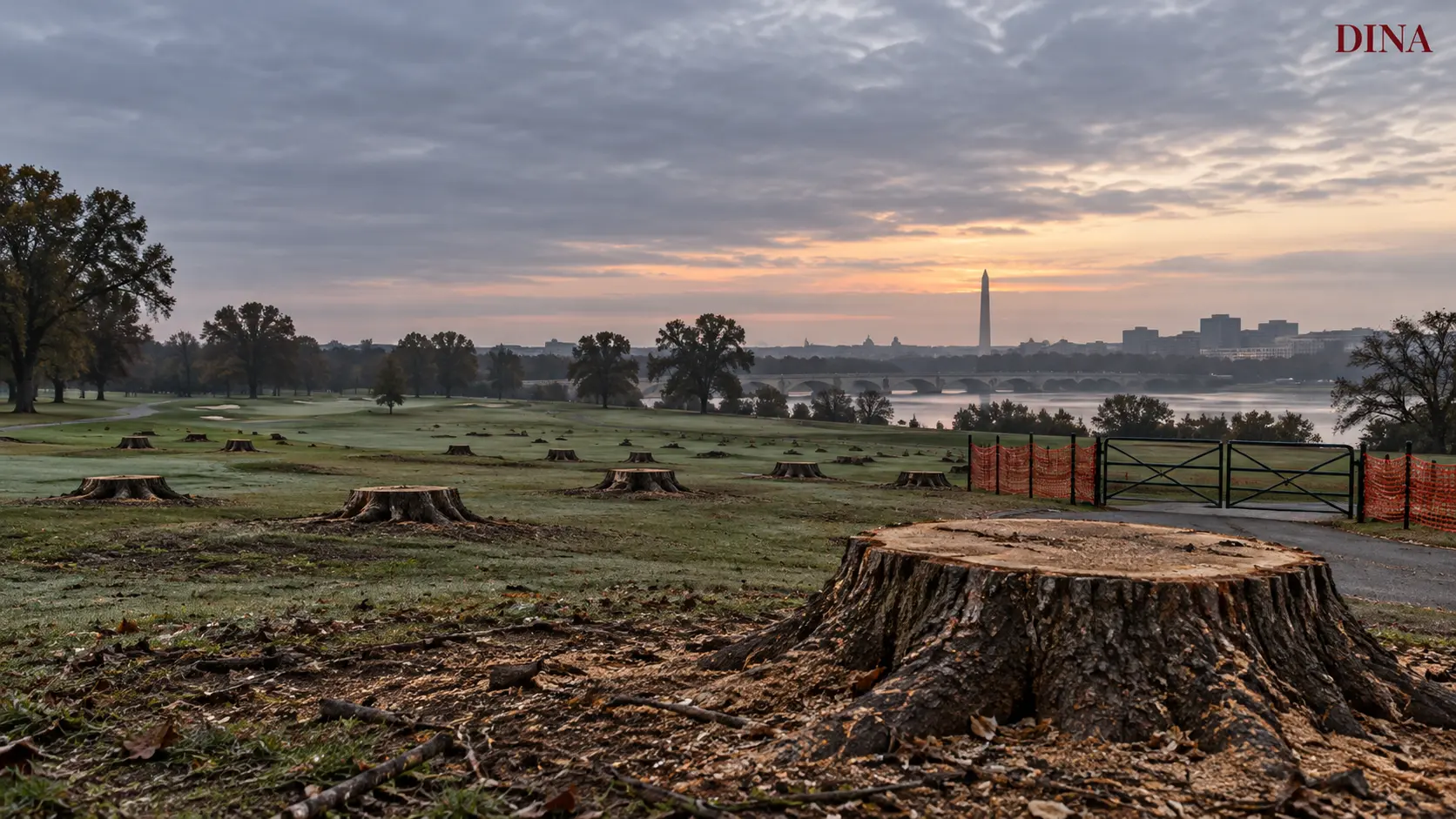
WASHINGTON — October 12, 2026: Preservation advocates have asked a federal judge to impose an immediate 14-day halt on additional tree removal at East Potomac Park after telling the court that National Park Service contractors felled 529 trees at the historic public golf course in a single day.
The emergency motion was filed Sunday in DC Preservation League v. Department of the Interior, No. 1:26-cv-00477, in the U.S. District Court for the District of Columbia. Plaintiffs also seek an order requiring the government to give the court and challengers at least three business days' written notice before making any other irreversible change to the park.
What is confirmed: The filing exists; it was docketed October 11 as Document 76-1; and it asks for a temporary restraining order or, alternatively, a 14-day stay under the Administrative Procedure Act. The filing says National Park Service workers began the operation Saturday morning, roughly 12 hours after a late-Friday notice described plans to remove 529 trees in stages.
What remains an allegation: The plaintiffs say government lawyers told them Sunday that all 529 trees had already been removed Saturday and that hundreds more would be cut once weather permits. That account appears in an advocate's filing and supporting public statement. It is not yet a judicial finding, and DINA has not independently counted the removed trees or inspected each tree's condition.
The motion says plaintiffs' lawyers met with government counsel Sunday afternoon and were told the work had moved “faster than anticipated.” It also says a supplemental National Park Service document disclosed that the initial inventory had undercounted the number of trees targeted for removal.
The government opposes the plaintiffs' request for a longer restraint. Reyes indicated at the Monday hearing that she intends to extend the pause, but the duration and terms of any longer order remained unresolved when this update was prepared.
The government's position
The Interior Department has described the work as long-planned maintenance and landscape rehabilitation, not the start of President Donald Trump's proposed transformation of the century-old public golf course into a championship-level venue. In an earlier court filing, the Park Service said the trees selected for removal did not contribute to the historic landscape and said no healthy trees considered historic contributing features—including historic cherry trees—would be removed.
The agency tied the work to recommendations in a 2019 cultural landscape report and said it recently obtained funding and temporary workforce support. The October 9 categorical-exclusion document treated the tree project as routine maintenance exempt from a fuller review under the National Environmental Policy Act.
The plaintiffs dispute that explanation. Their motion alleges the agency is unlawfully “segmenting” connected parts of a larger golf-course overhaul so that each piece avoids review of the project's cumulative environmental impact. They say healthy mature oaks and maples were among the trees removed.
Those competing descriptions—maintenance versus implementation—are central to the court fight. The plaintiffs have not yet proved their NEPA claim, and the government has not publicly supplied a tree-by-tree inventory, condition assessment or complete contract record sufficient for independent review.
Why this matters
East Potomac Park is federal public land in the nation's capital, and the golf course is part of a landscape with more than a century of public use. Tree removal is irreversible on the timetable of emergency litigation. If the plaintiffs' account is accurate, the government completed in one day the full quantity it had described the evening before as a multi-stage operation, leaving the court little practical ability to preserve the prior condition while it reviews the legal dispute.
The case also tests a broader principle of administrative accountability: an agency cannot evade environmental review merely by dividing one connected plan into smaller actions. Whether that happened here is a legal question for the court, not a settled fact.
DINA analysis: the accountability gap is documentary
This section is analysis, not a statement of adjudicated fact. The strongest accountability question is not whether the administration prefers a different golf-course design. It is whether federal officials gave the public and the court a complete, timely and testable record before carrying out irreversible work.
The late-Friday notice, Saturday cutting and Sunday inventory revision create an unusually compressed timeline. A responsible public record should show when officials approved the contracts, when they learned the original count was incomplete, how each tree was classified and why the agency concluded that a categorical exclusion—rather than a fuller environmental assessment—was lawful.
Until those materials are public, neither the government's maintenance explanation nor the plaintiffs' implementation theory can be fully tested outside court. The speed of the work makes prompt disclosure more important, not less.
Urgent records and follow-up requests
- Obtain the complete October 9 categorical-exclusion record and October 11 supplemental determination, including maps, photographs, inventories and tree-condition ratings.
- Request every contract, task order, amendment, invoice and scope-of-work document for tree removal at East Potomac Park in 2026.
- Seek communications showing when Interior, the Park Service, the White House and contractors learned that the 529-tree count was incomplete.
- Ask the government to publish the verified number, species, diameter, condition and exact location of every tree removed October 10 and every tree still marked for removal.
- Obtain the legal analysis supporting use of a categorical exclusion and any review of cumulative impacts associated with the proposed course redesign.
- Track the court's ruling, the government's response and any schedule for a preliminary-injunction hearing.
Related DINA coverage
- Federal Judge Halts $20 Million Taxpayer-Funded Trump Ad Campaign
- DOJ Opens Antitrust Inquiry Into White House TV Pool's Coverage Halt
Sources
- U.S. District Court docket via CourtListener/RECAP — DC Preservation League v. Department of the Interior, No. 1:26-cv-00477, including the November 7 minute order
- Associated Press — court gives notice of proposed Jessie Liu appointment and response deadline, November 7, 2026
- Reuters — proposed special master and Interior Department response, November 8, 2026
- Reuters — federal judge opens ethics inquiry in East Potomac litigation, October 30, 2026
- Associated Press — inquiry into government statements and East Potomac planning, October 30, 2026
- The Washington Post — October 30 hearing and proposed inquiry scope
- U.S. District Court for the District of Columbia — public case documents in DC Preservation League v. Department of the Interior, No. 1:26-cv-00477
- October 26, 2026 preliminary-injunction opinion, Document 103
- U.S. District Court for the District of Columbia — plaintiffs' memorandum supporting emergency motion, filed October 11, 2026
- Democracy Forward — plaintiffs' public statement and link to the filing, October 11, 2026
- National Park Service — October 9, 2026 categorical-exclusion document cited in the court filing
- Associated Press — Park Service position and earlier removal plan, October 10, 2026
- The Washington Post — court halts tree removal pending Monday hearing; emergency motion and government response, updated October 12, 2026
- Reuters, republished by StreetInsider — Monday hearing, judicial criticism and indication that the halt would be extended, October 12, 2026