
Breaking News · Russia–Ukraine War · Civilian Protection · War-Crimes Investigation · DINA Analysis
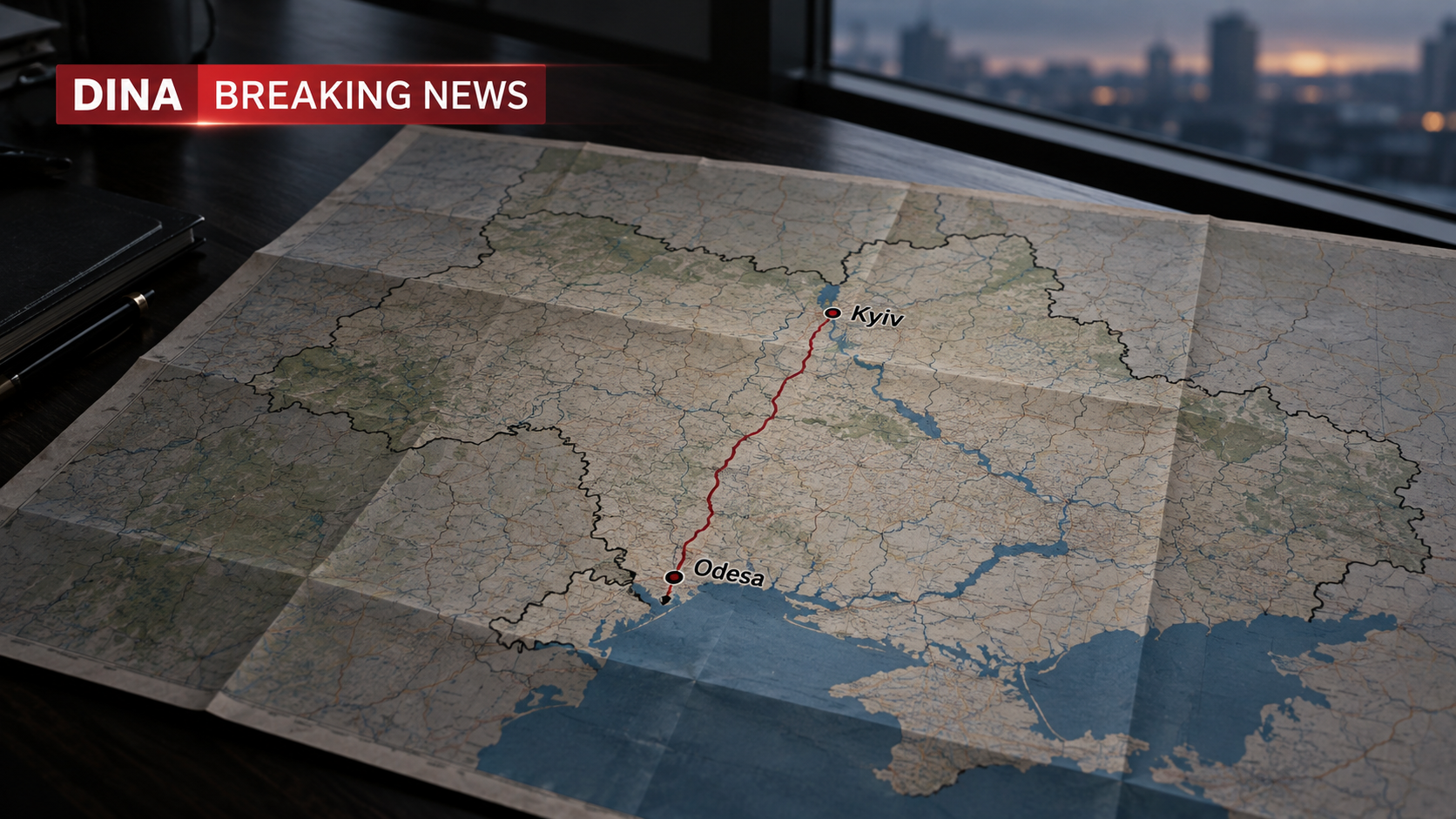
KYIV — October 20, 2026, 5:50 a.m. ET: A Russian drone struck near the Kyiv–Odesa highway on Tuesday, killing three people and wounding four, according to the Kyiv regional prosecutor's office.
Reuters reported that several vehicles caught fire after the strike. The news service attributed the casualty count and the identification of the weapon as a Russian drone to the prosecutor's official Telegram statement. Images distributed by Ukraine's State Emergency Service showed firefighters working around a burned vehicle on the outskirts of Kyiv.
What is confirmed: Kyiv regional prosecutors reported three deaths, four injuries and multiple vehicles on fire near the highway. Reuters independently published the officials' statement at 5:03 a.m. ET.
What remains preliminary: Authorities had not publicly identified the victims, specified their conditions, released the precise strike coordinates or published a final forensic finding on the drone type when DINA published this report. The initial casualty count may change as emergency and investigative work continues.
The Associated Press separately reported that Russian missile and drone attacks across the wider Kyiv region killed four people and wounded 27 over the preceding day, citing regional police. That broader total includes incidents outside the highway strike and should not be treated as a revised casualty count for this single location.
Why it matters
The strike reached a major civilian transport corridor connecting the capital with southern Ukraine. People traveling on an open highway have little warning or physical protection from a one-way attack drone, and burning vehicles can create a second danger for other motorists and emergency crews.
The location also matters for accountability. A strike near ordinary traffic requires investigators to preserve flight-path data, fragments, vehicle damage, surveillance video and emergency-call records before debris is cleared and traffic resumes. Those records can help establish the weapon, its route, the military objective—if any—and whether the attack complied with the laws of war.
DINA independent analysis
This section is DINA analysis, not an independently established factual finding. The central accountability issue is not simply whether a drone reached the highway. It is whether the weapon was directed at a lawful military target, whether Russian forces could distinguish that target from civilian traffic, and whether expected civilian harm was excessive in relation to any concrete military advantage.
The deaths alone do not establish the perpetrator's intent or prove a war crime. Those are legal and evidentiary conclusions for investigators and courts. But a strike that kills civilians on a public road creates an urgent duty to document targeting information, weapon remnants and the presence or absence of military activity at the site.
The strongest public-interest angle is evidence preservation. Fast-moving battlefield claims are often narrowed, corrected or contested. Publishing the exact time, coordinates, recovered components, chain of custody and official casualty reconciliation would allow independent experts to test government statements rather than relying on a single early account.
Strongest accountability questions
- What are the exact coordinates and time of impact, and was the highway open to civilian traffic?
- What drone components were recovered, and what evidence supports attribution to Russian forces?
- Was any military objective present near the impact point, and what civilian objects were in the immediate area?
- Do traffic cameras, business surveillance systems or vehicle recordings show the drone's approach?
- How will prosecutors reconcile the highway casualty count with the wider Kyiv-region total?
- Were first responders exposed to a follow-on strike or unexploded ordnance?
Urgent records and follow-up requests
- Request the Kyiv regional prosecutor's incident notice, case number, time-and-location record and any redacted scene diagram.
- Seek the State Emergency Service dispatch log, arrival times, fire-suppression report and final casualty reconciliation.
- Request preserved highway-camera and nearby commercial surveillance footage, with victim identities protected.
- Ask Ukraine's Air Force for the relevant air-alert timeline, tracking data and any public assessment of the drone model and route.
- Request Russia's Defense Ministry target list and legal review for the attack; compare any response with the documented civilian scene.
- Track whether Ukrainian prosecutors open a proceeding under the country's war-crimes statute and whether international investigators receive the evidence.
Sources
- Reuters — Russian drone strike kills three near Kyiv, Ukrainian prosecutors say, October 20, 2026
- Associated Press — Russian missile and drone blitz kills four in Ukraine, October 20, 2026
- Kyiv Regional Prosecutor's Office — official website