
Breaking news · Black Sea · Bulgaria · Maritime security · Civilian shipping · DINA analysis
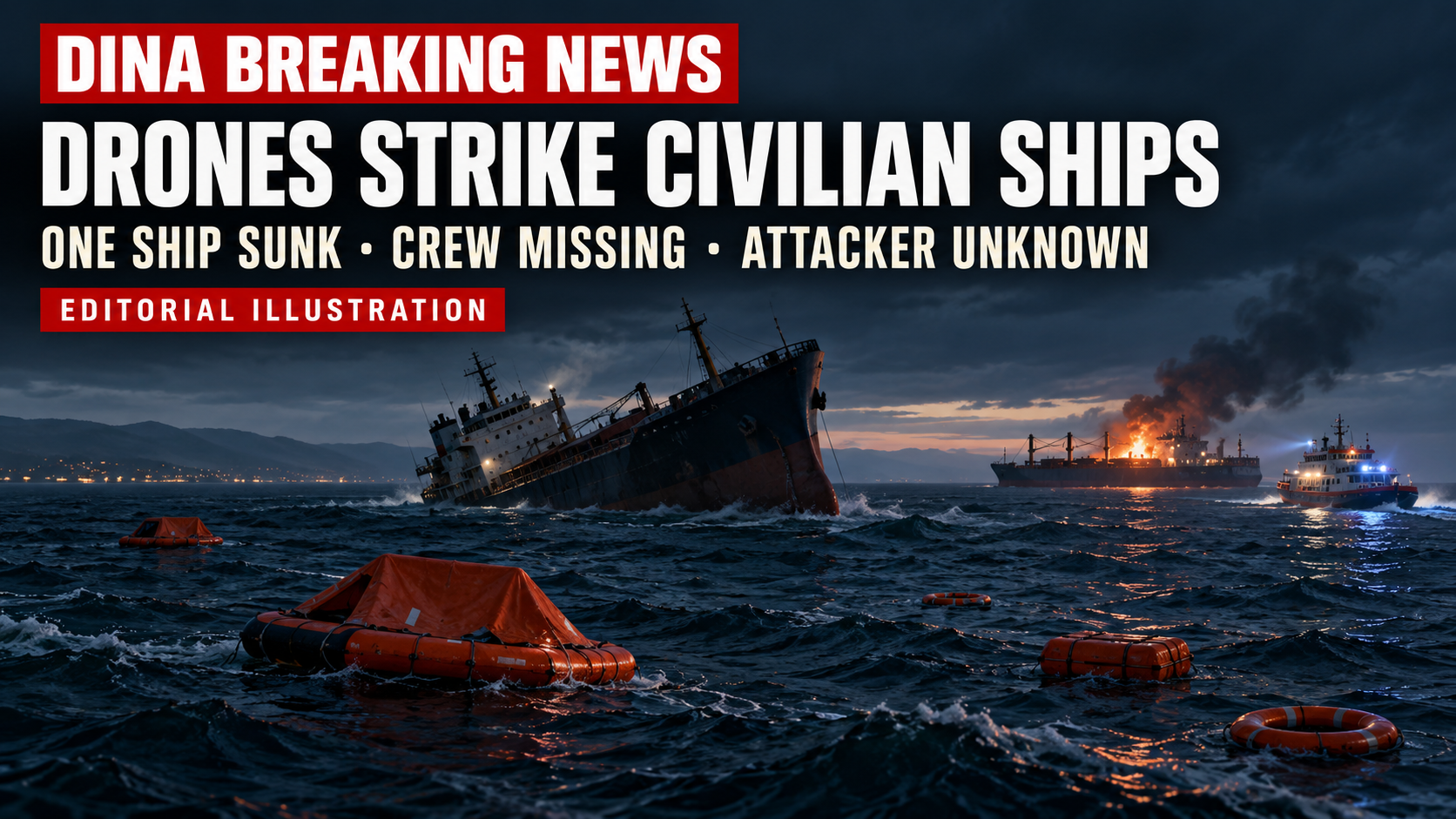
UPDATED OCTOBER 13 — SOFIA, Bulgaria — Eleven sailors remained missing after drones sank the Guinea-Bissau-flagged cargo ship HS DIGNITY just outside Bulgaria's territorial waters early Tuesday, Bulgarian officials said. Five people from the vessel were rescued and the search continued. President Iliana Iotova publicly identified the ship. A second vessel, the Maltese-flagged CHELSEA 3, was damaged in the attack but all 15 people aboard survived.
Identification correction: An earlier version cited initial Bulgarian media reports identifying the sunken vessel as the AZOV CONCORD. Iotova's later official identification of the HS DIGNITY supersedes that preliminary report.
The CHELSEA 3 crew—seven Ukrainians and eight Azerbaijanis—reported three aerial-drone strikes. Five received medical care for injuries described as minor. The attack came exactly one week after drones struck two other merchant ships in Bulgaria's exclusive economic zone, sinking one of them.
The Associated Press placed the strikes about 17 and 18 miles (27.5 and 29 kilometers) from Bulgaria's coast; Reuters reported the CHELSEA 3 was about 18 nautical miles offshore. Bulgaria's territorial sea extends 12 nautical miles—about 13.8 ordinary miles—making the reported locations close to, but outside, territorial waters and within Bulgaria's broader maritime zone.
Responsibility remains unconfirmed. Radev said there was no clear evidence identifying the attacker. He said the outcome benefits Russia, summoned Russia's ambassador and sought NATO and European Union assistance. Ukraine directly blamed Russia, while European Commission President Ursula von der Leyen condemned the attacks and called the Black Sea another front in Russia's war against Ukraine.
Russian Ambassador Eleonora Mitrofanova said after meeting Radev that she had no information from Russia's Defense Ministry about attacks on commercial vessels, but did not rule out what she described as a possible third-party provocation. That is Russia's diplomatic response, not evidence identifying a third party. NATO Secretary General Mark Rutte said the alliance would adjust its eastern-flank military presence as needed after Radev requested stronger maritime and airspace surveillance.
What changed on October 13
- Eleven sailors are missing: Bulgarian officials said five people were rescued while 11 remained missing from the HS DIGNITY. The search-and-rescue operation remained active.
- The CHELSEA 3 survived: the ship sustained deck and hull damage after its crew reported three aerial-drone hits. All 15 crew members were evacuated.
- The danger moved closer: the new strikes occurred roughly 17 to 18 miles from shore, much closer than the October 6 attacks about 70 to 80 miles offshore.
- Bulgaria sought allied help: Radev asked NATO and the EU for support strengthening maritime and airspace surveillance. Rutte said NATO would adjust its eastern-flank presence as needed.
- No attribution yet: Bulgarian authorities have not released drone debris analysis, radar data or other public evidence establishing who launched the weapons.
Why the new attack matters
This is no longer a single unexplained maritime incident. Four commercial vessels have now been struck in Bulgaria's maritime zone within seven days, with two ships sunk. A separate Turkish-owned cargo ship sank off Romania after a drone attack, killing two people, according to Romanian authorities.
The repetition and movement toward Bulgaria's coast raise the risk of a wider NATO security response even though neither Bulgaria nor NATO has declared the incidents an armed attack on alliance territory. The threshold questions remain attribution, intent, exact location and whether commercial vessels were deliberately selected.
DINA analysis: The public record supports urgent allied investigation and protection of civilian shipping, but not a definitive accusation against Russia, Ukraine or another actor. Bulgaria's decision to summon the Russian ambassador is diplomatically significant; it is not itself proof of Russian responsibility.
Immediate accountability questions
- Who owns, manages and chartered the Guinea-Bissau-flagged HS DIGNITY, and what cargo was aboard?
- What search-and-rescue operations are underway for the 11 missing sailors, and what are their nationalities?
- Were the drones launched from land, sea or another platform, and were they aerial, maritime or a coordinated combination?
- What do Bulgarian military, coast-guard and civilian radar records show about flight paths and launch directions?
- Has NATO deployed surveillance, mine-countermeasure or maritime-patrol assets, and under what legal authority?
- What evidence supports Radev's statement that the outcome benefits Russia, and what evidence would be required for formal attribution?
October 6 attack: 10 sailors from the ALFA WATAN still missing
SOFIA, Bulgaria — Sea and aerial drones struck two commercial ships in Bulgaria's exclusive economic zone early Tuesday, sinking one vessel and setting the other on fire, according to Bulgaria's government and maritime-rescue officials.
Nine Syrian sailors and one Egyptian sailor from the Togo-flagged ALFA WATAN remained missing after the ship sank, Reuters reported. Search teams found an overturned boat, life rafts and life jackets but no crew members, and Bulgaria halted the search on October 7.
All 18 people aboard the Palau-flagged ABLE were rescued by the Bulgarian ferry DIOSCURIA. Two were seriously injured, according to Reuters and the Associated Press.
The attacker has not been identified. A maritime-security source cited by Reuters said an initial assessment suggested Russia, but Bulgarian authorities had made no official attribution and Russia had not commented. DINA therefore treats responsibility for the attacks as unresolved.
What is confirmed — and what remains unresolved
- Confirmed by Bulgaria: two ships were hit by drones in Bulgaria's Black Sea exclusive economic zone. The government convened defense, interior, transport, environment, presidential and security-service representatives in response.
- Confirmed by rescue officials: the ALFA WATAN sank and 10 sailors were missing; the ABLE burned, but all 18 people aboard were rescued.
- Confirmed casualties: two people from the ABLE were seriously injured. Officials had not announced deaths from either ship.
- Still unknown: the fate of the 10 missing ALFA WATAN sailors, the ownership and control of the drones, the drones' launch points, the intended targets and the full sequence of the attacks.
- Environmental question: Bulgaria began assessing the risk of pollution. The ABLE was carrying wheat; the ALFA WATAN's cargo had not been publicly identified.
First reported attack on commercial ships in Bulgaria's economic zone
The incidents occurred roughly 70 to 80 miles off Bulgaria's coast near Byala. Bulgarian National Radio reported that distress signals were received around 4 a.m. and that one vessel later disappeared from Border Police radar.
Prime Minister Rumen Radev called the strikes unacceptable and a violation of international and maritime law. European Commission President Ursula von der Leyen also condemned attacks on civilian shipping while emphasizing that the circumstances were still under investigation.
An exclusive economic zone is not the same as a country's territorial sea. Bulgaria nonetheless has defined rights and responsibilities there under the law of the sea, including jurisdiction over resources and obligations connected to navigation, rescue and environmental protection. The location makes the attacks a serious regional-security event, but it does not by itself establish that Bulgarian sovereign territory was attacked.
A widening danger to merchant shipping
The attacks came one day after the Royad Mammadov, a corn carrier, sank elsewhere in the Black Sea. Romania confirmed two deaths and 11 rescues in that case. Ukraine alleged a Russian drone strike, while Romanian authorities had not publicly identified the cause when DINA reported the sinking.
The two events should not be merged into a single narrative without evidence. But their proximity in time underscores the mounting danger to civilian crews and commercial trade routes across the Black Sea.
Why it matters
Merchant ships carry food, fuel and other goods through a war zone whose risks increasingly extend beyond the immediate coasts of Russia and Ukraine. Drone attacks on commercial vessels can kill multinational crews, spill fuel or cargo, raise insurance costs, disrupt grain exports and force neutral or allied coastal states to commit rescue and security resources.
Bulgaria is a NATO and European Union member, making any hostile action in its maritime zone politically consequential. That fact should not be overstated: an attack on foreign-flagged commercial ships in an exclusive economic zone does not automatically amount to an armed attack on Bulgarian territory or automatically trigger NATO's collective-defense clause. Attribution, intent, location and the relevant governments' legal assessments will matter.
DINA analysis: attribution is the accountability hinge
DINA analysis: The immediate human priority is locating the missing crew. The next accountability question is who launched the sea and aerial drones, and on whose orders. Until investigators recover and analyze debris, communications, radar and vessel-tracking data, assigning responsibility would risk turning an initial assessment into a false certainty.
The use of different drone types against two merchant ships suggests coordination, but that is an inference—not proof of the operator, motive or target-selection process. Governments should release enough technical evidence for independent specialists to test official attribution claims.
The strongest accountability angle is whether the attacker deliberately selected civilian commercial vessels, mistook them for military targets, or launched weapons without sufficient discrimination in a busy shipping area. Each possibility raises distinct legal and command-responsibility questions.
Urgent follow-up and public-records requests
- Obtain the complete crew manifests and last-known status of every person aboard the ALFA WATAN and HS DIGNITY.
- Request Bulgarian Border Police radar logs, AIS records, distress calls, rescue dispatches and the full search grid.
- Seek photographs, serial numbers and forensic reports for recovered drone fragments, while protecting operationally sensitive details during the active search.
- Request statements and voyage records from the owners, operators, charterers, insurers and flag states of both vessels.
- Obtain cargo manifests, fuel inventories, spill observations, water samples and the government's environmental-risk assessment.
- Ask Bulgaria, NATO and the European Union what information is being shared and whether a joint technical investigation has begun.
- Request satellite imagery, maritime-warning notices and commercial ship-routing data for the affected area.
- Seek the rescued crew's accounts through appropriate authorities without interfering with medical care or the investigation.
Sources
- Reuters — President Iliana Iotova identifies the sunken HS DIGNITY; five sailors rescued and 11 missing
- Associated Press — Two more commercial ships struck near Bulgaria on October 13
- Bulgarian Council of Ministers — Government meeting on two drone-struck ships in Bulgaria's economic zone
- Reuters — Drones strike two ships in Bulgaria's Black Sea zone
- Associated Press — Drone attacks strike merchant ships in Bulgaria's Black Sea economic zone
- Bulgarian National Radio — Rescue-operation and distress-signal details
- The Sofia Globe — Bulgarian prime minister's statement and environmental assessment
- Reuters — European Commission response