
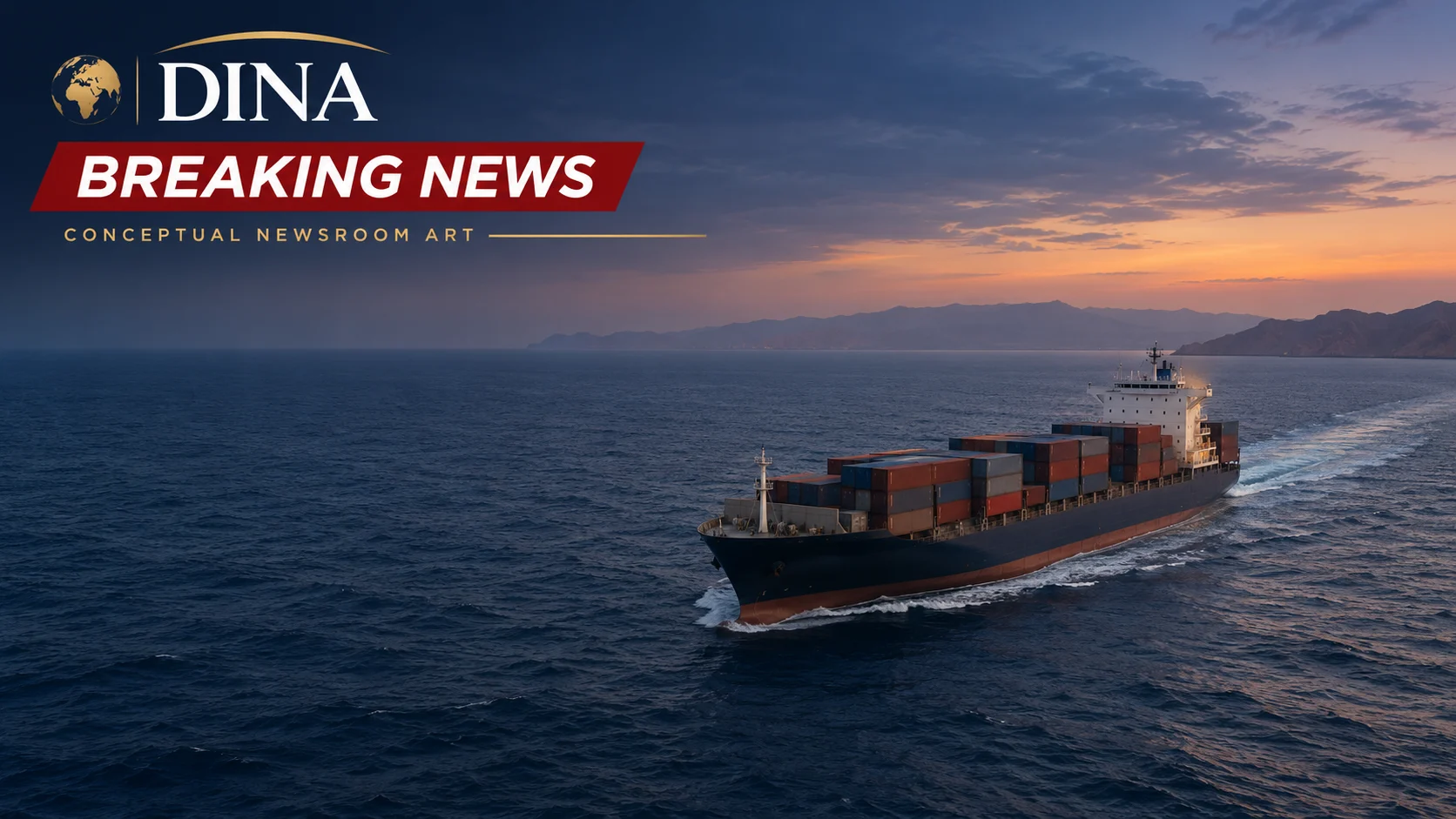
Verification status: U.S. Central Command confirms that a U.S. military aircraft fired precision munitions at the stern of the St. Kitts-flagged merchant vessel M/V Huda in the Gulf of Oman and disabled it. CENTCOM says the civilian crew ignored repeated warnings, tried multiple times to violate the U.S. blockade and was directed away from the targeted spaces. Those allegations, the warning sequence and the necessity and proportionality of the force have not been independently verified. The crew's condition, cargo, owner, operator, IMO number, precise location, full damage assessment and environmental impact were not publicly identified by the verification cutoff.
GULF OF OMAN — November 7, 2026, updated 5:52 p.m. ET: A U.S. military aircraft fired precision munitions at a commercial cargo ship and disabled it while enforcing Washington's naval blockade against Iran, according to U.S. Central Command.
CENTCOM identified the vessel as the St. Kitts-flagged M/V Huda. The command said the ship tried to leave regional waters after visiting an Iranian port and that its civilian crew ignored repeated warnings and made multiple attempts to violate the blockade. It said U.S. forces directed the crew to leave the spaces that would be targeted before the aircraft struck the stern.
The military's public statement confirms U.S. responsibility for using kinetic force against the merchant vessel. It does not independently establish the ship's cargo, ownership, route, legal status, exact coordinates, warning record or the force necessary to stop it. CENTCOM did not publicly report casualties, medical needs, flooding, fire, pollution, salvage arrangements or whether the vessel remained safely afloat.
CENTCOM said its forces have redirected 147 commercial vessels that complied with the blockade since July and disabled five merchant ships that refused. It also said U.S. forces previously destroyed 10 Iranian commercial oil tankers that it described as part of an Islamic Revolutionary Guards Corps shadow network. DINA treats those cumulative numbers and classifications as U.S. military claims pending a vessel-by-vessel record and independent verification.
Conflicting and unresolved reports around the strait
Iranian state media separately reported explosions on Qeshm Island and in the southern port of Jask. Iranian officials had not confirmed missile strikes, while the semi-official Tasnim news agency cited a source denying that the Qeshm explosions were missile-related. Iran's state broadcaster suggested that some sounds could be connected to Iranian military activity. The cause, targets, damage and any connection to U.S. operations remain unestablished.
Iran's Revolutionary Guards Navy also said two unidentified oil tankers caught fire after striking mines while using what it called an unauthorized route through the Strait of Hormuz. The claim did not identify the ships, flags, owners, crews, cargoes or locations. No independent mine-investigation finding or publicly identified connection to the explosions was available at the cutoff.
These are separate reported events. DINA is not combining them into a single attack sequence without evidence.
What is confirmed, alleged and unresolved
- Confirmed U.S. action: CENTCOM publicly acknowledged that a U.S. aircraft fired precision munitions at M/V Huda's stern and disabled the vessel in the Gulf of Oman.
- CENTCOM allegations: The command says the crew ignored repeated warnings, attempted to violate the blockade multiple times and was directed to abandon the targeted spaces. DINA has not obtained the warning recordings, bridge communications, video, radar track or after-action review.
- Not publicly established: The ship's cargo, beneficial ownership, operator, IMO number, exact position, previous Iranian port, sanctions status, crew condition, damage, pollution risk, salvage plan and the legal analysis supporting the strike.
- Separate Iranian claim: The IRGC Navy says two tankers struck mines and caught fire. Vessel identities, mine origin, casualties and independent corroboration remain unavailable.
- Unresolved explosions: Iranian media reported blasts around Qeshm and Jask, but officials did not establish their cause or connect them to the Huda action.
Task Force Iron Gate expands the enforcement architecture
Earlier Saturday, CENTCOM announced Task Force Iron Gate, an approximately 20-person civilian-military staff at its Tampa headquarters intended to coordinate federal efforts against Iranian weapons, dual-use technology, sanctioned material and alleged revenue moving over land borders and through the Caspian Sea.
The command said Adm. Brad Cooper ordered the task force and that it will work with other U.S. agencies. Reuters, citing an unnamed military official, identified expected partners as the Treasury, State and Justice departments and the intelligence community. The public announcement does not show a ground deployment, a physical border closure, new seizure authority or a completed operation by the task force.
CENTCOM also claimed that the maritime blockade has prevented Iran from exporting more than $25 billion in crude oil. It has not published the calculation, covered period, vessel list, price assumptions or audit trail. DINA therefore treats the figure as an unverified military estimate.
Why it matters
The Huda strike is direct U.S. kinetic action against a civilian-crewed merchant vessel. Whatever the cargo or route, the use of precision weapons changes the immediate risk faced by commercial crews and raises legal, environmental and escalation questions that cannot be answered by a short military statement.
Blockade enforcement also affects shipping insurance, port access, energy markets and lawful humanitarian commerce. The public needs to know what conduct triggers warning, diversion, disabling fire or destruction; what notice was given to flag states and mariners; and how neutral ships can contest a mistaken classification.
The Iranian mine claim adds a second danger. Without rapid vessel identification, independent inspection and transparent incident reporting, each side can assign blame before physical evidence is secured. That increases the risk of retaliation based on incomplete or incorrect attribution.
DINA analysis
Independent accountability analysis: CENTCOM's acknowledgment resolves who fired on M/V Huda, but it does not resolve whether the vessel was lawfully subject to interdiction or whether the strike met applicable necessity, proportionality and civilian-protection requirements. Those assessments require the blockade order, location, notice, warning log, vessel response, cargo evidence, available alternatives and actual harm.
The decision to warn the crew away from targeted spaces, if documented, would be relevant to civilian-harm mitigation. It is not by itself proof that the crew was safe, the strike was lawful or less-forceful alternatives were unavailable.
Task Force Iron Gate and the Huda action together show a widening pressure system: headquarters coordination across land and Caspian routes alongside armed maritime enforcement. That does not prove a new regional ground blockade, but it makes congressional notification, legal authority and safeguards for civilian trade more urgent.
Strongest accountability angle
The central question is whether CENTCOM can document, vessel by vessel, why force was used and what happened to the people and environment afterward. A public incident ledger should identify the flag, owner, operator, cargo basis, coordinates, warnings, response, weapon, damage, casualties, pollution, salvage, flag-state notification and legal review for each ship redirected, disabled or destroyed—subject to narrow operational redactions rather than blanket secrecy.
Urgent follow-up and records to seek
- CENTCOM's incident report, after-action review, strike video, radar and tracking record, bridge-to-bridge communications, warning timeline and command authorization for the Huda action.
- The vessel's IMO number, registry file, beneficial ownership, operator, insurer, cargo manifest, bills of lading, last port call, intended destination and sanctions-screening record.
- Crew manifest and aggregate condition; medical, evacuation, rescue, tow and salvage records; fire, flooding and pollution assessments; and current vessel position.
- The blockade declaration, geographic coordinates, notices to mariners, rules of engagement, targeting guidance and Defense and Justice Department legal reviews.
- Communications with the St. Kitts and Nevis flag-state authority, the International Maritime Organization, U.K. Maritime Trade Operations, the Joint Maritime Information Center and relevant coastal states.
- Evidence supporting CENTCOM's claims that the vessel attempted multiple violations and that 147 ships were redirected, five disabled and 10 tankers destroyed, including a reconciled vessel-by-vessel ledger.
- Independent identification and inspection records for the two tankers Iran says struck mines, including hull damage, mine fragments, voyage-data recorder material and crew accounts.
- The CENTCOM directive, mission charter, participating agencies, authorities and congressional notifications for Task Force Iron Gate.
- The methodology and source data supporting CENTCOM's more-than-$25-billion crude-export estimate.
Sources
- U.S. Central Command release — M/V Huda, warning allegation and blockade-enforcement totals, November 7, 2026
- Associated Press — U.S. action, unresolved southern-Iran explosions and Iranian tanker-mine claim, November 7, 2026
- Reuters — CENTCOM account of the Huda strike, November 7, 2026
- Reuters — Qeshm and Jask reports, competing Iranian accounts and two-tanker mine claim, November 7, 2026
- Reuters — Task Force Iron Gate and reported interagency partners, November 7, 2026
- U.S. Central Command — order resuming the naval blockade and humanitarian-vessel exception, July 13, 2026
- DINA — previous U.S. action disabling a commercial vessel during blockade enforcement, October 11, 2026
Verification cutoff: November 7, 2026, 5:52 p.m. Eastern. DINA verified the text of CENTCOM's statement through a contemporaneous command-release feed and corroborating Associated Press and Reuters reports. The command had not publicly supplied the underlying warning record, ownership and cargo documentation, crew status, strike assessment or legal review by the cutoff. The Iranian tanker and explosion accounts remain attributed and unverified.