
Breaking News · Federal Courts · Washington, D.C. · Public Lands · Public Spending · Historic Preservation · DINA Analysis
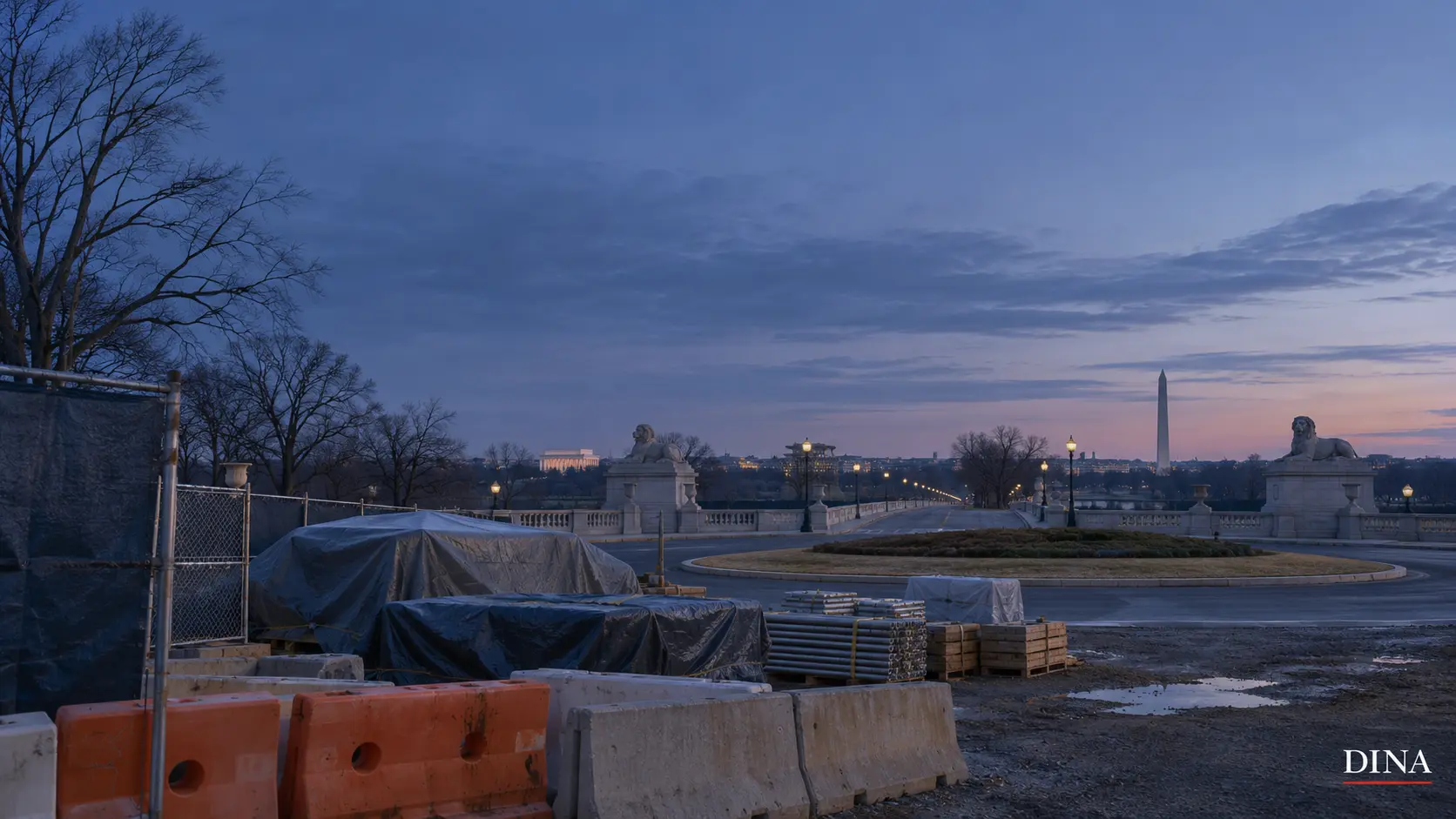
WASHINGTON — November 6, 2026: A federal judge has stopped the Trump administration from beginning construction of a proposed 250-foot monumental arch at Memorial Circle for 14 days, hours after two federal agencies completed key approvals that could have allowed excavation and foundation work to start immediately.
U.S. District Judge Tanya Chutkan issued the temporary restraining order late Thursday after the National Capital Planning Commission voted 8-4 to approve final site and building plans and the Department of the Interior authorized the National Park Service proposal for implementation. The order bars construction-related activity while the court considers challenges brought by the District of Columbia, Virginia, military veterans and a retired architectural historian.
The pause is confirmed; the legality of the arch has not been finally decided. A temporary restraining order preserves the existing conditions for a short period. It is not a final judgment that the project is lawful or unlawful, and it does not permanently cancel the arch.
What happened
The National Capital Planning Commission considered the final plans during a marathon public meeting Thursday. Associated Press and Reuters reported that the 12-member commission approved them on an 8-4 vote after hearing extensive opposition. As of DINA's publication time, the commission's project page displayed the November 5 submission materials but still listed the final action as “not found in database.” The missing web entry does not negate the reported vote, but the official action, roll call and any adopted conditions should be posted promptly.
The National Park Service's newly posted decision record says Interior authorized the selected action for implementation after reviewing the revised environmental assessment and finding of no significant impact. The decision describes the arch as a commemoration of the nation's 250th anniversary at the intersection of Arlington Memorial Bridge and Memorial Avenue, within the George Washington Memorial Parkway.
Reuters reported that Justice Department lawyers said the first six to eight months of work would focus on excavation and foundations and that total construction could last 33 to 39 months. The proposed structure would stand near Arlington National Cemetery and the flight path to Ronald Reagan Washington National Airport.
Why the judge intervened
Chutkan found that immediate construction could cause concrete harm before the legal challenges are resolved, including traffic disruption, noise, major excavation and unrecoverable costs for regional governments. She ordered a status report Monday on compliance with the pause.
The administration relies on a century-old statute connected to Arlington Memorial Bridge. The challengers argue that Congress did not authorize this specific monumental structure. The judge questioned that position in the temporary order, writing that the government's reading would assign previously unrecognized authority for a 250-foot arch at one of the capital region's most prominent sites.
DINA analysis: The order exposes a basic separation-of-powers dispute. An executive branch may plan and manage federal land, but a project of this scale also implicates Congress's control of appropriations and the statutory system for commemorative works. The court must decide which laws apply and whether the 1925 authorization reaches this project. Political approval, agency enthusiasm and design review cannot substitute for a demonstrated source of legal and spending authority.
What the order does — and does not do
- It stops construction-related activity for 14 days.
- It preserves the site while the court reviews requests for longer relief.
- It does not reverse the planning commission vote or erase Interior's decision record.
- It does not decide the ultimate claims about congressional authorization, environmental review, historic preservation or public spending.
- It does not establish misconduct by any official, contractor or commission member.
Why it matters
The dispute combines presidential power, congressional authority, public-land stewardship, transportation safety and the permanent design of a nationally significant landscape. The proposed arch would alter a ceremonial corridor connecting the Lincoln Memorial and Arlington National Cemetery. Even a temporary excavation could create costs and physical changes that are difficult to reverse.
The case also tests whether agencies can compress design, environmental, historic-preservation, aviation and construction decisions into a schedule driven by an executive priority. The legal pause gives the public and the court a short window to examine the records behind those decisions before work begins.
Strongest accountability angle
The strongest accountability question is the money-and-authority trail: who approved spending, which appropriation or transfer pays for the project, what the full lifecycle cost is, which contracts or task orders have been issued, and what statutory text authorizes construction of this specific monument. The public record should connect every design and construction commitment to a legal authority, a funding source, a responsible official and a procurement record.
A second accountability issue is publication speed. Interior posted an executed decision record, but the planning commission's project page had not yet posted the final action at DINA's deadline. Agencies should publish the signed action, vote, conditions, final transcript and complete decision attachments before relying on the approvals to begin irreversible work.
Urgent follow-up and public records
- Obtain the complete November 5 temporary restraining order and all consolidated-case docket entries filed after the planning commission vote.
- Request the NCPC's signed final action, commissioner-by-commissioner roll call, adopted conditions, meeting transcript and communications about the timing of construction.
- Request from Interior and NPS the project cost estimate, funding source, appropriation or transfer authority, acquisition plan, solicitations, bids, task orders, awards, modifications and notices to proceed.
- Obtain the executed November 5 decision record with every appendix, including the National Historic Preservation Act, FAA and NCPC correspondence.
- Request construction staging, traffic-management, emergency-response and airport-safety plans and identify which state, local and federal agencies approved each one.
- Ask the Government Accountability Office and congressional appropriations committees whether the funding structure has been reviewed for compliance with appropriations law.
- Track Monday's compliance report and any hearing or ruling on preliminary injunctive relief.
Primary and corroborating sources
- National Park Service — November 5 decision record authorizing the selected action for implementation
- National Capital Planning Commission — project record, final-plan materials and staff report
- National Capital Planning Commission — November 5 meeting record and participation information
- National Park Service — revised environmental assessment and finding of no significant impact
- Reuters — court order, agency approvals and construction schedule
- Associated Press — temporary restraining order, regional harms and planning commission vote
- Virginia attorney general — plaintiffs' description of the consolidated legal challenge