
Investigative Op-Ed · Election 2026 · U.S. House · Congressional Leadership · Voting Rights · Democratic Caucus · Political & Legal Analysis
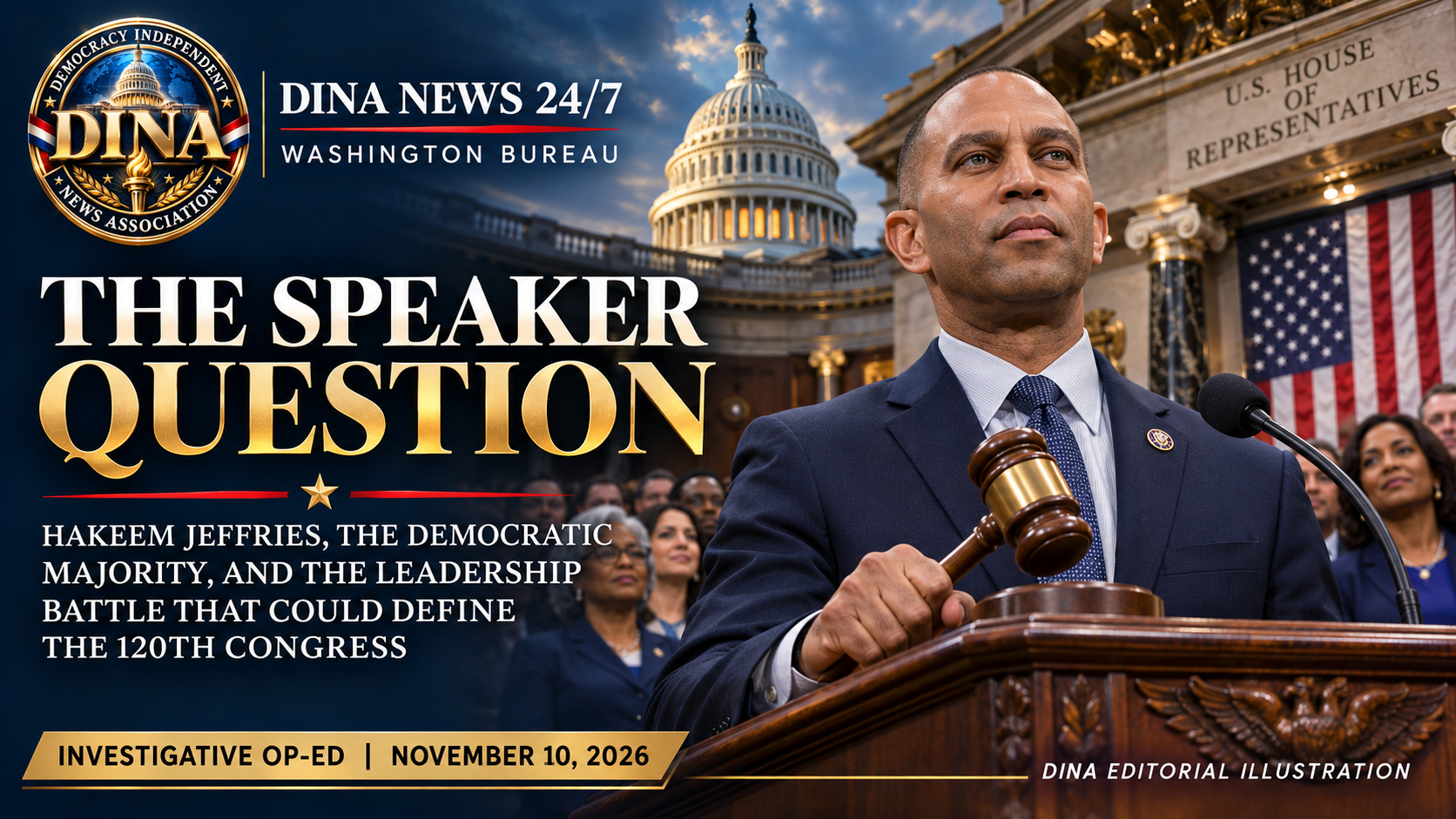
WASHINGTON — November 10, 2026: The Democratic Party's victory in the November 3 congressional elections has opened the door to a historic change in American government: Representative Hakeem Jeffries of New York could become the first Black Speaker of the United States House of Representatives.
But the transition from minority leader to Speaker is not automatic. Jeffries must first prevail in the Democratic Caucus and then win a majority of the votes cast for a named candidate when the House convenes. If all 435 members vote for a person, the familiar threshold is 218; absences and votes of “present” can lower the number required. That distinction is constitutional arithmetic, not political trivia.
Jeffries formally entered the contest on November 4. His letter to colleagues centered the next House majority on affordability, accountability and what he called American values. A progressive campaign has nevertheless urged incoming Democrats to reject him over corporate political influence, the party establishment, Israel policy, the Iran war and what critics view as insufficient resistance to President Donald Trump's administration.
This dispute presents two questions that should not be blurred. What does Jeffries' actual record establish? And what would House Democrats gain—or place at risk—by replacing him with another leader who, as of this publication, has not emerged?
I. The record: votes, legislation and institutional leadership
Jeffries' record is neither a blank slate nor a campaign biography. It contains roll-call votes and legislative work that can be independently checked.
Voting rights and democratic representation
On August 24, 2021, Jeffries voted for H.R. 4, the John R. Lewis Voting Rights Advancement Act. The House passed the measure 219–212. The bill sought to restore a federal preclearance framework and strengthen protections against discriminatory voting changes after Supreme Court decisions weakened the Voting Rights Act's enforcement structure.
Jeffries also voted for H.R. 1, the For the People Act, which passed the House 220–210 on March 3, 2021. That legislation addressed ballot access, election administration, redistricting, campaign finance and government ethics. Neither House vote alone made those proposals law, but both are concrete evidence of where Jeffries stood when the chamber was required to decide.
Infrastructure, healthcare and household economics
Jeffries voted for the Infrastructure Investment and Jobs Act on November 5, 2021. The final House vote was 228–206. The law authorized major federal investment in transportation, broadband, drinking-water systems and other public works.
He also voted for the Inflation Reduction Act on August 12, 2022, when it cleared the House 220–207. Its provisions included Medicare prescription-drug negotiation, continued Affordable Care Act premium assistance, clean-energy incentives and corporate tax changes. The long-term effects of a law must be assessed separately from a sponsor's claims, but a member's recorded vote remains an objective part of the leadership inquiry.
Civil rights and criminal-justice reform
Jeffries supported the Emmett Till Antilynching Act, which became Public Law 117-107 in 2022. More significantly for evaluating legislative capacity, he worked across the aisle with then-Representative Doug Collins on the FIRST STEP Act. The House approved that criminal-justice measure 358–36 in December 2018, and it was signed into law. That episode shows more than ideological alignment: it shows an ability to convert a reform priority into bipartisan statutory text capable of surviving both chambers.
None of these facts requires progressives to agree with Jeffries on every issue. They do, however, defeat the claim that his record contains no material work on voting rights, infrastructure, healthcare costs, civil rights or sentencing reform.
II. The opposition: what is established—and what is not
Reporting before the election identified six progressive candidates who had declined to commit to Jeffries: Melat Kiros of Colorado; Darializa Avila Chevalier and Claire Valdez of New York; Adam Hamawy of New Jersey; Chris Rabb of Pennsylvania; and Donavan McKinney of Michigan.
That wording matters. A pre-election refusal to commit is not a recorded vote against Jeffries. It does not prove that a member will prevent the House from organizing, and it should not be frozen in time after negotiations or changed circumstances. No Speaker floor vote has occurred.
The objections are nonetheless substantive. Kiros said she would not support a Democratic leadership candidate who accepted corporate PAC money. Rabb criticized Jeffries' involvement in Democratic primaries and questioned the rhetoric used against insurgent candidates. Other critics have focused on Israel, the Iran war and whether Democratic leaders mounted sufficiently forceful opposition to the Trump administration.
On November 10, Congressman-elect Don Leonard of Ohio publicly conditioned his support on engagement over ending the Iran war, U.S. policy toward Israel and a constitutional amendment addressing Citizens United. Leonard also alleged that unnamed senior House Democrats threatened political retaliation if he withheld support. DINA has not independently verified that allegation, and the individuals accused were not identified in the report reviewed for this analysis. It should be investigated, not repeated as established fact.
The broader grassroots revolt is real. Congressional offices told Axios they had received hundreds of calls opposing Jeffries, while progressive organizers argued that Democrats should not return to “business as usual.” But current reporting also establishes a crucial counterfact: no alternative candidate has entered the House race. Representative Jamie Raskin has been promoted by some activists, but he has not launched a bid.
III. The support: broad, public and organizational
Jeffries retains extensive institutional backing. Representatives Jim Himes of Connecticut and Sam Liccardo of California publicly said they would support him. Former Speaker Nancy Pelosi endorsed his candidacy. Representative Debbie Dingell of Michigan also defended his leadership, and multiple House Democrats told reporters that they expect him to win.
The proposed leadership slate reinforces that expectation: Katherine Clark for majority leader, Pete Aguilar for majority whip, Ted Lieu for Democratic Caucus chair and Joe Neguse for assistant speaker. House Democrats are scheduled to conduct internal leadership elections November 18–19. The full House is expected to elect the Speaker when the 120th Congress convenes January 3, 2027.
Support is not the same as election. But organizational continuity, the absence of a challenger and a Democratic majority already standing at 255 called seats make Jeffries the overwhelming favorite.
IV. Where the critics are right
Progressive members are right to demand commitments rather than coronations. A majority does not erase the duty to examine campaign financing, foreign policy, committee access, economic priorities or the treatment of junior members. The Speakership carries enormous control over referrals, floor time, committee organization and negotiations with the Senate and president. Those powers justify conditions, transparency and debate.
They are also right that historical symbolism cannot substitute for policy. Electing the first Black Speaker would be nationally significant, but it would not immunize any leader from scrutiny. Representation and accountability are complementary democratic values, not competing ones.
V. Where a leaderless revolt goes wrong
The error is not disagreement. The error would be turning disagreement into an unstructured veto without a candidate, a vote count or a governing plan.
A serious leadership challenge requires four things: an identified alternative; an achievable coalition; published commitments; and a credible plan to organize the House on the first ballot or soon thereafter. The present anti-Jeffries campaign has not produced those elements. It has produced grievances and pressure, some of them legitimate, but no demonstrated governing substitute.
That distinction matters because the Speaker does not merely symbolize the party. The Speaker administers the House's constitutional opening, committee structure, rules package, legislative calendar and oversight machinery. A faction that blocks a viable nominee without offering a viable replacement does not increase its leverage indefinitely. It can instead delay the very investigations, healthcare measures, voting-rights bills and checks on executive power that progressives say they want.
Democrats would also surrender a strategic advantage. Jeffries has kept his caucus unified through repeated Speaker votes, led the party from the minority into a commanding majority and assembled a transition team before the new Congress. Removing him immediately after that result—absent evidence of incapacity or an organized alternative—would tell voters that electoral victory cannot produce institutional stability.
DINA's judgment is therefore direct: Democrats should elect Hakeem Jeffries Speaker, while requiring a written governing compact that answers the progressive critique. Accountability should shape his Speakership, not destroy the majority's capacity to begin it.
VI. The compact Democrats should demand
A responsible agreement should be public and measurable. It should include:
- a first-100-days schedule covering affordability, healthcare, voting rights, anti-corruption and executive-branch oversight;
- fair committee participation for the ideological and regional breadth of the Democratic majority, including incoming members;
- clear procedures for rank-and-file members to secure hearings and floor consideration;
- campaign-finance and stock-trading reforms that apply to leadership as well as ordinary members;
- a defined process for caucus debate on Israel, the Iran war and congressional war powers; and
- protection against retaliation for good-faith disagreement inside the caucus.
Such a compact would allow progressives to claim concrete reforms, allow Jeffries to demonstrate responsive leadership and allow the House to organize without converting policy disputes into institutional paralysis.
VII. The historical significance—and the constitutional test
No Black American has served as Speaker of the House. Jeffries' election would mark a historic breach in an institution shaped for generations by racial exclusion from political power.
Yet the office must be evaluated beyond symbolism. The next Speaker must direct a chamber representing the entire country, defend Congress as a coequal branch, organize rigorous oversight and turn electoral promises into legislation. Jeffries' supporters point to his experience, recorded votes, bipartisan legislative work and caucus relationships. His critics point to policy, donor influence and the changing expectations of the Democratic electorate.
Both belong in the debate. But only one candidate has declared, built a leadership team and demonstrated the votes needed to begin governing.
THE DINA CONCLUSION
The question before House Democrats is larger than the future of one leader. It concerns the relationship between electoral victory, ideological diversity and the institutional duty to govern.
Jeffries should not receive a blank check. He should receive the gavel with enforceable commitments. His critics should not be dismissed, threatened or caricatured. They should be required to state precisely what they seek—and, if they would deny him the office, whom they propose and how that person can win.
On the present record, replacing Jeffries would exchange a tested coalition for an undefined possibility. That is not reform. It is risk without a governing return.
House Democrats should negotiate the compact, publish the commitments and elect Hakeem Jeffries Speaker. The historical milestone would be real. The more important achievement would be a majority capable of opening the House on time and using its power to legislate, investigate and check the executive branch.
The November leadership elections will provide the first formal test. The January floor vote will determine who holds the gavel. Until then, every claim of support or opposition should be described with precision: announced, undecided, conditional or recorded—never assumed.
Source record and verification
- Office of Rep. Hakeem Jeffries — November 4 candidacy letter.
- Associated Press — Democrats at 255 called House seats; unresolved races remain, November 10, 2026.
- Office of the Historian, U.S. House — Speaker-election procedure and multiple ballots.
- House Clerk roll call 260 — H.R. 4, John R. Lewis Voting Rights Advancement Act; roll call 62 — H.R. 1, For the People Act.
- House Clerk roll call 369 — Infrastructure Investment and Jobs Act; roll call 420 — Inflation Reduction Act.
- House Clerk roll call 448 — FIRST STEP Act; Jeffries office account of the bipartisan Collins–Jeffries legislation.
- Axios — pre-election Jeffries-skeptic candidates and their stated objections, July 8, 2026; The Washington Sun — six pre-election noncommittals and leadership outreach, September 30, 2026.
- Axios — grassroots opposition, current supporters, leadership schedule and absence of a challenger, November 6, 2026.
- The Washington Post — progressive campaign and incoming-member uncertainty, November 10, 2026.
- Common Dreams — report of Don Leonard's conditional support and unverified retaliation allegation, November 10, 2026.
Verification cutoff: November 10, 2026, 8:45 p.m. Eastern. Election counts remain subject to canvass, certification, recounts and additional race calls. This article distinguishes recorded congressional votes, public statements, reported positions, allegations and DINA's editorial judgment. The masthead is an AI-generated DINA editorial illustration; it is not a photograph of Jeffries, a Speaker election or any congressional proceeding.