
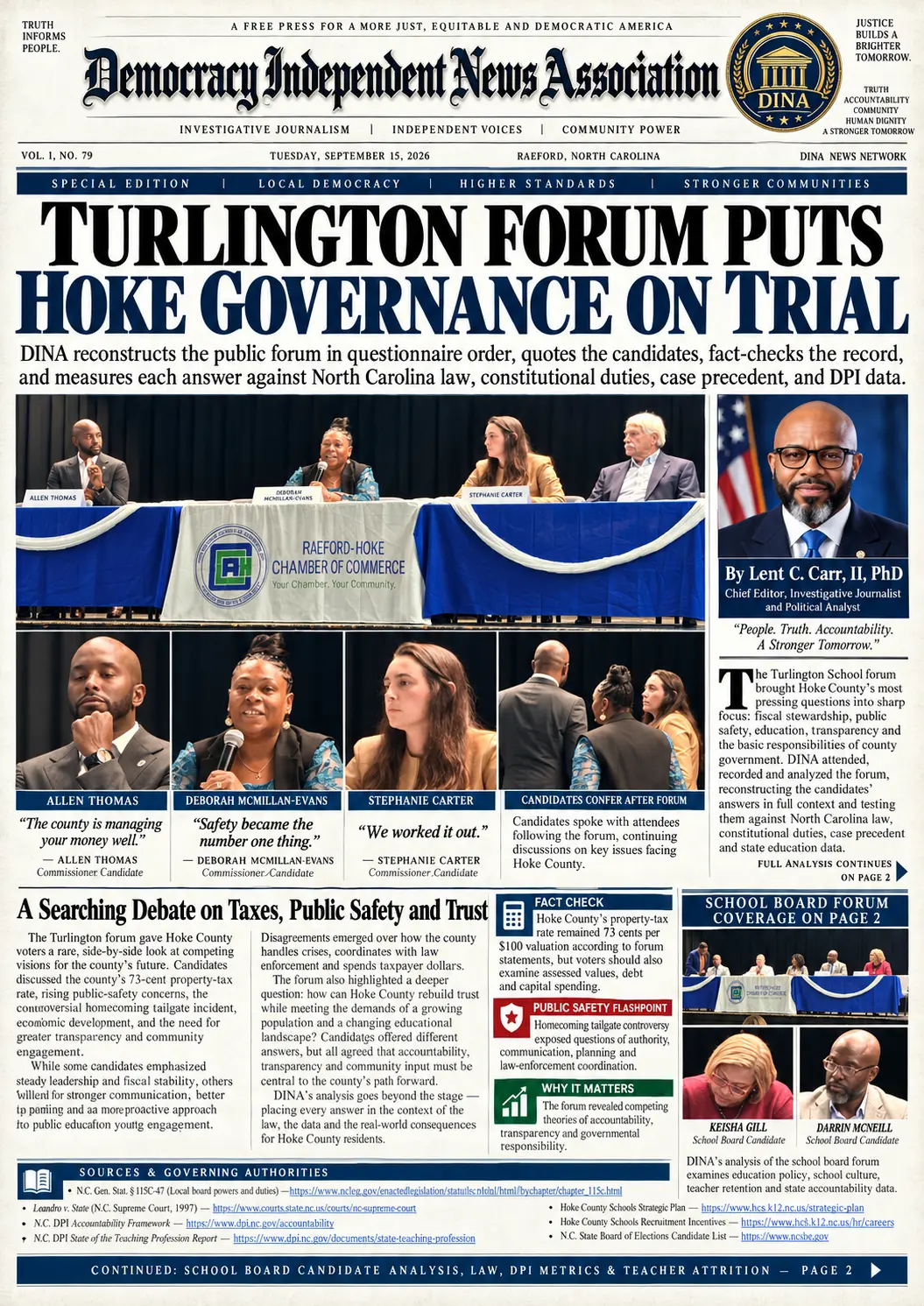
RAEFORD, N.C. — The Turlington School political forum brought Hoke County’s most pressing public questions into one room: taxes, public safety, education, economic development, transparency and the basic responsibilities of county government.
DINA attended, recorded and analyzed the forum. This report reconstructs the central issues in questionnaire order and measures the candidates’ answers against North Carolina law, the county’s published fiscal record and the practical consequences for residents.
The commissioner discussion featured Allen Thomas, Deborah McMillan-Evans and Stephanie Carter. They did not offer one theory of government. Thomas emphasized fiscal steadiness. McMillan-Evans placed public safety at the center. Carter stressed problem solving. Their differences matter because the Board of Commissioners controls the county budget, sets the property-tax rate, funds core departments and shares responsibility for the conditions in which Hoke County’s schools operate.
Question one: What is county government responsible for?
A commissioner’s first duty is not to win the room. It is to understand the office. County government must adopt a lawful budget, levy taxes, finance public safety and public health, maintain county facilities, support elections, fund legally required services and provide the local share for public schools.
North Carolina law gives county commissioners substantial fiscal authority, but not unlimited freedom. The board must operate through public votes, published records and a balanced budget. Promises about safety, schools and growth therefore rise or fall on whether a candidate can connect priorities to revenue, staffing and measurable results.
The strongest answers at Turlington treated government as a continuing obligation rather than a campaign slogan. The weaker moments came when broad words—accountability, transparency, growth—were not paired with a timetable, a reporting requirement or a responsible official.
Question two: Is the county managing taxpayer money well?
Allen Thomas told the audience, “The county is managing your money well.” The statement carries a testable premise.
Hoke County’s published tax information lists a general county rate of 73 cents per $100 of assessed value. A stable rate can indicate fiscal discipline, but it does not by itself prove that a tax bill is stable or that spending is effective. Assessed values, special-district charges, debt, capital projects and the growth of the tax base all affect what residents pay and what the county can afford.
The public should therefore demand a fiscal scorecard that shows, at minimum, annual debt service, fund balance, major capital commitments, vacancy rates in essential departments, school appropriations and the cost of postponed maintenance. A rate without those facts is an incomplete measure.
Thomas’s defense of county management deserves to be evaluated through that complete record. So do challenges from his opponents. Fiscal criticism should identify the expenditure, the alternative and the consequence—not rely on generalized distrust.
Question three: What did the homecoming tailgate controversy reveal?
The forum repeatedly returned to the controversial homecoming tailgate incident. Deborah McMillan-Evans said, “Safety became the number one thing.” Stephanie Carter summarized the response with, “We worked it out.”
But the incident should not be reduced to whether one event was ultimately resolved. It exposed a governance chain: who possessed authority, what policy applied, how schools and law enforcement coordinated, what the public had been told, and whether decisions were enforced consistently.
A credible after-action review should answer four questions: What was planned? What changed? Who made each decision? What written procedure will govern the next event? Without that review, officials may calm one controversy while preserving the conditions for another.
Public safety is not achieved through force alone. It depends on clear lines of authority, advance planning, lawful and proportionate enforcement, and communication that residents can understand before an event—not only after conflict begins.
Question four: How should Hoke County rebuild trust?
The candidates offered competing approaches. Some emphasized stable leadership and fiscal continuity. Others pressed for stronger communication, better reporting and more proactive public education. Those theories are not mutually exclusive. Good government requires institutional competence and visible accountability.
Trust does not mean that the public agrees with every decision. It means residents can discover who decided, under what authority, using what evidence, at what cost and with what result.
Hoke County can strengthen that trust by publishing meeting materials before votes, presenting searchable budget-to-actual reports, recording major policy decisions in plain language and scheduling regular public briefings on public safety, infrastructure and school capital needs.
Community engagement must also be more than a microphone at the end of a meeting. Officials should show how public input changed a proposal—or explain why it did not.
Question five: What does growth require?
Hoke County’s growth affects roads, water, emergency response, school capacity, housing and the tax base at the same time. Economic development cannot be judged only by announcements or acreage. The public needs to know the expected jobs, wage levels, infrastructure cost, incentive terms and long-term tax return.
Growth that arrives without school seats, water capacity or emergency staffing can transfer private gain into public expense. Growth planned with enforceable standards can expand opportunity and reduce pressure on existing taxpayers.
The forum’s most important unanswered question was therefore not whether candidates favored growth. It was what conditions they would impose so growth pays its fair share and improves daily life.
The Carr analysis: three competing standards
Turlington revealed three distinct standards for leadership.
Stability: maintain fiscal continuity and defend the county’s record. This approach benefits from experience but must disclose weaknesses as clearly as achievements.
Safety: make public protection the organizing priority. This approach responds to immediate concern but must define safety broadly enough to include planning, youth, schools, health and lawful accountability.
Problem solving: bring parties together and reach workable outcomes. This approach can break stalemates but must leave a public record showing what was resolved and whether the solution lasts.
Hoke County does not need to choose only one. It needs leaders capable of combining all three—and proving the combination through public measures.
DINA’s public-interest standard
For every major promise made at the forum, voters should ask:
- What specific action will the candidate take?
- Which office or official has the legal authority to take it?
- How much will it cost, and how will it be funded?
- When should residents expect a result?
- What public measure will show success or failure?
The Turlington forum did more than introduce candidates. It placed Hoke County governance on trial before the people who finance it and live with its consequences.
The verdict should not rest on applause. It should rest on the record.
Public record and governing authorities
- North Carolina General Statutes, Chapter 153A — counties
- Hoke County — tax rates and fees
- Hoke County — agendas and minutes
- Hoke County Board of Commissioners
- North Carolina State Board of Elections — official election information
Archive note: This canonical web edition restores DINA’s September 15, 2026 Turlington forum investigation and its original edition artwork.