
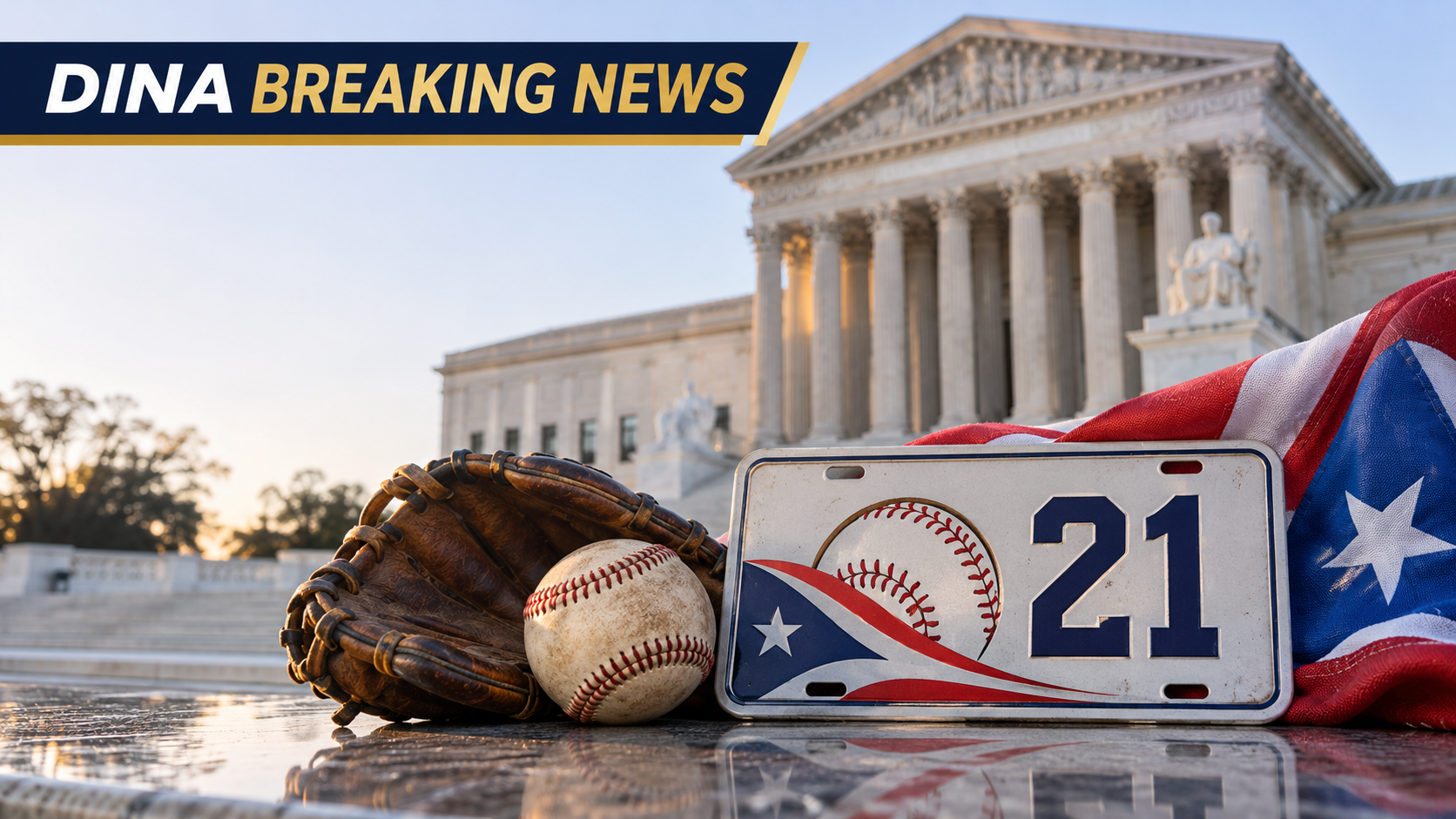
Breaking News · U.S. Supreme Court · Puerto Rico · Roberto Clemente · Trademark Rights · Fifth Amendment · DINA Analysis
Verification status: The Supreme Court's official November 9 order list records that certiorari was denied in Clemente Properties, Inc. v. Pierluisi-Urrutia, No. 25-1426. The denial is confirmed. The Court issued no opinion and did not endorse or reject the First Circuit's reasoning. The lower appellate ruling remains controlling in this case.
WASHINGTON / SAN JUAN, Puerto Rico — November 9, 2026: The U.S. Supreme Court declined Monday to hear a challenge brought by Roberto Clemente's three sons and two family-controlled companies over Puerto Rico's use of the baseball legend's name and image on commemorative license plates and registration tags.
The unsigned order denied review in case No. 25-1426 without explanation. That action leaves in place a January ruling by the U.S. Court of Appeals for the First Circuit rejecting the family's Fifth Amendment theory that the alleged use of its trademark should be treated like a physical appropriation requiring automatic compensation.
The petitioners are Clemente Properties, Inc.; 21 In Right, Inc.; Roberto Clemente Jr.; Luis Roberto Clemente; and Roberto Enrique Clemente. Their complaint alleged that Puerto Rico used the Roberto Clemente mark and likeness without permission in a 2022 program tied to the 50th anniversary of Clemente's 3,000th major-league hit.
According to the pleadings and petition—not a judicial finding—the license-plate and registration-tag program generated about $15 million. The plaintiffs sought to stop future unauthorized uses and pursued $45 million in alleged damages plus $3.15 million in asserted trademark compensation. Puerto Rico disputed the legal theory and defended the lower-court ruling.
What the Supreme Court did—and did not do
- Confirmed: The Court denied the petition for a writ of certiorari on November 9, 2026.
- Legal effect: The First Circuit's judgment remains in force in this litigation.
- Not decided: A certiorari denial is not a merits decision and creates no new Supreme Court precedent approving Puerto Rico's conduct or the First Circuit's constitutional analysis.
- Not established as fact: The claimed $15 million in program proceeds and requested damages are allegations and litigation demands, not amounts awarded or independently audited in the Supreme Court record.
The Court's docket shows that the petition was filed June 25, distributed for three conferences and last considered at the justices' November 6 conference. No justice publicly noted a dissent from Monday's denial.
The lower court rejected an automatic physical-taking rule
The First Circuit assumed for purposes of analysis—without finally deciding—that the plaintiffs possessed a trademark property interest protected by the Fifth Amendment. It nevertheless rejected their request to analyze the alleged infringement under the categorical rule used when government physically occupies or appropriates tangible property.
The appellate court stressed that it was not holding that trademark infringement can never amount to a compensable taking. It held instead that the plaintiffs had not shown why the alleged invasion of an intangible trademark right should be treated as the constitutional equivalent of a physical seizure. Because the appellants did not present an alternative, fact-intensive regulatory-takings theory under Penn Central, the court affirmed dismissal of the takings claim.
The family's Supreme Court petition argued that leaving the ruling intact would give governments too much room to appropriate intangible property without automatically paying compensation. Puerto Rico answered that the First Circuit had not categorically excluded trademarks from Fifth Amendment protection and had simply applied existing doctrine to the theory actually presented.
The broader lawsuit was not entirely erased
Monday's order does not mean every claim in the underlying litigation disappeared. The First Circuit affirmed dismissal of the takings claim, the false-advertising claim, all claims against the Puerto Rico Convention Center District Authority and official-capacity claims against Commonwealth defendants. But it vacated dismissal of three Lanham Act claims—registered-mark infringement, false endorsement and dilution—against individual Commonwealth officials in their personal capacities and sent those claims back to the federal district court.
Those surviving claims were not a determination that infringement occurred. At the pleading stage, the appellate majority concluded only that the allegations were plausible and that qualified immunity had not been properly preserved for those claims at that point. The court said officials could raise qualified immunity again later. Chief Judge David Barron dissented from that portion and would have affirmed dismissal.
Why it matters
Roberto Clemente's public legacy belongs culturally to Puerto Rico and to baseball history, while enforceable trademark rights can belong to private owners. The dispute tests the legal boundary between public commemoration and government use of privately controlled intellectual property.
The practical consequence is narrower than the headline may suggest. The Supreme Court did not authorize governments to take trademarks at will. It declined to review one case in which the challengers pressed a particular categorical-takings theory. But the denial leaves trademark owners, public agencies and lower courts without a new nationwide Supreme Court rule clarifying when government use of intangible property becomes a per se taking.
DINA analysis
Independent legal analysis: The accountability question is not whether Roberto Clemente deserves public honor; that is beyond serious dispute. The question is whether a government may monetize that honor through compulsory fees while bypassing the rights it would demand private businesses respect.
The Supreme Court's silence avoids answering that question at the national level. It also illustrates why certiorari denials must be reported precisely: the justices rejected review, not necessarily the family's moral claim, Puerto Rico's policy choice or every possible constitutional theory.
The First Circuit opinion itself points to the unresolved terrain. It recognized that intangible property can receive Takings Clause protection, declined to equate trademark infringement with a physical occupation and noted that the plaintiffs did not develop a Penn Central regulatory-takings argument. Future disputes may therefore turn on pleadings, economic evidence, the nature of the government use and the remedy sought rather than on a universal rule that trademarks are either always or never protected.
Strongest accountability angle
Puerto Rico should publish a complete accounting of the 2022 program: total plate and tag collections, administrative costs, transfers to the proposed sports district, vendors, contracts, licensing reviews and the legal advice used before adopting Clemente's image. Those records would not decide the constitutional question, but they would test the plaintiffs' revenue allegation and show whether officials treated the family's asserted rights as a legal risk, a negotiable license or an obstacle to be ignored.
The surviving personal-capacity Lanham Act claims also require careful tracking. A revived claim is not a finding of liability, and a later immunity ruling could narrow or end the case. Public reporting should follow the remand docket rather than treating Monday's certiorari denial as the final end of every dispute between the family and Puerto Rico.
Urgent follow-up and records to seek
- The federal district court's current remand schedule, amended pleadings, pending immunity motions and any discovery orders concerning the surviving Lanham Act claims.
- Puerto Rico Department of Transportation and Public Works records showing the number of commemorative plates and tags issued and the gross and net revenue collected.
- Contracts, invoices, transfers and expenditure ledgers connected to the Roberto Clemente Sports District and the 2022 plate program.
- Government legal memoranda, licensing communications and notices exchanged with Clemente Properties or 21 In Right before and during the program, subject to lawful privilege claims.
- Any renewed legislative or administrative proposal to use Clemente's name, image or marks after the 2022 program ended.
Primary sources and reporting
- U.S. Supreme Court — official November 9, 2026 order list, page 3
- U.S. Supreme Court docket — Clemente Properties, Inc. v. Pierluisi-Urrutia, No. 25-1426
- Petition for a writ of certiorari, filed June 25, 2026
- Puerto Rico respondents' brief in opposition, filed August 27, 2026
- U.S. Court of Appeals for the First Circuit — official opinion index, case No. 23-1922
- First Circuit opinion, January 16, 2026
- Reuters — report on the Supreme Court denial, November 9, 2026
Verification cutoff: November 9, 2026, 10:14 a.m. Eastern. DINA reviewed the Supreme Court's official order list and docket, the parties' certiorari filings, the First Circuit's published opinion and current wire reporting. The associated image is an AI-generated DINA editorial visualization; it does not depict the disputed plate, a court filing, evidence or Roberto Clemente's likeness.