
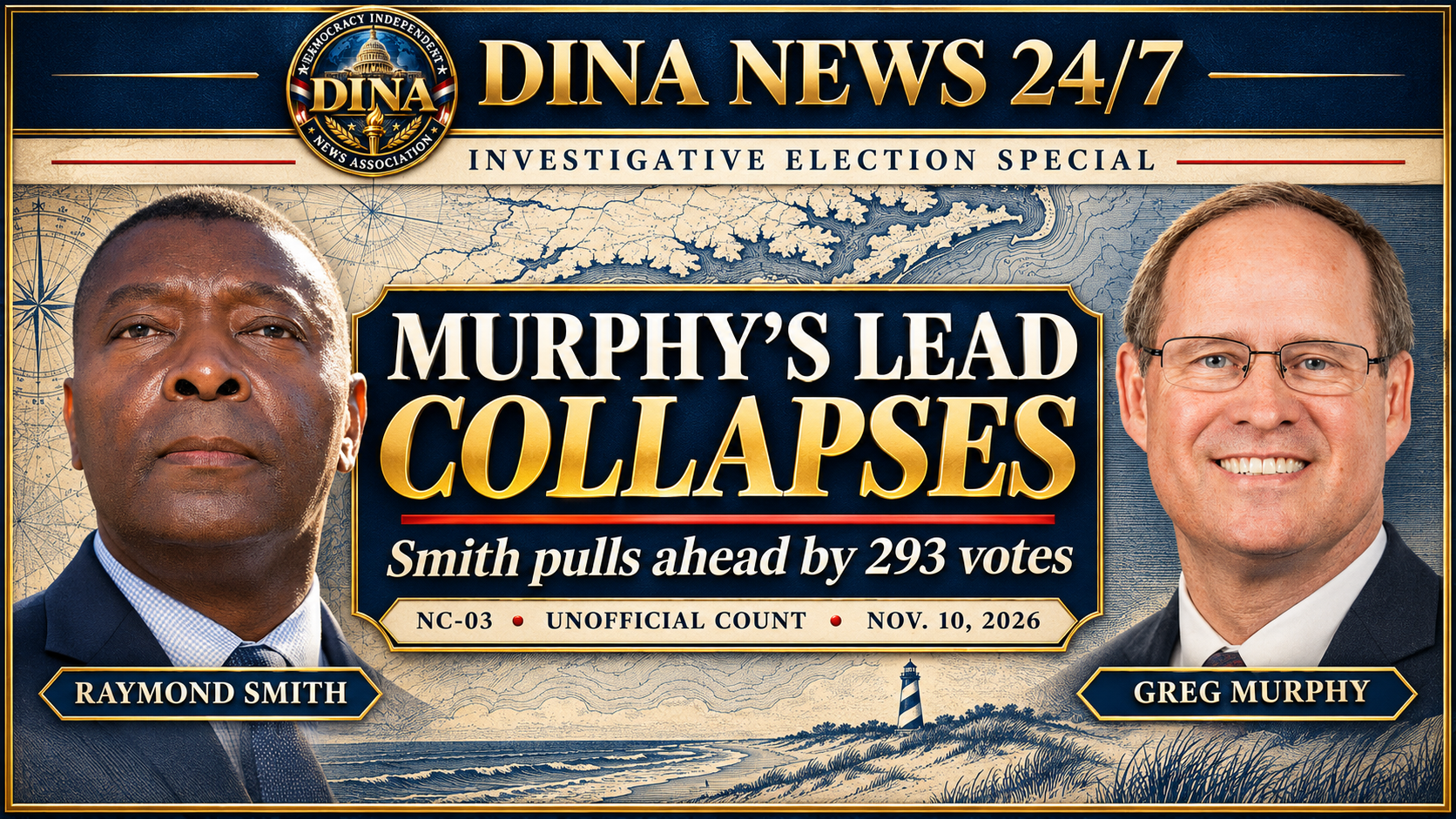
Greg Murphy declared victory last Wednesday. Six days later, he was the candidate who needed to make up ground. Democrat Raymond E. Smith Jr., a former North Carolina legislator, led the Republican congressman by 293 votes in the unofficial count reported at 8:08 p.m. Tuesday, with all counties reporting. Three days before the county canvass, a seat Republicans have held throughout Murphy’s seven years in Congress could change hands.
How a 233-vote lead changed hands
On election night, all 190 precincts had reported. Murphy had 117,583 votes to Smith’s 117,350. That was the count behind the incumbent’s claim. It included voters whose ballots could be tabulated immediately. Others had already voted, but county election workers still had to establish which of their votes qualified.
On Tuesday, county boards added eligible provisional ballots and absentee ballots whose voters had corrected a deficiency. At 7:18 p.m., WUNC’s Adam Wagner reported Smith up 264, with Greene County’s provisional results still outstanding. Fifty minutes later, Laura Leslie reported a 293-vote Smith lead with all counties reporting. Measured from election night, Smith had gained 526 votes more than Murphy.
That distinction matters to anyone who saw the precinct tracker reach 100 percent last week. The tracker counted precinct reports. It could not tell a voter whose name was missing from a pollbook, for example, whether a county board had finished checking their registration. The State Board requires officials to investigate each provisional ballot. If a voter qualified for only some contests on it, only those votes count.
The cost of trying to take Don Davis’s seat
To understand how a Republican incumbent wound up here, look across the district line. In October 2025, lawmakers redrew the First and Third congressional districts. Republican state Sen. Ralph Hise told his colleagues the objective was to “bring an additional Republican seat to the Congressional delegation,” as ABC11 reported during the debate.
The targeted incumbent was Democrat Don Davis in the First District. Moving Republican-leaning areas from Murphy’s side of the line into Davis’s district improved the GOP’s prospects against Davis on paper. The same trade left Murphy defending different territory. Even then, Republicans had reason for confidence. WUNC reported that Donald Trump had carried the territory inside the new Third District by about 13.6 percentage points in 2024.
Davis went on to defeat Republican challenger Laurie Buckhout. Now Smith has a chance to take the other seat affected by the redraw. If his lead survives, Democrats will have held the seat Republicans went after and gained the one Republicans already had. The returns establish that political consequence if the margins hold. They cannot tell us how the same voters would have divided under the old boundaries, or which issue moved any one of them.
The scale of the potential reversal reaches Washington. Republicans entered this cycle holding ten of North Carolina’s fourteen House seats. Tuesday evening’s returns put Democrats ahead in eleven. The final makeup of the delegation depends on other close races as well, including the contest between Chuck Hubbard and Rep. Virginia Foxx in the Fifth District.
What can still move the margin
One group of voters still had time under state law for its ballots to arrive when Tuesday’s numbers appeared. Qualifying military and overseas ballots mailed by Election Day can reach a county elections office through 5 p.m. Thursday, November 12. Counties can also adjust their totals to reflect a successful eligibility challenge. Neither party knows from those rules alone who will gain votes.
County boards meet in public at 11 a.m. Friday, November 13 to review and authenticate their counts. If the margin after canvass is one percent or less of votes cast for this office, the trailing candidate may demand a recount. The State Board must receive that written request by noon Tuesday, November 17. The state canvass for congressional races is scheduled for 11 a.m. Tuesday, November 24. All times are Eastern.
For the eastern North Carolinian who had to cast a provisional ballot, those dates are the difference between hearing a candidate announce the result and knowing their own vote had a place in it. With 293 votes separating the candidates in Tuesday evening’s count, that difference could decide who speaks for the district in Congress.
Reporting and public records
- Laura Leslie, News From The States, November 10, 8:08 p.m. ET — updated district margin.
- Adam Wagner, WUNC, November 10, 7:18 p.m. ET — earlier margin, Murphy’s victory statement and district voting history.
- The North Carolina Beat, election-night returns and ABC11’s coverage of the map debate.
- North Carolina State Board of Elections, canvass and recount guidance and instructions for checking whether your vote counted.