
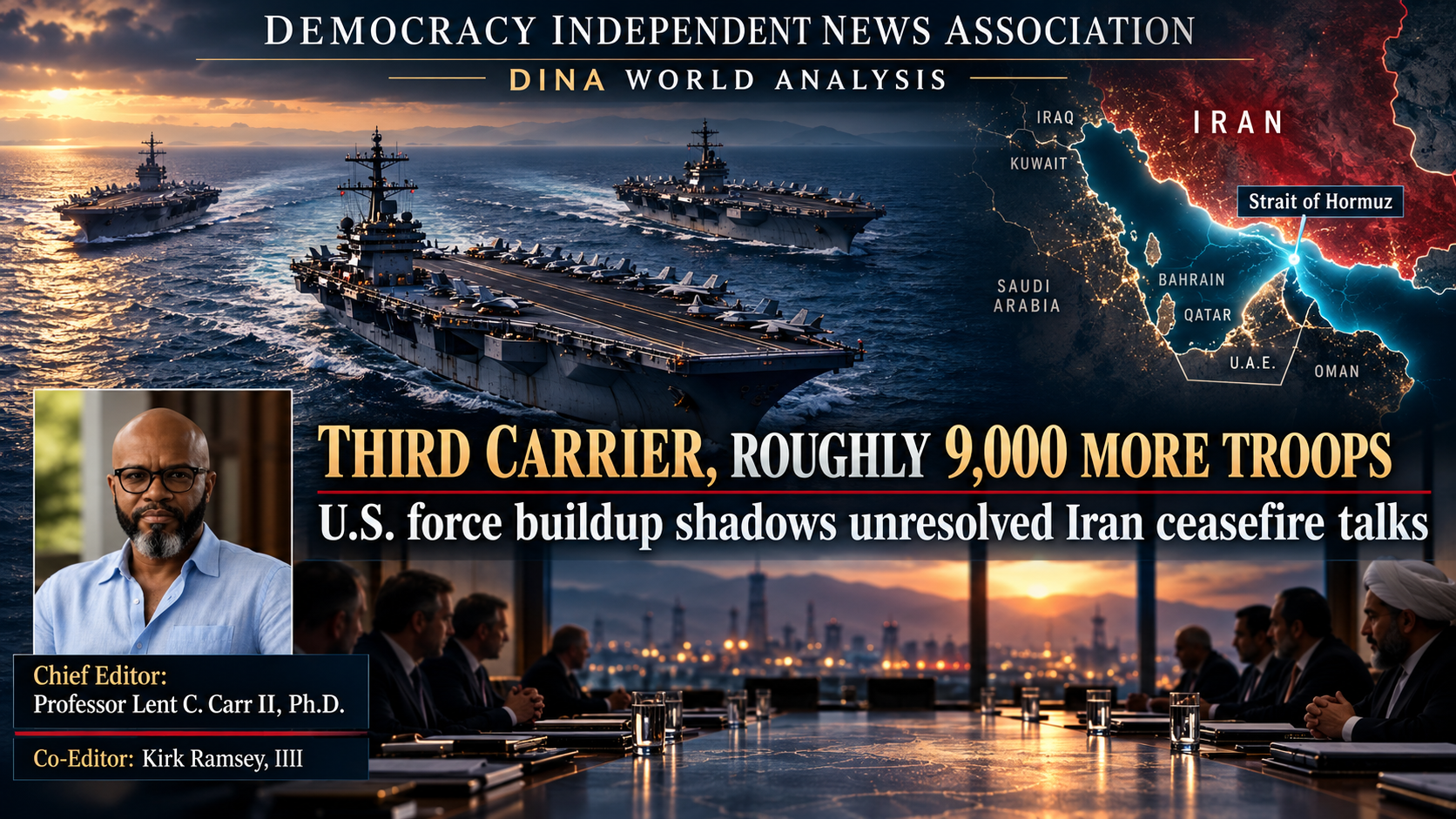
WASHINGTON AND THE PERSIAN GULF — The United States is sending roughly 9,000 additional sailors and Marines toward the Middle East aboard the USS Theodore Roosevelt carrier strike group and the USS Makin Island amphibious readiness group, according to The Associated Press, which attributed the deployment details to a U.S. official who was not authorized to speak publicly.
The ships carry more than 7,000 sailors and 2,000 Marines. If the Theodore Roosevelt overlaps with the USS George H.W. Bush and USS George Washington, three American carrier groups could be in the region by late October. AP reported that the broader naval presence could exceed 20,000 sailors and Marines and include hundreds of aircraft. The USS Boxer amphibious group is already in the region.
Deterrence or preparation for another escalation
A force deployment can serve several purposes at once: protect U.S. personnel, reassure allies, enforce maritime operations, strengthen leverage at the negotiating table or prepare for strikes. The administration has not publicly provided a detailed mission statement matching the scale of the reported movement.
President Donald Trump has said additional bombing after the November 3 midterms is possible and has rejected Iran’s latest truce proposal as insufficient.
That combination creates a dangerous ambiguity. Military commanders gain options while the public, Congress and regional civilians are left to infer the objective. The absence of a clear endpoint increases the risk of mission expansion, accidental confrontation and decisions driven by political timing rather than a defined national-security strategy.
A diplomatic channel is still open
Reuters reported September 30 that Iranian Foreign Minister Abbas Araqchi received U.S. feedback through Qatari mediators on a seven-day trust-building plan. The proposal seeks a return to an expanded version of a June memorandum covering Iran’s nuclear program and the Strait of Hormuz. According to an official briefed on the talks, the main dispute concerns the sequence of steps rather than the plan’s broad components.
The existence of that channel matters. It means the choice is not simply attack or surrender. Negotiators are debating who acts first, how the strait reopens, what nuclear measures are verified and how each side demonstrates compliance. Those are difficult questions, but they are precisely the questions diplomacy is designed to answer before more families are placed in danger.
Markets and civilians are already paying
The confrontation is affecting shipping, energy prices and regional markets. Reuters reported Friday that major stock indexes in Dubai and Abu Dhabi extended their declines as stalled U.S.-Iran talks and reports of a military buildup weighed on investors. The Strait of Hormuz remains central to global energy flows, making miscalculation capable of reaching household budgets far beyond the region.
The human stakes are greater than the market reaction. More military assets mean more service members exposed to attack and more civilians vulnerable if strikes expand.
DINA rejects the idea that questioning escalation is weakness. Democratic accountability requires leaders to explain the threat, the law, the objective, the civilian-protection plan, the cost and the conditions for ending military action.
Unverified allegations must not become a shortcut to war
The administration has suggested possible Iranian links to recent security incidents involving a FlyDubai flight and a U.S.-used air base in Britain. Public reporting has not established the evidence needed to attribute those incidents conclusively to Tehran.
Investigations should proceed, and any responsible party should be held accountable. But allegations should not become a substitute for proof or a pretext for escalation before facts are established.
DINA legal and political analysis
A Democratic foreign-policy standard should combine defense with restraint: protect U.S. personnel, demand verifiable nuclear limits, keep the Strait of Hormuz open, support allies and pursue the Qatar channel with measurable reciprocal steps.
Congress should require a classified and public explanation of the deployment, examine the legal authority for further strikes, insist on civilian-harm safeguards and debate any open-ended expansion of hostilities. The executive branch’s ability to position forces does not eliminate Congress’s constitutional responsibility over war powers, appropriations and oversight.
The concentration of military power may deter Iran. It may also create momentum toward using that power. The administration must prove that its strategy is designed to prevent a wider war, not merely to postpone a decision until after an election.
Sources and attribution
- Associated Press — U.S. ship and personnel deployment report
- Reuters — Qatar-mediated U.S.–Iran feedback
- Reuters — market reaction and diplomatic deadlock
- Associated Press — allegations and asymmetric warfare explainer
Source note: Deployment details attributed to an unnamed official remain subject to on-record Defense Department confirmation. DINA treats alleged Iranian involvement in separate security incidents as unproven unless investigators release evidence.