
Breaking news · Yemen · Bab el-Mandeb · U.S.–Iran conflict · Maritime security · DINA analysis
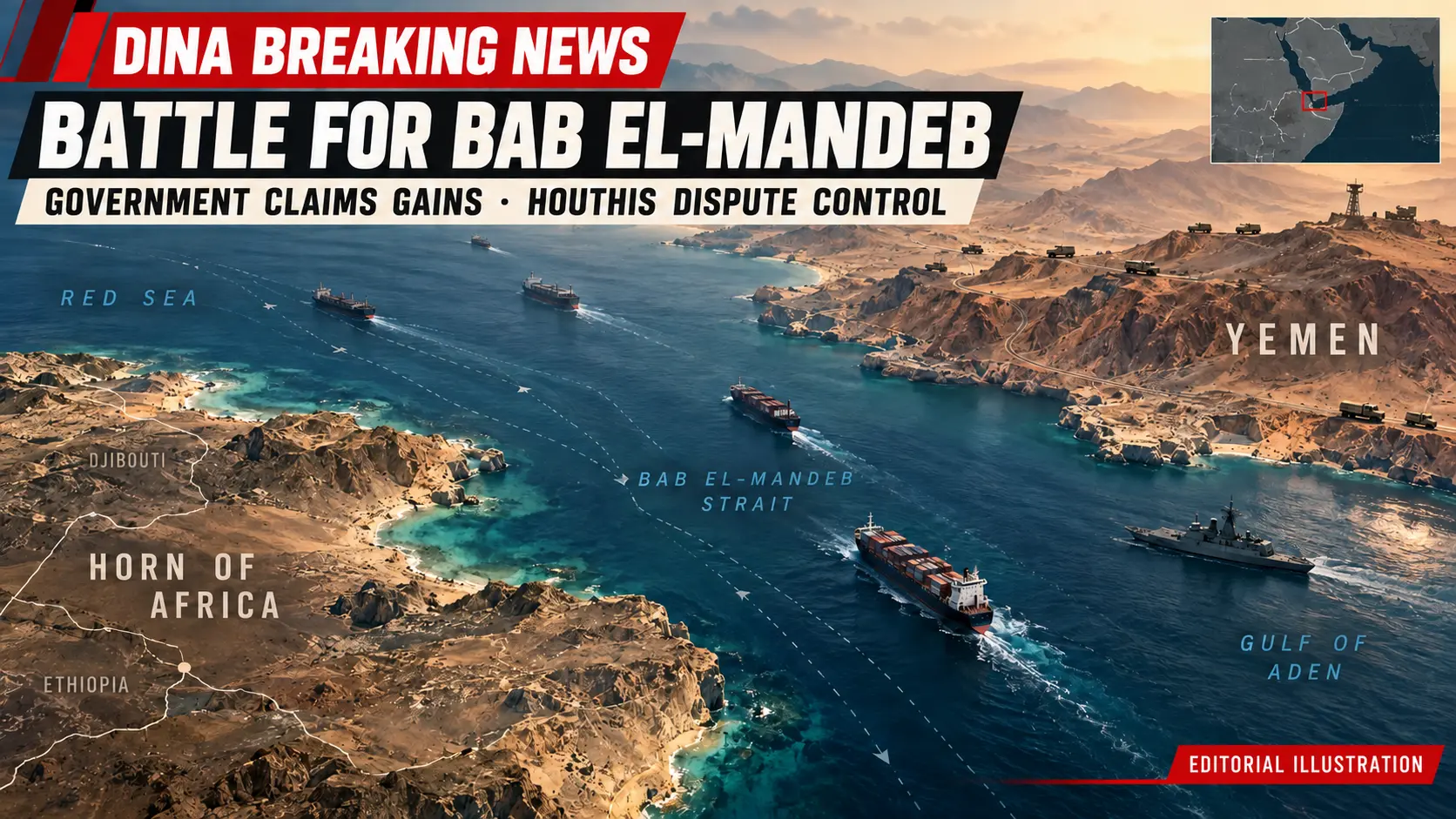
ADEN, Yemen — Saudi-backed Yemeni government forces say they have retaken coastal positions around the Bab el-Mandeb Strait and the port city of Mocha from Iran-aligned Houthi forces, a potentially significant reversal at one of the world's most important shipping chokepoints.
The Houthis dispute the government's account. Reuters said it could not independently verify the extent of the territorial gains, and the group said reports of its retreat were baseless. DINA therefore reports the battlefield control as a government claim—not an established map of who holds each location.
Saudi Arabia separately confirmed Tuesday that coalition naval forces carried out an operation in Yemen's Hodeidah governorate. Coalition spokesman Maj. Gen. Turki al-Maliki said the operation destroyed Houthi weapons depots, facilities holding explosive-laden boats and naval mines, and thwarted an imminent threat to southern Red Sea waterways. Those descriptions and the claim of an imminent attack are Saudi coalition assertions that have not been independently verified.
What happened
Yemen's internationally recognized government announced a nationwide offensive Sunday after Houthi forces had gained territory along the Red Sea coast and around Bab el-Mandeb. Presidential Leadership Council chair Rashad al-Alimi said government forces would continue operations until state authority was restored across the country.
By Monday, government and military sources said Saudi-backed forces had retaken Dhubab, positions at the mouth of the strait and Mocha, reaching the city's outskirts under heavy Saudi air cover. Yemen's Defense Ministry later said Mocha had fallen. The Houthis continued to claim battlefield gains elsewhere, including around Taiz, and disputed their opponents' coastal narrative.
Confirmed facts, official claims and unresolved questions
- Confirmed official action: Yemen's Presidential Leadership Council announced the new offensive October 4.
- Confirmed Saudi statement: the coalition acknowledged a naval operation in Hodeidah on October 6.
- Government claim: Saudi-backed forces retook Mocha, Dhubab and positions around Bab el-Mandeb.
- Houthi position: the group disputes the scale of those gains and says it remains in control of its battlefield advances.
- Not independently established: the precise front line, the condition of captured infrastructure, the number of combatants or civilians killed in the latest operations, and whether shipping through the strait is materially safer.
- Separately alleged: the Houthis said they attacked airports, oil infrastructure and military sites in Saudi Arabia. Saudi aviation authorities confirmed attacks at Jazan and Najran airports that caused three minor injuries, but Riyadh and Aramco attacks remain disputed or unverified.
Why Bab el-Mandeb matters
Bab el-Mandeb connects the Red Sea and the Gulf of Aden, carrying commercial traffic between the Indian Ocean and the Suez Canal. Control of coastline near the strait can affect shipping security even without physical possession of the entire waterway: land-based missiles, drones, mines and explosive boats can threaten vessels from a distance.
The stakes are higher because Iran's disruption of the Strait of Hormuz has already shaken global energy markets. Any sustained threat at Bab el-Mandeb creates pressure at a second maritime chokepoint, affecting oil, fuel, food and container traffic.
Government control of coastal towns would not, by itself, eliminate that threat. Mobile launchers, drones, mines and forces operating farther inland could still reach commercial routes. Independent evidence about weapons sites, cleared waters and safe navigation is more important than a victory declaration.
The humanitarian emergency is worsening
The renewed campaign is unfolding inside one of the world's gravest humanitarian crises. The Associated Press reported that the International Organization for Migration counted more than 184,000 people displaced since the latest war resumed, while the World Health Organization reported at least 959 people killed and more than 4,200 wounded in the escalation.
Those aggregate figures require continuing verification and do not assign every casualty to a particular party. They nevertheless show that territorial gains are being measured against widespread civilian loss, displacement and additional pressure on Yemen's fragile health system.
All parties are bound to distinguish civilians from military objectives, take feasible precautions and facilitate humanitarian relief. Coalition descriptions of a weapons site do not remove the obligation to disclose target-selection standards and investigate civilian harm.
U.S. role and accountability
Secretary of State Marco Rubio said Saudi Arabia has the right to defend itself and that Yemeni government forces would seek to retake lost territory. News organizations report that Washington is providing intelligence support. The U.S. government should disclose the legal authority, limits and safeguards governing any intelligence or operational assistance.
If U.S.-supplied information contributes to targeting, Congress and the public need a record of how civilian-harm risk is assessed, what end-use monitoring applies and whether assistance can be suspended after credible allegations of unlawful strikes.
DINA analysis: a strategic gain is not yet a verified security outcome
DINA analysis: The government's claimed coastal advance may reduce immediate Houthi control near Bab el-Mandeb, but the battlefield picture remains contested. The responsible conclusion is narrower: the Saudi-backed coalition has launched a major offensive and says it has reversed recent Houthi gains; independent verification of the map and the durability of those gains is still missing.
The strongest accountability question is whether the campaign protects navigation without transferring the danger to civilians. A military operation that clears a shipping lane while displacing communities, damaging ports needed for food imports or leaving unexploded weapons behind cannot be judged only by territory captured.
The conflict is also becoming more tightly bound to the U.S.–Iran war. That raises the risk that Yemen's internal struggle will be treated primarily as a proxy battlefield, pushing civilian protection, political negotiations and reconstruction further from view.
Urgent follow-up and records requests
- Obtain time-stamped satellite imagery and independently geolocated video for Mocha, Dhubab and the Bab el-Mandeb approaches.
- Request the Yemeni Defense Ministry's operational map, casualty report and list of captured facilities.
- Seek the Saudi coalition's target list, battle-damage assessment and civilian-harm review for the Hodeidah naval operation.
- Request maritime warnings, mine-clearance notices and incident logs from regional navigation authorities.
- Obtain IOM displacement data and WHO casualty methodology by district and reporting period.
- Ask the U.S. State Department and Defense Department to disclose the legal basis, scope and safeguards for intelligence support.
- Track access to Mocha port, roads to Taiz, hospitals, water systems and humanitarian supply routes.
- Seek independent interviews with residents, shipping crews and aid organizations before declaring the strait secure.
Sources
- Office of Yemen's Presidential Leadership Council — Announcement of military operations
- Saudi Press Agency — Coalition confirms naval operation in Hodeidah
- Reuters — Yemeni government launches offensive
- Reuters report — Government claims gains near Bab el-Mandeb; Houthis dispute them
- Associated Press — Saudi-backed forces claim coastal advances
- Associated Press — Yemen escalation, displacement and humanitarian context
- U.S. Department of State — Secretary Rubio remarks on Saudi and Yemeni operations