
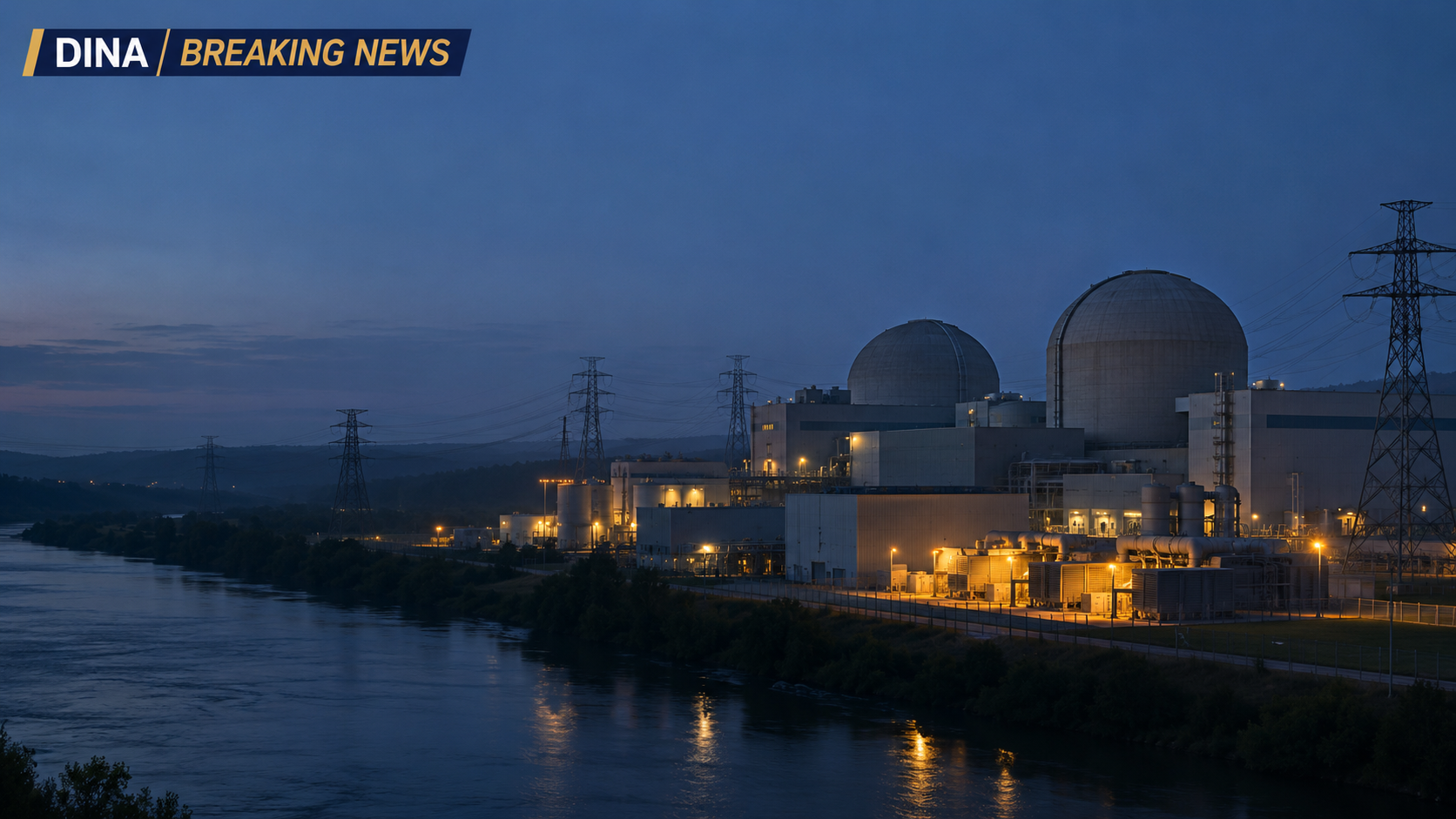
Latest update — November 8, 2026, 9:13 p.m. ET: External electricity has been restored to the occupied Zaporizhzhia Nuclear Power Plant after an outage of about 15 hours. Ukraine's state nuclear operator Energoatom said the 330-kilovolt Ferosplavna-1 line was switched on at 5:41 p.m. Kyiv time. The International Atomic Energy Agency subsequently said it had been informed that off-site power had returned.
Verification status: Energoatom's primary statement establishes the reconnection time and line. The IAEA independently confirmed that the plant again had off-site power. The public record does not establish the outage's cause or location, confirm that the main 750-kilovolt Dniprovska line is available, or provide a complete contemporaneous radiation dataset. Restoration reduces immediate diesel dependence; it does not eliminate the plant's single-line vulnerability.
ZAPORIZHZHIA REGION, Ukraine — November 8, 2026: Europe's largest nuclear power plant has regained external electricity after its only operating grid line disconnected early Sunday and forced nuclear-safety equipment onto emergency diesel generation.
The plant lost the Ferosplavna-1 connection at 2:36 a.m. Kyiv time. Energoatom said the line was re-energized at 5:41 p.m., making the interruption roughly 15 hours and five minutes. The IAEA's later confirmation establishes the end of diesel-only operation but does not identify what caused the disconnection or where it occurred.
Energoatom said the 330-kilovolt Ferosplavna-1 line disconnected at 2:36 a.m. Kyiv time and an automatic attempt to reconnect it failed. The company said the plant's own electricity needs were being met exclusively by backup diesel generators. The Russian-installed administration separately said automatic protection disconnected the line after damage and that generators were supplying equipment required for safe operation.
The IAEA's initial confirmation established the core outage but not who or what caused it. The agency said the cause and location remained unknown. Its estimate of roughly two weeks of fuel applied to a limited number of emergency generators; the public updates did not identify the operating units, reserve units, fuel burn rate, equipment condition or precise fuel inventory.
The Russian-installed administration said radiation levels at the plant and in its surveillance zone were normal. DINA has not found a contemporaneous IAEA or Ukrainian regulator reading independently confirming that assertion. There is no verified report of a reactor accident or radioactive release.
Why an external-power loss matters
The plant's six reactors are shut down and are not generating electricity, but shutdown does not end the need for power. Cooling, monitoring, control, water-management and spent-fuel systems still require electricity. Diesel generators are designed to bridge an outage, yet prolonged dependence makes safety contingent on machinery, fuel, maintenance and access for repairs in an active war zone.
Energoatom described this as the plant's 16th complete loss of external power in 2026. That annual count is the Ukrainian operator's figure and has not yet been reconciled against an IAEA event ledger. The IAEA said in September that the site had suffered repeated off-site power losses and warned that stable electricity and replenished diesel reserves were essential after an earlier outage depleted fuel stocks.
The Ferosplavna-1 line had been restored on September 7 following an IAEA-brokered localized ceasefire. At that time, the IAEA said the plant's main 750-kilovolt Dniprovska line remained unavailable and emphasized that the restored connection did not eliminate the site's vulnerability.
What is confirmed, attributed and unresolved
- Confirmed restoration: Energoatom says Ferosplavna-1 was switched on at 5:41 p.m. Kyiv time, and the IAEA confirmed that off-site power returned.
- Confirmed outage chronology: The line disconnected at 2:36 a.m.; emergency diesel generators carried the plant's safety load during the roughly 15-hour interruption.
- Confirmed operating-margin estimate during the outage: The IAEA said available fuel could operate a limited number of emergency generators for about two weeks. The agency did not publicly identify the unit roster, burn rate or precise inventory.
- Russian-installed administration's claim: Radiation levels remain normal. DINA has not found contemporaneous independent radiation measurements confirming that assertion.
- Energoatom's claim: This is the 16th complete external-power loss at the plant in 2026. The IAEA has not yet publicly reconciled that count.
- Not established: The fault's cause and location; whether combat, sabotage, technical failure or another event was responsible; the full generator condition; or whether a second independent external line is operational.
- No verified release: Switching to generators is a serious loss of safety margin, not proof that cooling has failed or radiation has escaped.
Why it matters
Restoring one external line removes the immediate dependence on emergency generators, but it does not create a robust supply. Each transition to diesel power adds mechanical and logistical exposure while fighting can delay line inspection, demining, repair crews and fuel delivery. The most urgent public-interest question is whether the plant has a genuinely independent second connection and how quickly the restored line can be repaired again if it fails.
The incident also arrives before U.S.-brokered Russia–Ukraine talks expected in Abu Dhabi on November 10 and 11. A limited nuclear-safety arrangement—protecting power lines, repair corridors and fuel deliveries—could be pursued separately from broader war negotiations because both sides face catastrophic consequences from a failure at the plant.
DINA analysis
Independent accountability analysis: The restoration is a material reduction in immediate risk, not proof that the underlying vulnerability has been fixed. The agreement between Ukrainian and Russian-side plant authorities on the loss of power made the outage credible; Energoatom's restoration notice and the IAEA confirmation establish that off-site supply returned. Neither record makes either side's attribution or broader political conclusion self-proving. A defensible account of the failure still requires physical inspection, protection-system logs, line telemetry, geolocated damage documentation and IAEA access.
The IAEA's two-week fuel estimate narrowed one uncertainty during the blackout without eliminating the risk. The restoration provides an opportunity to inspect every generator used, replenish diesel, disclose any faults and document the line failure before another outage occurs. The immediate accountability test is transparency about how many generators started, how many remain in reserve, the verified on-site fuel inventory, cooling-water status, spent-fuel temperatures and the status of the second external connection.
The larger lesson is institutional: nuclear safety cannot be reduced to competing wartime statements. The IAEA's permanent presence gives it a unique role in publishing prompt, technically specific updates that separate measured conditions from the parties' accusations.
Strongest accountability angle
Both sides should permit the IAEA to verify the restored line, generator configuration, diesel reserve, radiation readings and failure point, then publish the non-sensitive findings. If military activity caused the outage, the responsible chain of command and weapon should be identified. If a technical failure caused it, maintenance and equipment records should be released. The public should not have to infer nuclear-safety conditions from anonymous or politically controlled channels.
Urgent follow-up and records to seek
- The IAEA team's time-stamped confirmation of the outage, generator status, radiation measurements, cooling parameters and diesel inventory.
- Energoatom and plant control-room event logs, protection-relay records, line telemetry and the failed automatic-reconnection record for Ferosplavna-1.
- Geolocated inspection photographs and engineering assessment identifying the damaged span, failure mechanism and repair requirements.
- The current emergency-diesel roster: units started, units operating, reserves, faults, maintenance status, fuel burn rate and replenishment plan.
- Communications among the IAEA, Ukrainian grid operator, Energoatom, Rosatom, Russian-installed management and military authorities about repair access and a localized ceasefire.
- A reconciled 2026 outage ledger showing the start, duration, cause, generator performance, fuel deliveries and restoration record for every external-power loss.
- Radiation-monitoring data from independent stations, not only summary assurances, plus any abnormal-event notification submitted under international nuclear-safety conventions.
Sources
- Energoatom — primary confirmation that Ferosplavna-1 was switched on at 5:41 p.m. Kyiv time, November 8, 2026
- Reuters — IAEA confirmation that external power returned and outage context, November 8, 2026
- Energoatom — loss of Ferosplavna-1 and diesel-generator operation, November 8, 2026
- Ukrinform — English-language report of Energoatom's statement, November 8, 2026
- IAEA Update 366 mirror — September restoration, diesel vulnerability and nuclear-safety context, September 11, 2026
- DINA — prior reporting on power-line repair access and the plant's safety margin, October 15, 2026
Verification cutoff: November 8, 2026, 9:13 p.m. Eastern. DINA compared Energoatom's primary outage and restoration statements, the IAEA's confirmations as carried by Reuters and the Russian-installed administration's account. The record confirms that external power returned after about 15 hours, but the fault's cause and location and the status of a second independent external connection remain unresolved. This report will require another update if the line fails again, the cause is established, radiation measurements materially change, or the plant regains a second external connection.