
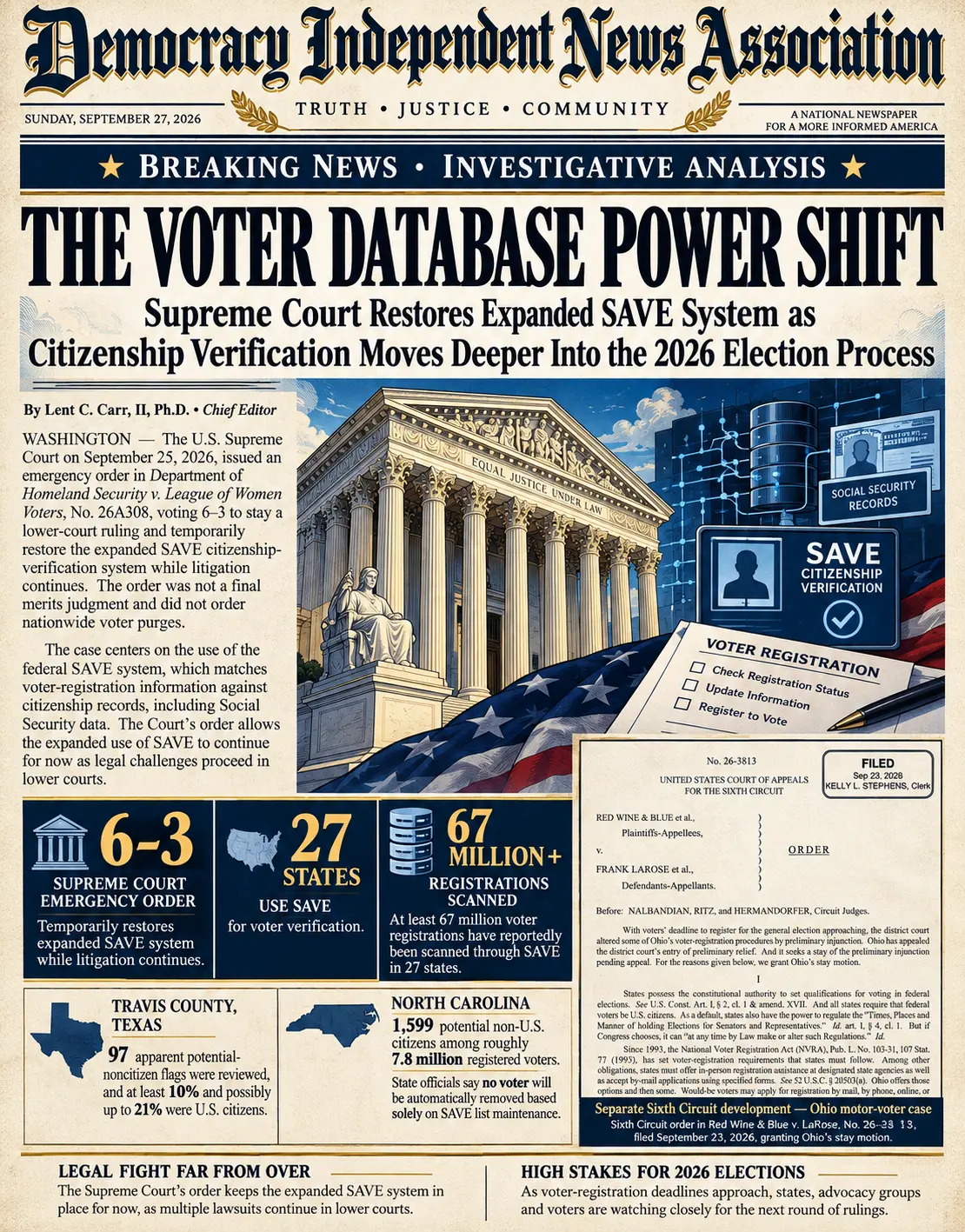
WASHINGTON — The U.S. Supreme Court on September 25, 2026, issued an emergency order in Department of Homeland Security v. League of Women Voters, No. 26A308, voting 6–3 to stay a lower-court ruling and temporarily restore the expanded SAVE citizenship-verification system while litigation continues.
The order was not a final judgment on the merits. It did not direct a nationwide purge of voter rolls. What it did was consequential enough: it allowed the federal government to resume sharing and processing a broader range of personal data for voter-registration checks while the appeal proceeds.
That makes this case about more than a database. It is about where election power now sits—between federal agencies that hold identity records, state officials who maintain voter lists, courts reviewing privacy and administrative-law claims, and voters who may be required to prove citizenship when government records do not agree.
What changed inside SAVE
SAVE—the Systematic Alien Verification for Entitlements program—was created in 1986 to help government agencies verify immigration or citizenship status for public-benefit programs. State election officials later began using it for voter verification.
In 2025, the Trump administration expanded the system in two important ways. First, SAVE began checking additional Social Security Administration records, including Social Security-number data. Second, agencies gained the ability to submit bulk searches instead of relying only on individual inquiries.
Under the modified process described by the Supreme Court, an agency submits identifying information to SAVE; Social Security records may be searched for a match; and the result is returned through the federal portal. If the system cannot confirm citizenship, the agency may contact the person and request additional proof before registration is accepted or maintained.
That shift turns a benefits-verification tool into a more powerful election-administration instrument. It can accelerate legitimate list maintenance. It can also multiply the consequences of stale, incomplete or mismatched records.
The Court’s emergency ruling
A federal district court had vacated the modifications after organizations including the League of Women Voters and the Electronic Privacy Information Center challenged the program under the Social Security Act, the Privacy Act and the Administrative Procedure Act. A divided panel of the U.S. Court of Appeals for the District of Columbia Circuit declined to pause that ruling.
The Supreme Court granted the federal government’s request for a stay. The unsigned majority concluded that the challengers likely had standing but that their statutory claims were unlikely to succeed. It relied heavily on later federal legislation authorizing the sharing of citizenship and immigration-status information among government agencies.
The majority also weighed the timing of the 2026 elections. Federal law generally requires states to finish systematic programs for removing ineligible voters no later than 90 days before a federal election. The Court emphasized, however, that individualized inquiries can still occur during that period. The separate question of how the 90-day rule applies to programs aimed at noncitizens remains before the Court in another case.
The stay lasts through the D.C. Circuit appeal and any timely petition for Supreme Court review. If review is denied, the stay ends automatically; if review is granted, it continues until the Court sends down its judgment.
The dissent’s warning
Justice Ketanji Brown Jackson dissented, joined by Justices Sonia Sotomayor and Elena Kagan. The dissent argued that the Court intervened without full briefing or oral argument and failed to give adequate weight to privacy concerns and the risk of lawful voters being harmed by inaccurate records.
The Court’s own order acknowledges one naturalized citizen whose Social Security record did not accurately reflect her citizenship. That is the system’s central vulnerability: a database may fail to confirm citizenship even when the voter is a citizen. A “no confirmation” response is not the same as proof of ineligibility.
Naturalized citizens are particularly exposed when older federal records lag behind a change in status. Name changes, data-entry errors, partial identifiers and mismatched birth dates can also produce false uncertainty. A responsible election system must distinguish a lead requiring review from evidence sufficient to cancel a registration.
What the ruling means in North Carolina
North Carolina State Board of Elections Executive Director Sam Hayes welcomed the decision and said SAVE is one of the tools available to detect ineligible registrations. He also stated that the system recently helped identify more than 35,000 deceased registrants.
Most important for lawful voters, Hayes said no voter will be automatically removed as a result of list maintenance using the database. That assurance should be treated as an enforceable standard of administration, not a public-relations footnote.
Database output must begin a documented process—not end one. Notice should be clear. Voters must have a practical opportunity to correct records. County boards must preserve an audit trail showing the information reviewed, the communications sent and the legal basis for any final action.
What voters should do now
The Court’s order does not require citizens to panic. It does make routine verification more important.
- Check your registration status. North Carolina’s official Voter Search shows status, polling place, districts, voter history and available sample ballots.
- Review your name and address. If the record is wrong, use the State Board’s official instructions to update it or contact the county board of elections.
- Keep citizenship documents secure. Naturalized citizens who receive a notice should respond promptly, retain copies and record the date and method of submission.
- Ask for the legal basis in writing. A database mismatch alone should not be treated as a final finding.
- Register by the deadline—or during early voting if eligible. North Carolina explains both ordinary registration and same-day registration options on its official site.
The power shift
The most significant development is institutional. Election officials can now query an expanded federal system at scale, drawing on data collected for purposes far beyond elections. That concentrates new power in the connection between federal identity systems and state voter lists.
Power of that magnitude requires transparent rules. How are potential matches scored? Which records are current? What notice is sent? How much time does a voter receive? Who reviews contrary evidence? How are errors measured and publicly reported?
Those questions are not arguments against accurate voter rolls. They are the requirements of accurate voter rolls. Citizenship is a legal status; database matching is an administrative method. The method must never be confused with the status itself.
The legal fight is far from over
The Supreme Court has not finally approved every feature of the expanded program. The lower courts still must address the appeal, and separate litigation may define the limits of pre-election list maintenance.
For now, the Trump administration has regained a powerful verification tool. Election officials have regained access to expanded searches. Voters, civil-rights groups and journalists must now watch how that power is used in practice.
The democratic test will not be whether government can search more records. It will be whether government can protect election integrity without converting imperfect data into wrongful exclusion.
Primary authorities and voter resources
- Department of Homeland Security v. League of Women Voters, No. 26A308 — official Supreme Court order and dissent
- U.S. Citizenship and Immigration Services — SAVE program
- North Carolina State Board of Elections — statement on the Supreme Court ruling
- Check your North Carolina voter registration
- Update your North Carolina voter registration
- How to register to vote in North Carolina
This article is investigative legal analysis, not legal advice. It distinguishes the Supreme Court’s temporary stay from a final judgment on the merits.