
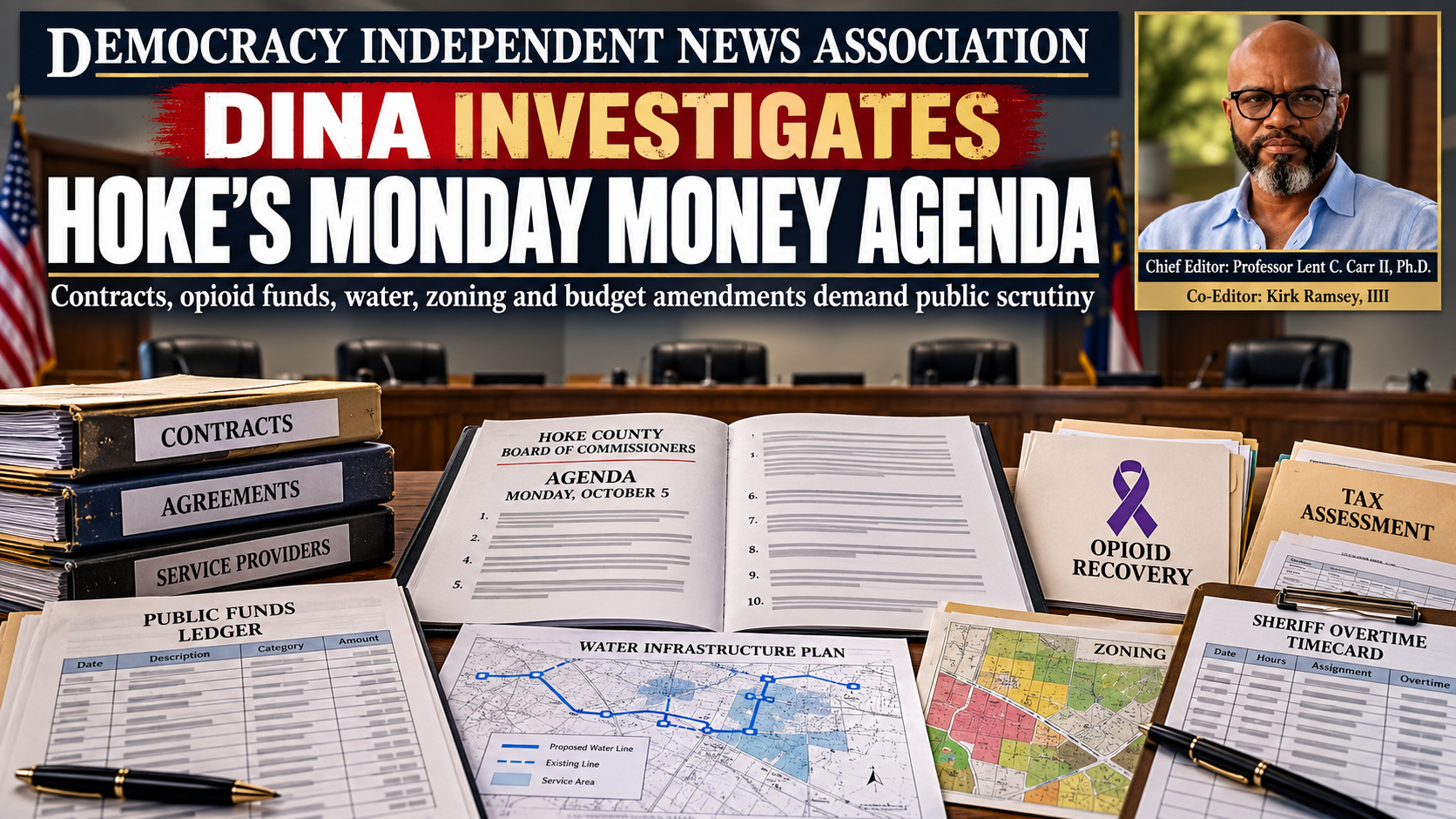
RAEFORD, N.C. — Hoke County commissioners will meet Monday at 7 p.m. with a compact agenda carrying consequences for taxpayers, neighborhoods, public health, law enforcement and future development. The two-page notice lists an information-technology services contract, Justice Center capital business, opioid-settlement spending, a tax-assessment contract amendment, an intergovernmental water agreement, budget amendments, sheriff overtime, an industrial-park waterline award and a rezoning request.
The meeting is properly visible on the county calendar, and the agenda was posted at 5 p.m. Friday. The problem is not that the public was told nothing. It is that the document tells residents what categories will be discussed without showing the amounts, vendors’ terms, performance requirements, funding sources or supporting analyses that would let ordinary people evaluate the decisions before commissioners vote.
A consent agenda carrying consequential business
Seven substantive matters are grouped under the consent agenda. These include the Gregory Technologies contract for backups, replication and managed services; Justice Center capital business; authorization to spend opioid-settlement funds; an amendment to the Tyler contract for tax assessment; a Fayetteville Public Works Commission intergovernmental water-services agreement that is still pending county-attorney approval; and unspecified finance budget amendments.
Consent agendas can make routine government efficient, but bundling significant contracts and public-money decisions can also reduce the discussion citizens hear unless a commissioner asks to pull an item for separate consideration.
The posted notice does not disclose the contract values, term lengths, procurement method, measurable deliverables or fiscal effect of those items. Nor did the Agenda Center show a public supporting packet alongside the agenda as of DINA’s Friday-evening review. Those omissions do not prove wrongdoing. They do create an information gap precisely when the public should be able to inspect the work its government is preparing to approve.
Rezoning and development questions
Commissioners will hold a public hearing on rezoning application RZ-26-6 for 8861 Fayetteville Road. The 0.505-acre parcel is now classified Residential Agricultural, or RA-20, and the applicant seeks Highway Commercial zoning. The Planning Board recommended approval on September 10, according to the agenda.
The public notice does not summarize the intended commercial use, traffic effects, driveway access, stormwater implications, compatibility with nearby homes or any conditions that might accompany approval.
A fair process requires more than allowing residents three minutes at a microphone. It requires giving them enough information early enough to understand what is changing around them. That is especially important along high-growth corridors where individual rezonings can accumulate into broader shifts in traffic, land values, infrastructure demand and neighborhood character.
Opioid funds, sheriff spending and public health
The board is also scheduled to consider a resolution authorizing opioid-settlement expenditures, sheriff budget amendments involving asset forfeiture and overtime, and the Health Department’s fiscal-year 2026 bad-debt write-off. Each category deserves a public explanation.
Opioid dollars should be tied to approved abatement strategies, measurable outcomes and transparent reporting. Asset-forfeiture and overtime funds should be presented with the amount, purpose and controls. A bad-debt write-off should explain how much is involved, what collection steps were taken and whether access to care will be affected.
DINA’s position is straightforward: public money should be traceable from appropriation to outcome. Communities damaged by addiction deserve proof that settlement dollars are reaching prevention, treatment, recovery and harm-reduction efforts rather than disappearing into an indistinct budget line.
Water infrastructure and meeting access
An industrial-park waterline extension is listed for acceptance of a tentative award, while the consent agenda separately includes the PWC water-services agreement. Water infrastructure can unlock development, but it can also shift long-term costs to ratepayers.
Before approval, residents should know the bid amount, competing bids, funding mix, service territory, capacity assumptions, ownership and maintenance obligations, and whether residential customers will subsidize industrial expansion.
Commissioners are also being asked to cancel the October 19 regular meeting. If approved, Monday’s session could become the board’s only regular meeting for most of October. That makes complete disclosure and meaningful discussion more important, not less.
DINA analysis
Democracy works best when government information is usable, not merely technically available. A title-only agenda arriving Friday evening gives working families one weekend to investigate contracts, land use and budget decisions. Insiders already familiar with the deals face no such disadvantage.
A Democratic public-interest standard should insist that agendas be accompanied by searchable staff reports, contract summaries, fiscal notes, maps and draft resolutions, with a visible change log when documents are added or revised.
The county can strengthen trust immediately: publish full agenda packets at least three business days before regular meetings; state the dollar amount and funding source beside every financial item; identify whether a matter will be discussed or voted upon; provide plain-language summaries; and archive the final documents with the minutes. Transparency is not a courtesy to taxpayers. It is part of their ownership of government.
Sources and public records
- Hoke County Board of Commissioners agenda for October 5, 2026
- Hoke County Agenda Center
- North Carolina General Statutes § 143-318.12 — public-meeting notice
Correction context: An earlier unpublished graphic concept referred to a missing agenda. DINA did not publish that concept. This report reflects the county’s 5 p.m. Friday posting and focuses on the information contained in—and absent from—the posted notice.