
Breaking news · Russia–Ukraine war · Moldova · DINA analysis
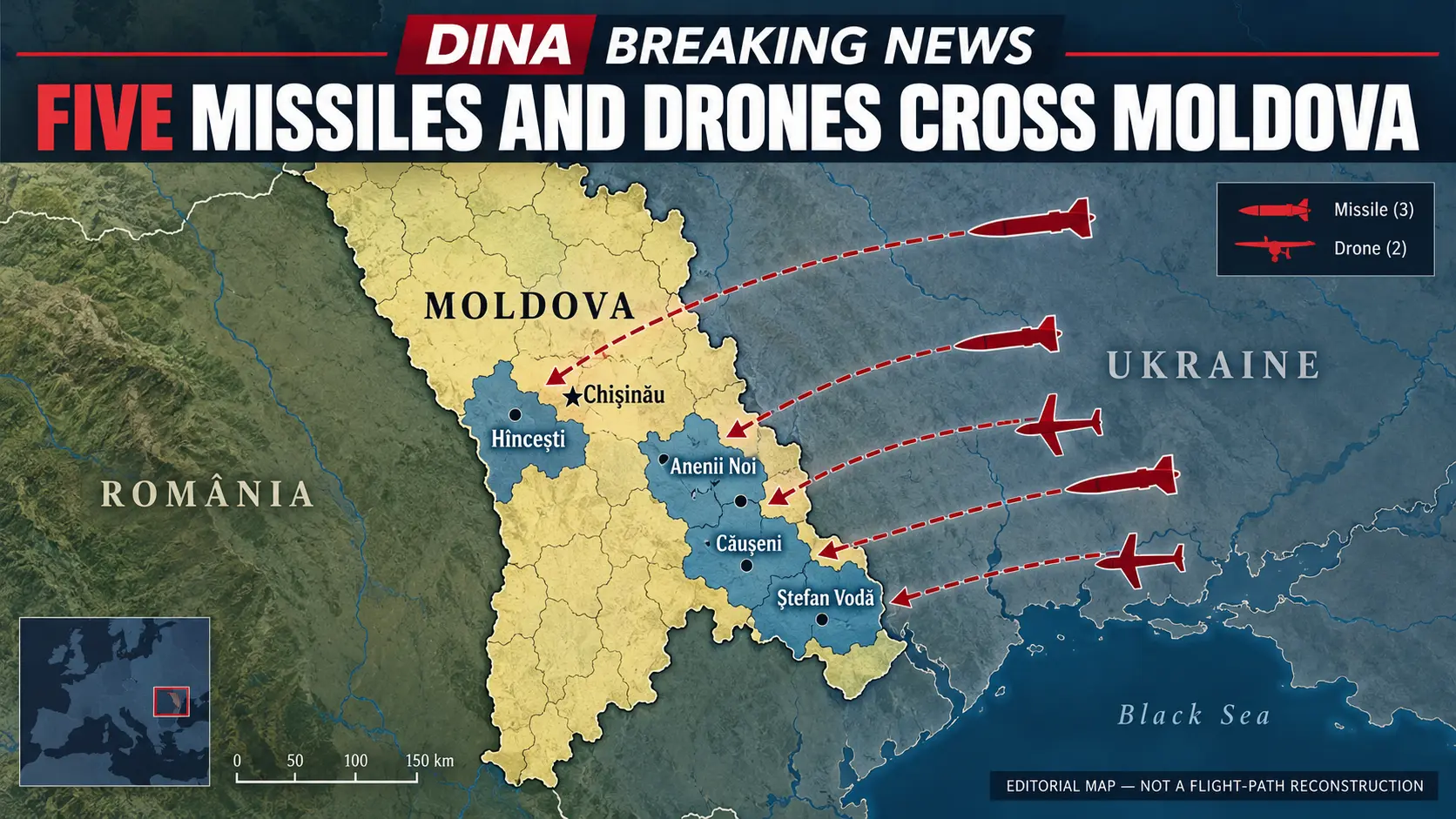
CHIȘINĂU, Moldova — Five Russian missiles and drones crossed Moldova's airspace within roughly 15 minutes Saturday morning and exploded near communities in four districts, according to Moldova's president and defense minister, extending the danger from Russia's attacks on neighboring Ukraine across the border of another European state.
Defense Minister Anatolie Nosatîi identified the objects as three missiles and two drones. Authorities said the incursions occurred between 7:45 and 8 a.m. local time and that fragments were found in Căușeni, Ștefan Vodă, Anenii Noi and Hîncești districts.
At Crocmaz in Ștefan Vodă district, an explosion in a vineyard near an agricultural facility ignited vegetation and damaged the building's windows. Another vegetation fire followed an explosion near Constantinovca in Căușeni district. Authorities reported no casualties in their initial assessment.
What Moldova says happened
President Maia Sandu said five Russian air-attack weapons, including missiles and drones, violated Moldovan airspace and exploded on Moldovan territory. She urged residents not to approach fragments or suspicious objects and to call emergency services.
Nosatîi said the country had confirmed five incidents and that teams were securing the affected areas. He acknowledged that Moldova does not yet possess interception systems capable of reliably defeating the latest fast, sophisticated drones, describing surveillance and air defense along the country's 1,212-kilometer border with Ukraine as a major resource challenge.
The incursions came during a large Russian attack on Ukraine. Ukraine's air force said Russia launched Banderol cruise missiles toward the Odesa region, which borders Moldova. The Associated Press reported Sandu's account and described the Banderol as a low-cost, jet-powered loitering munition used to pressure air defenses.
Confirmed facts, attribution and limits
- Confirmed by Moldovan authorities: Five objects crossed Moldovan airspace between approximately 7:45 and 8 a.m. on October 3.
- Confirmed by Moldova's defense minister: The objects were three missiles and two drones.
- Confirmed by authorities: Fragments were recovered in four districts; two vegetation fires and damaged windows were reported.
- Confirmed in the initial assessment: No casualties were reported.
- Moldova's allegation: President Sandu and other officials attributed the weapons to Russia and connected the incursions to Russia's attack on Ukraine.
- Not yet independently established: The exact model and flight path of every object, whether each explosion resulted from impact, malfunction or interception, and whether any location inside Moldova was deliberately targeted.
The evidence available Saturday morning supports reporting a serious cross-border incursion. It does not support asserting that Russia intentionally attacked Moldovan civilian communities. Debris examination, radar records and any Russian response remain important to determining the full sequence and intent.
Why it matters
Moldova is not a NATO member. Its small military and constitutional neutrality do not prevent spillover from a war immediately across its eastern border. Repeated unauthorized overflights expose residents to blast, falling debris and fire while forcing the government to decide how quickly it can afford to build detection and interception capacity.
The incident also has a wider European dimension. A weapon does not need to strike its intended target to create a sovereignty crisis. Each incursion risks miscalculation, tests regional warning networks and creates pressure for new military assistance to Moldova.
DINA analysis: escalation must be measured by effects, not rhetoric
DINA analysis: Saturday's most important fact is not a prediction of wider war; it is that five weapons crossed into Moldova in minutes and produced explosions in four districts. That is a material escalation in exposure for Moldovan civilians even without reported deaths.
The accountability standard should be exacting on all sides. Moldova should publish a time-stamped incident map, the legal status of each affected site, damage totals and debris-identification findings when operationally safe. Ukraine should share relevant radar and warning data. Russia should state whether its forces launched the recovered weapons, identify the intended targets and explain what precautions were taken to avoid Moldovan territory.
European partners should disclose what air-surveillance and civil-defense support they will provide, the cost, delivery timetable and rules governing any future interception over or near Moldovan territory. Defensive urgency should not eliminate public oversight.
Urgent follow-up and records
- Moldova's radar tracks, alert timeline and national emergency-notification log.
- Photographed and catalogued debris, serial markings and laboratory identification for all five objects.
- Police and fire-service incident reports from Crocmaz and Constantinovca.
- A complete property-damage assessment and any later medical reports.
- The Foreign Ministry's diplomatic note and any response from Russia.
- Procurement records and delivery schedules for Moldova's planned air-surveillance and counter-drone systems.