
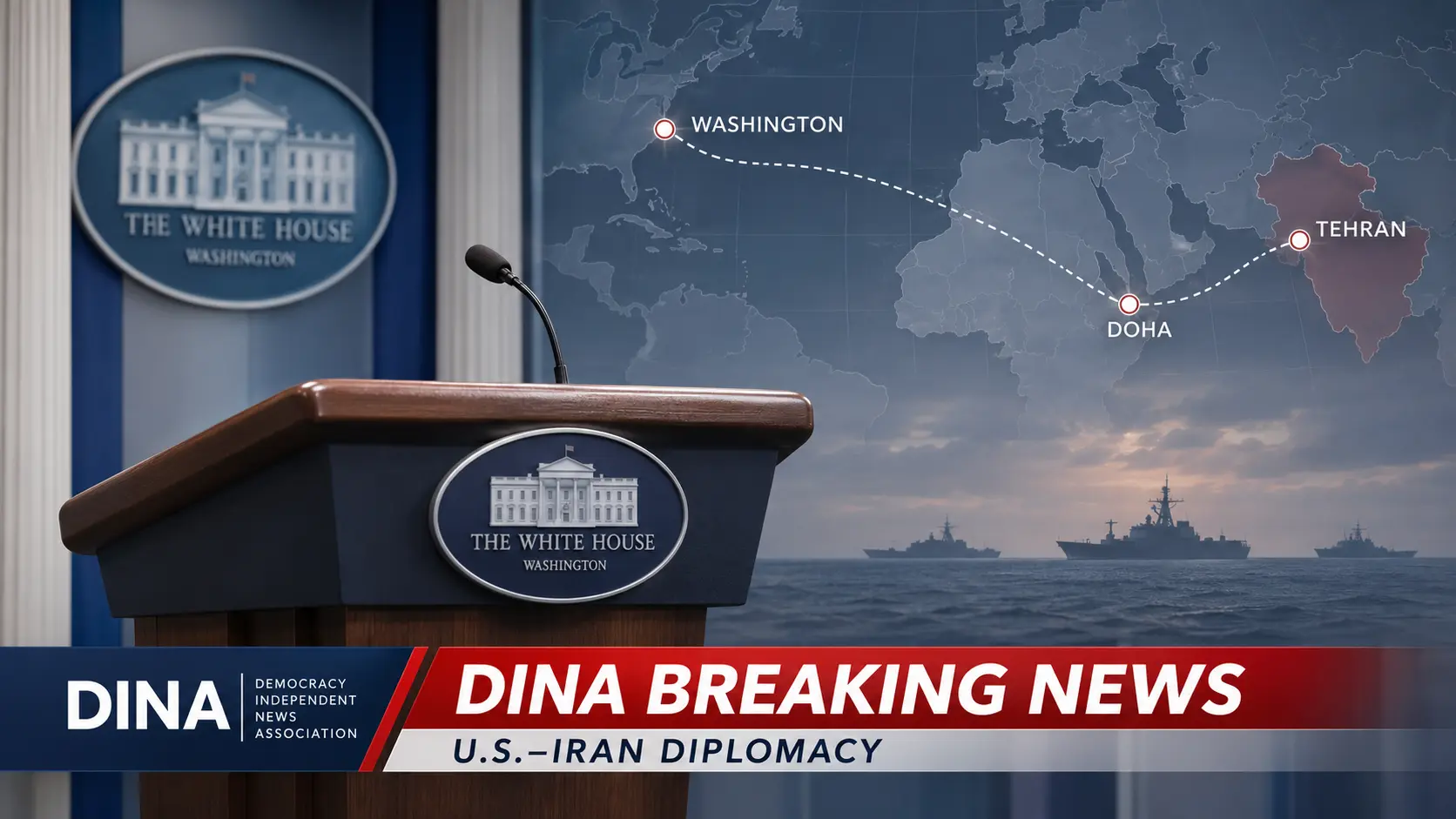
Breaking News · U.S.–Iran Conflict · White House · Qatar Mediation · Military Operations · War Powers · Diplomacy · Accountability · DINA Analysis
Verification status: President Donald Trump said on November 9 that the war with Iran is “militarily effectively over.” On November 10, Secretary of State Marco Rubio said the U.S. economic campaign is so damaging that there is “no need for major combat operations” at present, according to Reuters and AFP reporting from his Paris remarks after the G7 meeting. These are administration assessments—not a verified ceasefire, peace agreement or termination of U.S. military operations. No signed agreement or negotiating text had been announced by the White House, State Department, Qatar or Iran at DINA's update cutoff.
Breaking update — November 10, 2026, 10:15 a.m. Eastern: Secretary of State Marco Rubio said after the G7 foreign ministers' meeting in Paris that sanctions and the naval blockade are applying enough pressure that the United States sees no present need for major combat operations. Reuters and AFP independently reported the statement. The State Department had not posted an official transcript at DINA's cutoff. Rubio's assessment narrows the administration's immediate military posture; it does not end the blockade, limited operations or the armed conflict by law.
WASHINGTON / PARIS — November 9–10, 2026: Secretary of State Marco Rubio said Tuesday that the United States sees no need for major combat operations against Iran because its economic campaign is inflicting severe pressure, reinforcing President Donald Trump's statement that the conflict is “militarily effectively over.”
Trump's remarks were his clearest public claim yet that the eight-month conflict is moving away from major combat. But they did not end the war as a matter of law or military fact. The administration announced no ceasefire, no peace accord, no withdrawal order, no suspension of the U.S. naval blockade and no halt to limited strikes.
Associated Press reporting from the briefing room quoted Trump saying, “We're just keeping it the status quo,” and describing “positive momentum” without identifying agreed terms. He also said military action “doesn't seem to be a very necessary thing” but that the United States remained ready to act if conditions changed.
What happened
Trump met Monday with Sheikh Mohammed bin Abdulrahman Al-Thani, Qatar's prime minister and foreign minister. Qatar has been carrying proposals between Washington and Tehran and has urged both governments to prevent further escalation.
After the meeting, Trump entered the James S. Brady Press Briefing Room and characterized Iran's military as “decapitated.” He said the administration still wanted a long-term arrangement that would prevent Iran from developing a nuclear weapon.
The president did not identify any commitment made by Iran. Qatar had not published a readout of the White House meeting by DINA's cutoff. Iran had not announced acceptance of a ceasefire or nuclear framework.
Earlier Monday, Trump told Reuters that Qatar and Saudi Arabia wanted a peaceful solution, but he also said the United States was ready to resume strikes “anytime we want.” He said he was content, for now, with the U.S. naval blockade in the Strait of Hormuz.
Rubio shifts emphasis to economic pressure
After two days of G7 meetings in Paris, Rubio said the economic campaign was so “devastating” that major combat operations were unnecessary for now. Reuters reported that he pointed to sanctions and the blockade as restricting Iran's energy sales and said regional allies shared the assessment. AFP separately reported the core statement.
The remarks do not amount to an Iranian commitment, a mutual ceasefire or a Pentagon stand-down order. They describe the administration's present strategy: retain military capacity while relying on economic coercion. Iran disputes the legality of the blockade and has demanded sanctions relief, an end to attacks and other concessions as conditions for negotiations.
What remains unresolved
The conflict's operational posture has not matched a completed peace. AP reported that U.S. forces conducted limited strikes against Iranian air defenses at least twice during the previous week and disabled a commercial vessel Saturday after the United States accused it of trying to breach the blockade. Trump has also said U.S. planners identified additional infrastructure targets, including 38 bridges, if major strikes resume.
Those facts do not disprove diplomatic progress, but they show why the phrase “effectively over” cannot be treated as a confirmed end to hostilities. A war can enter a lower-intensity phase while blockades, targeted strikes and reciprocal attacks continue.
Qatar's foreign ministry said on November 3 that mediation was continuing in real time and that both sides were reviewing proposals, but its official spokesperson said then that no specific breakthrough could be announced. On November 5, Qatar's prime minister again stressed diplomatic initiatives, maritime navigation and the pursuit of a comprehensive agreement.
Why it matters
A genuine end to major combat could reduce the immediate danger to civilians, service members, Gulf shipping and energy markets. It could also create space for nuclear inspections and negotiations over Iran's enriched-uranium stockpile.
But an ambiguous declaration can create its own accountability problem. Military personnel, Congress, shipping operators and the public need to know whether the United States considers itself in an armed conflict, enforcing a blockade during negotiations or moving toward a formal ceasefire. Those categories carry different legal, operational and humanitarian consequences.
The distinction also matters for Congress. A presidential description of the war as effectively over does not answer whether U.S. forces remain in hostilities, what authority supports continuing operations or whether War Powers Resolution reporting and withdrawal obligations remain active.
DINA analysis
Independent accountability analysis: Trump's statement is materially important because it changes the administration's public description of the conflict after direct engagement with its principal mediator. It is not, by itself, evidence that the parties reached an enforceable agreement.
The verified record supports three conclusions. First, the president is signaling that he does not currently see a need for renewed large-scale attacks. Second, the United States is retaining military leverage, including a blockade and identified strike options. Third, no public text establishes what Iran would receive, what it must do, how compliance would be verified or when military measures would end.
Rubio's statement strengthens the first conclusion and sharpens the second: the administration is not presenting the lull as reciprocal de-escalation, but as a period in which economic pressure can pursue U.S. objectives without another major strike campaign. That distinction matters for civilian protection, humanitarian access, energy markets and congressional war-powers oversight.
The administration should therefore publish concrete milestones instead of relying on elastic phrases such as “status quo” and “effectively over.” If talks fail, those phrases can be reinterpreted. If talks succeed, the public deserves to know the commitments that turned a military pause into a durable settlement.
Strongest accountability angle
The most urgent question is whether the president's declaration changes U.S. orders and legal posture. The White House, Pentagon and Congress should disclose whether large-scale strike plans have been suspended, whether limited strikes remain authorized, what rules govern enforcement of the blockade and what event would trigger a formal end to hostilities.
Any agreement that exchanges blockade relief, frozen funds, inspections, shipping access or military restraint should be released in writing, with implementation dates and an independent verification mechanism. Secret or shifting terms would make it impossible for the public to assess compliance or responsibility for renewed conflict.
Urgent follow-up and records to seek
- The White House and Qatari readouts of Trump's November 9 meeting with Sheikh Mohammed bin Abdulrahman Al-Thani, including attendees and proposals exchanged.
- Any U.S.–Qatar, U.S.–Iran or multilateral draft framework, term sheet, memorandum, implementation schedule or side letter.
- Pentagon execute orders, fragmentary orders and legal guidance issued after Trump's “militarily effectively over” statement, with operationally sensitive details lawfully redacted.
- The current legal authority, geographic scope, rules of engagement and review process for the naval blockade and limited air-defense strikes.
- War Powers Resolution reports and congressional notifications identifying whether the administration still considers U.S. forces engaged in hostilities.
- The factual and legal basis for the claimed 38 bridge targets, including civilian-harm and protected-infrastructure assessments.
- Any International Atomic Energy Agency invitation, access agreement or inspection schedule connected to the negotiations.
Primary sources and reporting
- Associated Press — Trump says the Iran war is “militarily effectively over,” November 9, 2026
- Reuters — Trump says Qatar and Saudi Arabia favor diplomacy while U.S. strike options remain, November 9, 2026
- Reuters — Rubio says the economic campaign removes the present need for major combat operations, November 10, 2026
- Qatar Ministry of Foreign Affairs — mediation and proposal exchange, November 3, 2026
- Qatar Ministry of Foreign Affairs — diplomacy and maritime navigation, November 5, 2026
- White House — November 9 release summarizing Trump's earlier Iran and Strait of Hormuz remarks
- DINA — prior verified coverage of the negotiations and unresolved ceasefire terms
Verification cutoff: Updated November 10, 2026, 10:15 a.m. Eastern. DINA reviewed the president's remarks as reported from the White House briefing room, Reuters and AFP reporting of Rubio's Paris remarks, official Qatari mediation statements, the White House's November 9 release and DINA's prior sourced coverage. The State Department had not posted a transcript of Rubio's remarks at cutoff, so his November 10 statement is attributed to the independent reports. The associated image is a DINA editorial visualization; it does not depict the actual briefing, meeting, participants, military vessels, map, operation, document or item of evidence.