
Breaking News · Russia–Ukraine War · Territorial Integrity · Peace Negotiations · International Law · DINA Analysis
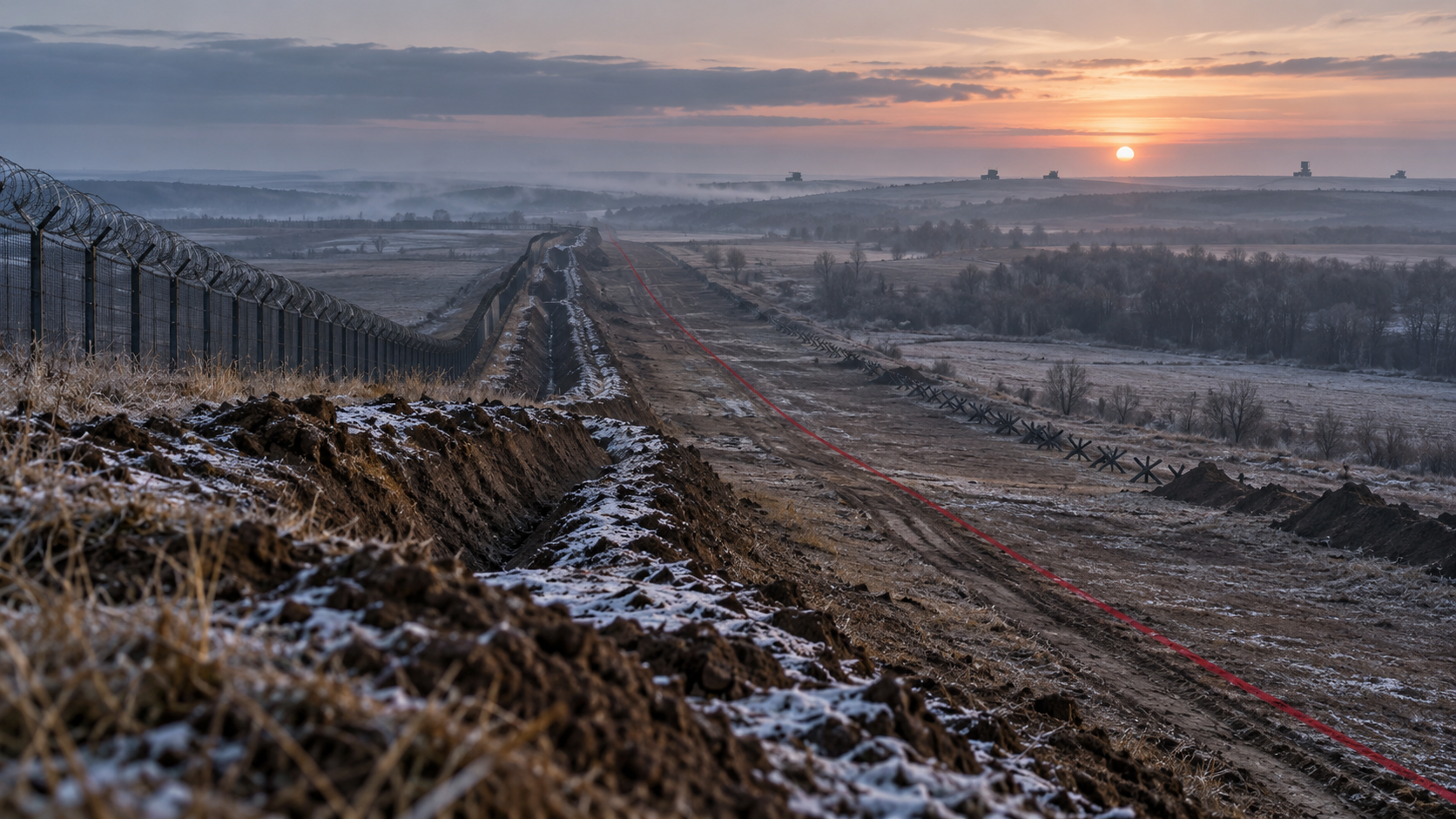
MOSCOW — October 16, 2026, 1:52 p.m. ET: Russian President Vladimir Putin said Friday that Russia is establishing a 660-kilometer — roughly 410-mile — “security zone” inside Ukraine and will not negotiate over it in any future peace talks, hardening Moscow's public territorial position as fighting and diplomatic tensions intensify.
Confirmed: Reuters reported Putin made the declaration in televised remarks during a visit to a military command post. Kremlin spokesperson Dmitry Peskov said the planned corridor would run along 660 kilometers of the border and claimed Russian forces already controlled about 70 percent of it.
Attributed Russian claims: The 70-percent figure, the military's progress and Putin's stated security rationale are Kremlin assertions. DINA has not independently verified the claimed control line. Russia did not publicly specify how deep the zone would extend into Ukraine, and Reuters reported that it would require taking territory in Ukraine's Sumy and Kharkiv regions.
What the declaration does not establish: Putin's statement does not change internationally recognized borders, prove legal title, create a negotiated settlement or establish that Ukraine and its partners accept the proposed zone. It is a unilateral wartime position announced by the leader of the invading state.
A new line Moscow says is beyond negotiation
Putin has previously argued that Russia needs a buffer or security zone along the frontier. Friday's statement went further by attaching a stated 660-kilometer extent to the plan and declaring the issue off-limits in future negotiations.
He said the order followed Ukraine's 2024–25 incursion into Russia's Kursk region and framed the operation as necessary to protect Russian border communities. That explanation is Moscow's position. Ukraine has said its cross-border and long-range operations are responses to Russia's invasion and continuing attacks.
Putin also claimed Russian forces still needed to capture a little more than 10 percent of Donetsk region and 16.5 percent of Zaporizhzhia region. Those figures likewise were not independently verified in the televised account. The proposed corridor in Sumy and Kharkiv is distinct from the four Ukrainian regions Moscow claimed to annex in 2022.
Ukraine's position and the legal baseline
Ukraine had not issued a specific public response to the 660-kilometer declaration at the time of publication. In a Friday address to European Union leaders, President Volodymyr Zelenskyy said Russia was conducting a winter campaign against Ukraine's energy system and urged partners to strengthen air defense.
The United Nations General Assembly has repeatedly affirmed Ukraine's sovereignty and territorial integrity within its internationally recognized borders. Its 2022 resolution on Russia's attempted annexations states that territorial acquisition resulting from the threat or use of force cannot be recognized as legal.
That legal baseline does not decide where forces are physically positioned on a given day. It does mean that military occupation and sovereign title are different questions, and that a Russian label such as “security zone” does not itself transfer sovereignty.
Why it matters
Declaring territory non-negotiable narrows the space for diplomacy before the parties have agreed on a ceasefire, security guarantees or borders. It also creates an open-ended military objective because Moscow has not disclosed the corridor's depth.
For civilians in Sumy and Kharkiv, the most immediate risk is not terminology but intensified combat, displacement and damage to homes and infrastructure. Any expanding military corridor also raises urgent questions about detention, filtration, forced movement, humanitarian access and treatment of residents in occupied areas.
DINA editorial analysis
This section is DINA's progressive editorial analysis, not a statement of independently established fact. A government cannot convert an invasion into a lawful border adjustment by renaming occupied land a security zone. Security concerns may be discussed in negotiations, but durable peace requires the consent of Ukraine and compliance with international law—not a unilateral veto announced from a military command post.
The declaration may also be designed to create a bargaining floor: define an expansive objective as already settled, then demand concessions elsewhere. Governments and news organizations should therefore avoid treating the 660-kilometer proposal or the 70-percent control claim as an agreed map.
Accountability must remain centered on people living in the affected regions. Any diplomatic framework should require public boundaries, civilian-protection guarantees, humanitarian access, independent monitoring and a lawful process for resolving territorial claims.
Strongest accountability questions
- What exact coordinates, width and communities does Russia include in the proposed 660-kilometer zone?
- What evidence supports Peskov's claim that 70 percent is under Russian control?
- Does Moscow intend a temporary military corridor, permanent occupation, annexation or another legal status?
- What orders govern treatment, evacuation, detention and property rights of civilians in affected Ukrainian communities?
- Will Russia permit independent humanitarian monitors and international investigators into areas it controls?
- How do the United States, European Union and Ukraine assess the announcement's effect on prospective negotiations?
Urgent records and follow-up requests
- Obtain the complete Kremlin video, transcript, operational maps and any written directive establishing the zone.
- Request geolocated control assessments from Ukraine, independent conflict monitors and commercial satellite providers.
- Seek civilian-displacement, detention and infrastructure-damage records for the affected Sumy and Kharkiv border communities.
- Request diplomatic cables, readouts and proposed negotiating texts addressing buffer zones or territorial exclusions.
- Track whether Russian occupation administrations, property registries or security services begin operating in newly claimed areas.
Sources
- Reuters — Putin says Russia is building a non-negotiable “security zone” in Ukraine, October 16, 2026
- Office of the President of Ukraine — address to the European Council, October 16, 2026
- United Nations General Assembly Resolution ES-11/4 — Territorial integrity of Ukraine