
Breaking news · International security · DINA analysis
SEOUL, South Korea — North Korea fired at least one ballistic missile from near its east coast early Saturday, turning an initially unidentified launch into a confirmed weapons test as tensions rise along the inter-Korean border.
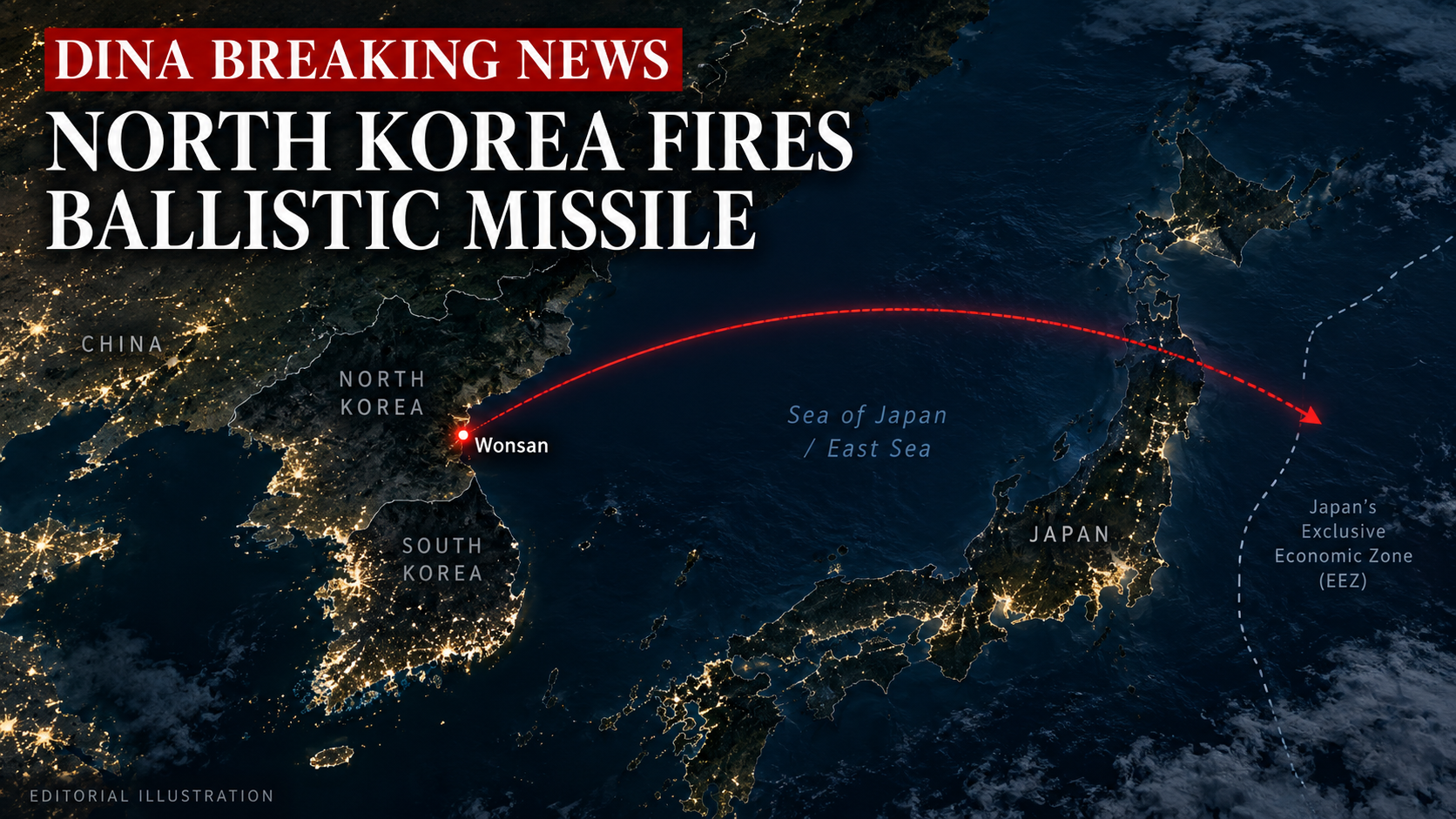
Japan's Defense Ministry and Cabinet Secretariat said the missile was launched at about 6:36 a.m. local time from near North Korea's east coast in a northeasterly direction. Japan assessed that it reached an altitude of roughly 90 kilometers, traveled about 680 kilometers and fell into the Sea of Japan outside Japan's exclusive economic zone. Japanese authorities said they had received no reports of damage to aircraft or vessels.
South Korea's Joint Chiefs of Staff said the launch originated in the Wonsan area and that the missile flew more than 700 kilometers. The South Korean and U.S. militaries were still analyzing the missile's precise characteristics. South Korea increased surveillance for possible additional launches and shared information with the United States and Japan.
Those measurements are not necessarily contradictory. National tracking systems can produce somewhat different early estimates while officials refine a missile's path, altitude and classification. North Korea had not publicly identified the missile or announced the purpose of the test when this report was published.
What is confirmed — and what remains unknown
- Confirmed: At least one ballistic missile was launched from the Wonsan-area east coast of North Korea toward open water.
- Confirmed: Japan assessed a roughly 90-kilometer maximum altitude and approximately 680-kilometer flight; South Korea reported a flight of more than 700 kilometers.
- Confirmed: The missile landed outside Japan's exclusive economic zone, and Japan reported no known damage to aircraft or vessels.
- Not yet confirmed: The missile model, warhead configuration, exact impact point, launcher type, intended target profile and whether the test involved a new system.
Japan said the launch violated relevant United Nations Security Council resolutions, lodged a protest with North Korea and convened its emergency response structure. Seoul's presidential national security office also called for Pyongyang to stop repeated ballistic launches.
A launch amid border tension
The test came during a sharp dispute over land-mine blasts near the Demilitarized Zone that injured South Korean soldiers in September. South Korea and the United Nations Command attributed responsibility to the North and said the incident violated the 1953 armistice. North Korea rejected Seoul's accusation and denied deliberately planting mines south of the military demarcation line.
That disagreement is separate from Saturday's launch. The missile test does not itself prove a connection to the mine incident, and North Korea had not publicly said that it was retaliation. The timing nevertheless adds pressure to a security environment already marked by North Korean weapons testing, border fortification and the collapse of sustained diplomacy.
Why it matters
A flight of roughly 680 to 700 kilometers is consistent with a short-range regional system, not an intercontinental trajectory. That does not make it routine or harmless. A missile in that range class can threaten military and civilian targets across much of South Korea and parts of Japan, depending on the system, payload and launch location.
The immediate public-safety risk appears contained: officials reported an open-water impact outside Japan's exclusive economic zone and no known damage. The strategic risk is cumulative. Repeated launches improve operational experience, test allied warning systems and normalize military signaling at a moment when diplomatic channels are weak.
DINA analysis: facts first, accountability next
DINA analysis: The verified facts support a serious breaking-news report, but not speculation that war is imminent or that the missile carried a nuclear payload. Governments should release the fullest technically supportable account of the trajectory while protecting legitimate intelligence methods. Public understanding suffers when every launch is described only as a provocation without clear information about what was tested, what it could reach and how officials assessed the threat.
The strongest accountability question is whether governments are matching military readiness with a credible diplomatic strategy. Deterrence requires surveillance, defense and coordination. It also requires an articulated path for preventing an accidental escalation from becoming a larger conflict.
What DINA is seeking next
DINA will monitor for North Korea's own description of the weapon, a final South Korean Joint Chiefs assessment, Japan's refined trajectory data and any public statement from U.S. Indo-Pacific Command. The next material update should identify the missile class, explain whether the launch differed from North Korea's September tests and state whether allied forces changed their alert posture.