
Breaking News · North Carolina · State of Emergency · N.C. 12 · Outer Banks · Public Infrastructure · DINA Analysis
RALEIGH — October 23, 2026, 4:43 a.m. ET: Governor Josh Stein has declared a state of emergency in Dare and Hyde counties after two coastal storms damaged N.C. Highway 12, disrupted ferry service and again isolated normal road access to parts of the Outer Banks.
Executive Order No. 41, signed October 22, says the September 24 storm brought high winds, heavy rain, ocean overwash and destructive flooding. It says a second storm on October 16 caused additional damage on Hatteras Island and another ferry suspension. The emergency area is limited to Dare and Hyde counties; the order is not a statewide emergency declaration.
What is confirmed: The governor ordered state and local agencies to cooperate under the North Carolina Emergency Operations Plan, delegated emergency-response authority to Interim Public Safety Secretary Casandra Hoekstra and directed the state to seek federal assistance and reimbursement. The order took effect immediately and remains in force until rescinded.
What the order does not establish: It does not state how much the repairs will cost, identify an approved federal award, set a reopening date for the damaged road or create a new restriction on firearms, ammunition or alcohol. The declaration expressly says it does not impose those restrictions.
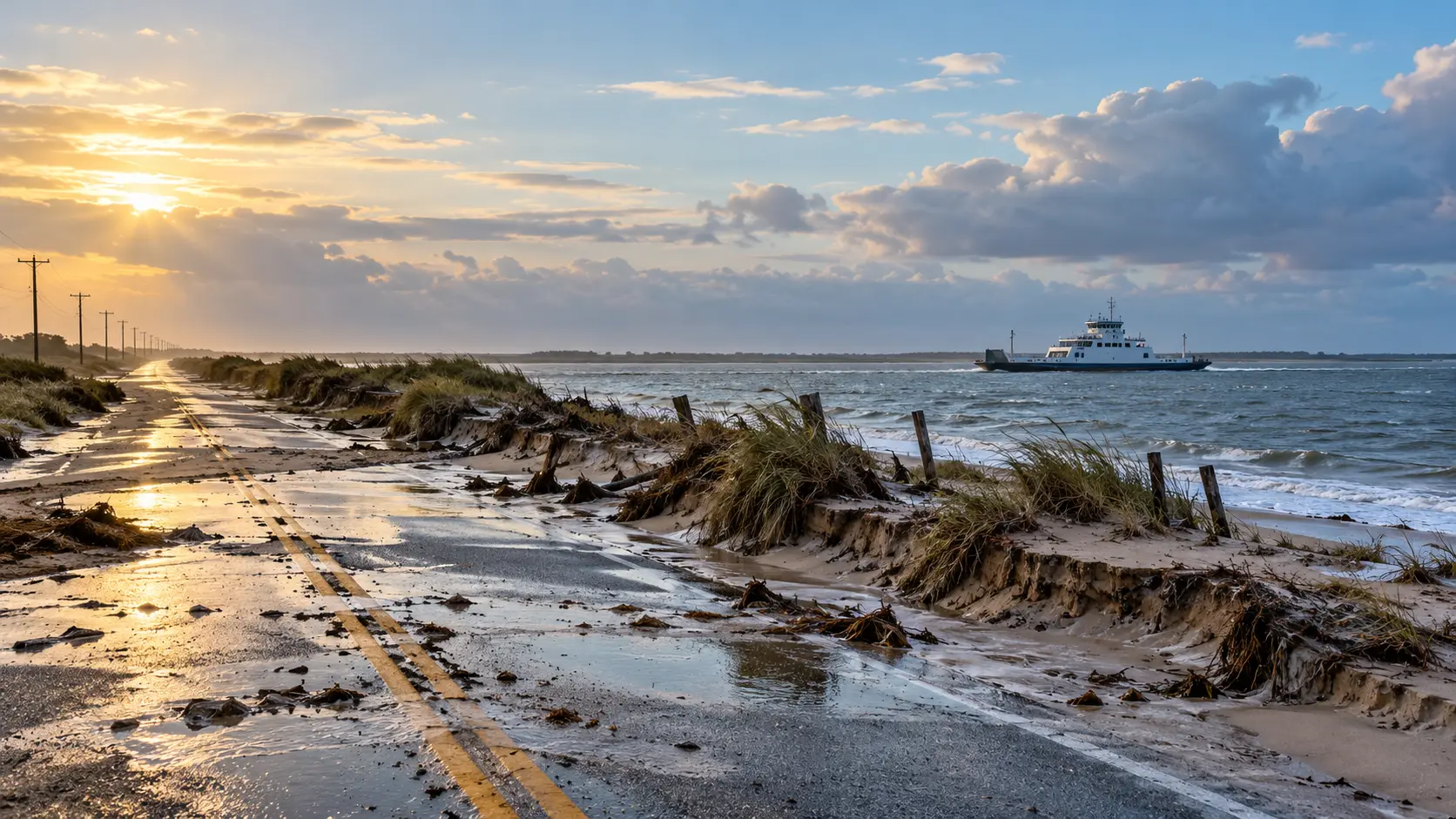
N.C. 12 closed; emergency ferry route operating
NCDOT says a section of N.C. 12 between the Marc Basnight Bridge and Rodanthe remains closed after waves undermined pavement near the Pea Island Visitor Center. The agency reported approximately 800 feet of damaged pavement and said crews were restoring more than 1,800 feet of protective dunes. As of its October 22 notice, NCDOT had no reopening timeline because continued overwash and high tides had to subside before a complete assessment.
The Ferry Division activated 24-hour emergency service between Stumpy Point and Rodanthe using three boats. NCDOT says the one-way trip takes about two hours. Dare County reentry restrictions apply to Rodanthe-bound departures: essential personnel, permanent residents, critical vendors, nonresident Hatteras Island property owners and island-business employees may travel, while visitors are not currently permitted on those ferries.
Travelers should verify current conditions through DriveNC or NCDOT before departing. Ferry capacity is limited, and the agency warned of long lines and significant delays.
Why it matters
N.C. 12 is the principal highway connecting communities along the Outer Banks, while emergency ferry routes become critical when the barrier-island roadway is severed. The declaration gives the state a clearer legal and administrative basis to coordinate resources and pursue federal highway emergency-relief support, but it does not itself guarantee federal reimbursement or a permanent resilience project.
The repeated damage also presents a longer-term public-finance question. Temporary pavement, dune reconstruction and emergency ferry operations can restore access after an individual storm. Recurrent overwash requires public disclosure of how often emergency repairs are being repeated, what they cost and whether long-term alternatives would reduce risk and taxpayer exposure.
DINA independent analysis
This section is DINA analysis, not independently established fact. The order appropriately distinguishes the emergency geography from the rest of North Carolina and documents the basis for seeking federal help. The accountability test now shifts from declaration to execution: state officials should publish damage estimates, contract awards, federal requests, reimbursements, repair milestones and the criteria for reopening N.C. 12.
The strongest accountability angle is the gap between emergency restoration and durable resilience. The public needs a project-level record showing whether funds are being used only to rebuild vulnerable segments repeatedly or also to evaluate elevation, relocation, bridge, ferry-capacity and shoreline-protection alternatives. DINA does not presume which alternative is best; that determination requires engineering, environmental, fiscal and community evidence.
Strongest accountability questions
- What is NCDOT's preliminary estimate for pavement, dune, ferry and traffic-control costs from the September 24 and October 16 storms?
- What emergency-relief amount has North Carolina requested from the Federal Highway Administration, and when does the state expect a decision?
- Which contracts have been awarded or modified, through what procurement authority, and to which vendors?
- What engineering criteria must be met before northbound and southbound travel can safely resume?
- How many days of ferry operations, road closure and restricted access have residents and businesses experienced?
- What long-term alternatives are under active study for the most frequently damaged portions of N.C. 12, and how will residents participate?
Urgent records and follow-up requests
- Request the state's FHWA Emergency Relief application, supporting damage estimates and all federal responses.
- Request NCDOT inspection reports, geotechnical assessments, drone or aerial surveys, repair plans and daily progress logs for the damaged N.C. 12 segments.
- Request emergency procurement determinations, bids, contracts, change orders, invoices and vendor-payment records.
- Request ferry ridership, vehicle counts, denied-boardings data, operating costs and service-reliability records for the emergency route.
- Request the state's after-action review comparing the September and October failures and identifying recommended resilience investments.
Sources
- North Carolina Office of the Governor — Executive Order No. 41: Declaration of a State of Emergency, October 22, 2026
- North Carolina Department of Transportation — Emergency ferry service activated as storm damage closes N.C. 12, October 22, 2026
- North Carolina General Statutes, Chapter 166A — North Carolina Emergency Management Act