
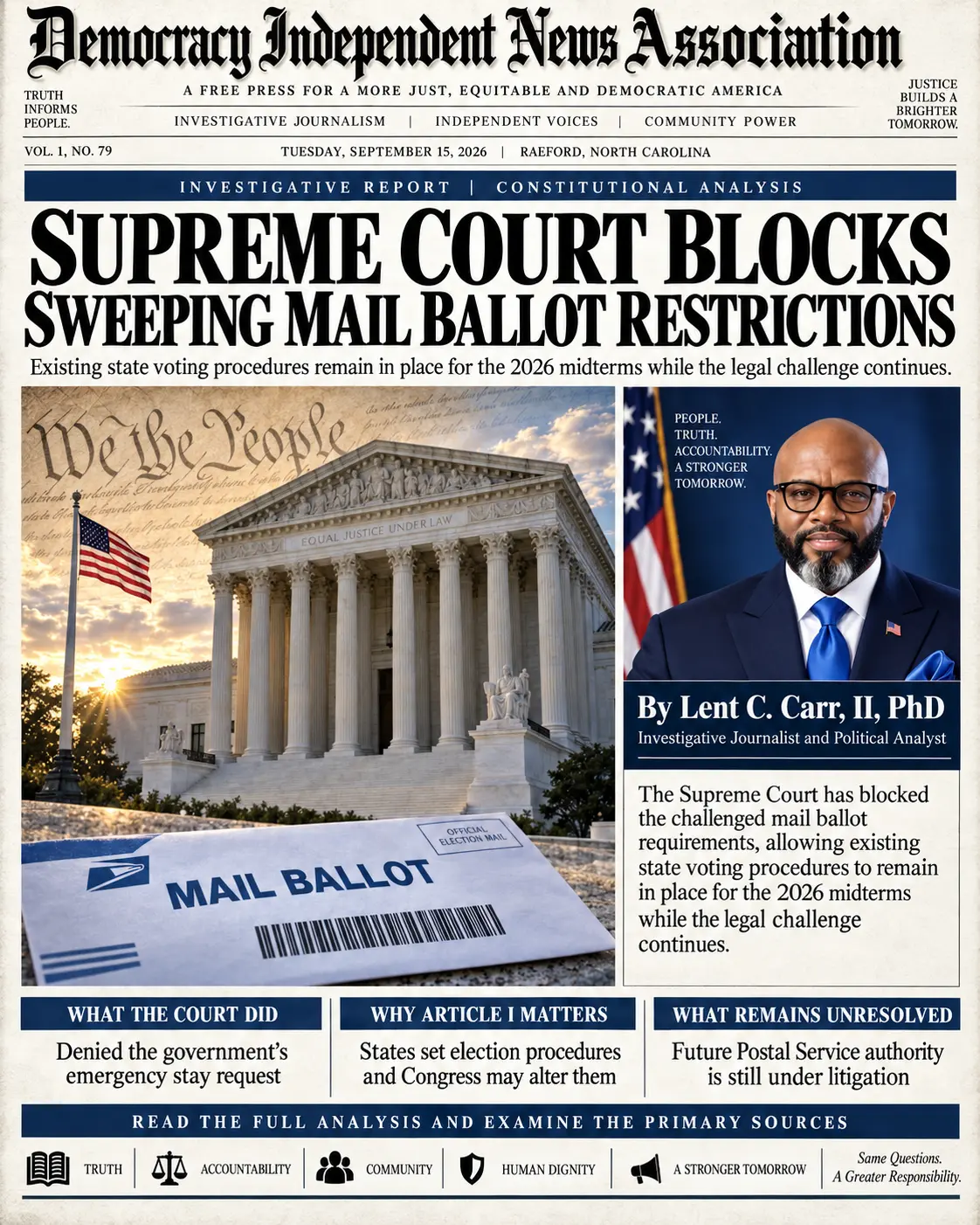
WASHINGTON — The Supreme Court on Monday refused to let the United States Postal Service enforce a new ballot mail rule during the 2026 midterm elections. The order leaves a nationwide preliminary injunction in place and allows states to continue using their established mail voting procedures while the underlying lawsuits proceed. The Court said the government was "unlikely to succeed on the merits" of its effort to overturn the injunction and that the equitable factors did not justify emergency relief. Justices Samuel Alito and Clarence Thomas publicly dissented. Supreme Court order.
That result is consequential, but its legal scope must be stated with precision. The Court did not conduct a full merits review, invalidate every possible federal standard for election mail or permanently dispose of the policy. It denied an emergency stay in United States Postal Service v California. The immediate effect is narrower and concrete: the challenged requirements cannot govern the November 3 election under the injunction now in force. Associated Press and Reuters reported that voting preparations and ballot mailing had already begun in several states.
The rule that reached the Court
President Donald Trump signed Executive Order 14399 on March 31. The order invoked Article II and federal criminal statutes, described citizenship verification and election integrity as federal responsibilities and directed the Postmaster General to initiate rulemaking for mail and absentee ballots. It called for designated election-mail markings, automation-compatible envelopes, unique Intelligent Mail barcodes and state-specific participation lists. Executive Order 14399.
The Postal Service issued its final rule on August 26 at 91 Federal Register 54966. Under that rule, state and local election offices using the mail for federal ballots would have to submit envelope designs for postal review, upload specified voter and mailing information to a federal portal and use voter-specific barcodes on outbound and return envelopes. Noncompliant outbound mailings could be refused and returned to election officials for correction. The agency described the measure as a postal operations and data-reporting rule, not a system for deciding voter eligibility. Federal Register final rule.
The distinction between regulating mail and regulating elections became the central dispute. The government relied on the Postal Service's power to adopt rules necessary to perform its statutory functions and to control the collection, handling, transportation and delivery of mail. Those powers appear in 39 USC 401 and 39 USC 404. The challengers answered that the rule did more than specify ordinary mailing standards because access to the national mail system would depend on state compliance with a federally designed ballot process.
The constitutional allocation of election power
Article I Section 4 begins with the states. It assigns the "Times Places and Manner" of congressional elections to each state's legislature, while permitting Congress to make or alter those regulations. The text therefore creates a dual structure: state administration is the default and congressional law may supersede it. Constitution Annotated.
The President is not identified in the Elections Clause as an independent election rulemaker. That does not remove the executive branch from federal election law. A president may sign or veto legislation under Article I, agencies may carry out authority that Congress has delegated and the Justice Department may enforce valid federal statutes. The constitutional question in this litigation is whether existing postal law supplies enough authority for the challenged requirements, or whether the executive branch attempted to create election conditions that Congress itself had not enacted.
The founding era confirms the structural purpose of the clause while counseling against oversimplification. In Federalist No 59, Alexander Hamilton defended congressional authority over federal elections as a means by which the national government could protect its continued existence if state arrangements failed. That argument supported a federal safeguard vested in the national legislature. It did not describe a freestanding presidential power to redesign election administration. Library of Congress guide to Federalist Nos 51 through 60.
Why the lower court intervened
U.S. District Judge Indira Talwani concluded at the preliminary injunction stage that the challengers had shown a substantial likelihood of success on three connected theories. First, she treated the final rule as an election regulation that intruded on authority assigned to the states and Congress. Second, she found a likely ultra vires problem because Congress had not expressly delegated Elections Clause authority to the Postal Service. Third, she concluded that the rule likely created a new category of conditionally nonmailable material without authorization in Title 39. District Court preliminary injunction.
The evidentiary record also focused on timing. The final rule arrived fewer than seventy days before the general election. States submitted declarations describing ballots and envelopes already purchased, software and vendor systems already configured, workers already trained and statutory mailing calendars already underway. North Carolina expected to begin sending ballots on September 4 to approximately 260,000 voters. Other states described millions of projected mail ballots and hundreds of local envelope designs that would require review. The district court record also stated that the federal portal was not yet operational when the injunction issued. District Court record and findings.
Those operational facts mattered independently of the constitutional theory. The Administrative Procedure Act authorizes courts to set aside agency action that is arbitrary capricious or contrary to law. 5 USC 706. Justice Brett Kavanaugh agreed that emergency relief should be denied because election officials lacked sufficient time to implement the rule. He wrote separately that there was nevertheless "at least a fair prospect" that the Postal Service possessed statutory authority for the rule in another setting. Kavanaugh concurrence.
The dissent and the unresolved legal questions
Justice Alito, joined by Justice Thomas, would have granted the stay. The dissent questioned whether some organizational plaintiffs had standing, emphasized the demanding standard for nonstatutory ultra vires review and relied on the Postal Service's broad statutory authority over the mail. It also disputed the district court's treatment of the rule as creating nonmailable matter. These arguments remain relevant because the Court's unsigned order gave no extended majority reasoning and the litigation has not ended. Alito dissent.
A separate federal judge in Washington also blocked the rule on September 13. That sequence is institutionally important but not partisan proof of the merits: Judge Carl Nichols was appointed by President Trump, while Judge Talwani was appointed by President Barack Obama. Judicial reasoning must be evaluated from the orders, statutes and record rather than the identity of the appointing president. Reuters report on the two lower court rulings.
The key unresolved question is how courts will draw the line between a valid postal standard and an election rule that requires specific state administrative choices. Ordinary requirements involving postage, dimensions and machine processing clearly affect election mail without necessarily becoming election law. The challenged rule added voter linked data submission, state participation lists and consequences that could stop ballots before delivery. Future courts may consider whether those components are severable, whether Title 39 authorizes them and whether a later rollout with more time would cure only the procedural defect or also the underlying constitutional objection.
What the decision protects and what it does not decide
For the 2026 midterms, the ruling protects continuity. State and local officials may proceed under existing law without rebuilding ballot mail systems during active election administration. Voters who lawfully request mail ballots remain subject to their states established rules rather than a newly imposed federal portal and envelope system. The Court also preserved the ordinary principle that an emergency applicant must show both a strong legal case and favorable equities before a lower court injunction is suspended.
The order does not establish that every national election mail standard is unconstitutional. Congress retains broad authority under the Elections Clause to enact uniform rules for congressional elections. The executive branch retains authority to enforce those statutes, and the Postal Service retains the postal powers Congress has granted. The unresolved issue is delegation: whether Congress already authorized the specific rule and, if not, whether Congress could authorize some or all of it through legislation consistent with other constitutional protections.
The preliminary injunction itself is limited to the November 2026 election. Judge Talwani expressly declined to enjoin implementation for later elections, allowing the legal challenges to proceed through the normal process. Justice Kavanaugh also left open the possibility that a future rule could fall within postal authority if implemented with adequate time. The Court therefore stabilized the current election while preserving a live legal dispute over future federal regulation. Supreme Court order and District Court injunction.
The public record citizens should examine
The litigation identifies five factual questions that will shape the next stage. What statute authorizes each requirement? Which provisions regulate mail operations and which alter election administration? What testing demonstrates that a portal or barcode system can operate without rejecting lawful ballot mail? What notice and correction procedures protect voters when errors occur? What safeguards govern voter-linked information transmitted to a federal system?
Those questions apply regardless of which party controls the White House. Election security measures can be evaluated through enacted authority, a transparent administrative record, tested systems and implementation schedules that respect voting already underway. The Elections Clause provides the institutional map. Congress may legislate. States administer subject to valid federal law. Executive agencies implement the authority Congress has actually supplied.
The Supreme Court's September 14 order did not write the final chapter. It kept an untested federal system from displacing established state procedures during the 2026 election and required the government to continue defending the rule in ordinary litigation. For now, the constitutional allocation identified by the lower court remains the controlling framework for this election. Any future change will have to be evaluated under the text of Article I, the limits of the Postal Service's statutory authority, administrative law and a factual record addressing whether election security is improved without obstructing lawful ballots.
Primary sources and reporting
Supreme Court order in United States Postal Service v California — Emergency stay denied September 14 2026 with concurrence and dissent
District Court preliminary injunction — Findings on the Elections Clause statutory authority and 2026 implementation record
Executive Order 14399 — Presidential directive issued March 31 2026
Ballot Mail for Federal Elections — Postal Service final rule at 91 Federal Register 54966
Article I Section 4 Clause 1 — Constitution Annotated text and Elections Clause materials
Postal Service authority under 39 USC 401 and 404 — Statutory provisions relied upon by the government
Administrative Procedure Act 5 USC 706 — Judicial review standard cited in the litigation