
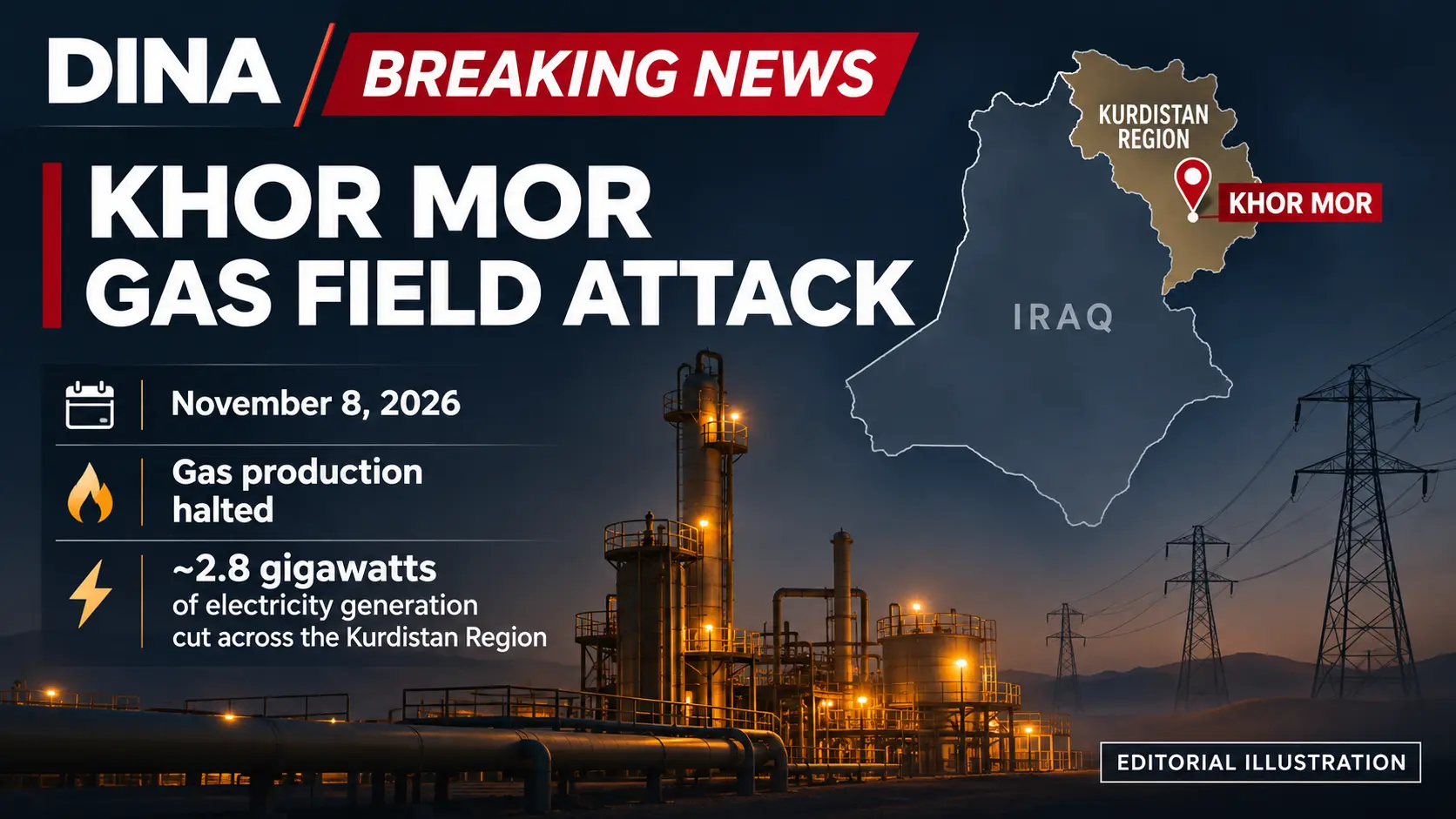
Verification status: Iraqi and Kurdistan Regional Government officials confirm that an attack hit the Khor Mor gas field late Sunday, stopped gas supplies to power stations and cut regional electricity generation by about 2.8 gigawatts. Iraq's prime minister ordered a joint investigation and said an initial assessment found no casualties. Reuters and Iraqi outlets, citing security, electricity-ministry and field sources, reported that a drone or other projectile struck an LPG storage or loading area and caused a fire. No publicly identified group has claimed responsibility, and DINA has not independently verified the weapon, launch point or perpetrator.
SULAYMANIYAH PROVINCE, Iraq — November 8, 2026, 6:40 p.m. ET: An attack halted gas production at the Khor Mor field in Iraq's Kurdistan Region and cut roughly 2.8 gigawatts of electricity generation, forcing regional authorities to protect hospitals, water systems and other critical services with alternate power sources while Baghdad opened a joint investigation.
The Kurdistan Regional Government's natural-resources and electricity ministries said the field was attacked at about 11 p.m. local time Sunday and called the incident a “terrorist act,” according to Reuters and Iraqi outlet +964. The ministries said they were working to limit reductions in electricity-supply hours and restore service.
Iraqi Prime Minister Ali Faleh al-Zaidi, acting as commander-in-chief of the armed forces, ordered a joint investigative committee with Kurdistan Region authorities. A statement from his security media office placed the attack at 11:10 p.m. in the Chamchamal district of Sulaymaniyah province and said preliminary information showed no human casualties.
Reuters reported, citing two regional electricity-ministry sources, that a drone struck an LPG storage tank and started a fire. Two security sources said smoke was visible, and workers were moved to shelters. +964 reported that field sources had not yet conclusively determined whether a drone or rocket struck the site, although debris was said to suggest a drone.
The attack is confirmed; the weapon and perpetrator are not. DINA therefore treats the drone description as credible, multi-source reporting rather than a completed forensic finding. No group had claimed responsibility by the verification cutoff, and public authorities had not released debris photographs, radar data, flight-path analysis, launch coordinates or a final damage assessment.
KRG Electricity Ministry spokesperson Omed Ahmed told +964 that the shutdown stopped gas supplies to regional power plants and removed nearly 2,800 megawatts of generation. He said authorities were using hydropower from the Dukan and Darbandikhan dams and plants capable of burning other fuels to keep hospitals, water stations and other critical sites supplied. The outlet reported power cuts in parts of Erbil, Duhok and Zakho.
Khor Mor is operated by Pearl Petroleum, whose lead partners are Dana Gas and Crescent Petroleum. In an August 4 company release, the operators said the field's expansion had raised installed capacity to 750 million standard cubic feet of gas per day and that Khor Mor fuel supported more than 80% of electricity generation in the Kurdistan Region. The companies also said the facility served more than 8 million Iraqis in the region and other governorates.
DINA did not locate an attack-specific statement from Pearl Petroleum, Dana Gas or Crescent Petroleum by the cutoff. The fire status, precise equipment damage, restart timetable, worker count, environmental impact and effect on household LPG supplies remained unresolved.
What is confirmed, attributed and unresolved
- Confirmed by public authorities: an attack struck Khor Mor late November 8, halted gas supplies to power stations and caused a major electricity-generation loss.
- Confirmed investigative action: Iraq's prime minister ordered a joint federal–regional committee. The prime minister's office said the initial assessment found no casualties.
- Confirmed regional estimate: the KRG electricity ministry put the lost generation capacity at about 2.8 gigawatts.
- Attributed reporting: Reuters sources described a drone strike on an LPG storage tank; +964 sources said the weapon had not been conclusively identified but that debris suggested a drone.
- Official characterization, not a proven attribution: KRG ministries called the incident a terrorist attack. That label does not identify a perpetrator or establish criminal responsibility.
- Unresolved: who carried out the attack; the launch point, weapon and flight path; whether air defenses detected or engaged it; the complete damage and pollution assessment; the number of workers sheltered; the service-restoration schedule; and any effect on cooking-gas supply.
Why it matters
Khor Mor is not only an energy-production site. It is a critical input to the Kurdistan Region's electricity system and to public services that depend on continuous power. Losing 2.8 gigawatts at once can force rationing, raise fuel costs and place hospitals, drinking-water systems, communications and businesses under immediate strain.
The field also links regional and federal energy policy. Dana Gas and Crescent Petroleum began supplying gas from Khor Mor to Iraq's federal electricity ministry in August. Damage or a prolonged shutdown can therefore affect both Kurdistan Region consumers and Baghdad's effort to reduce power shortages elsewhere in Iraq.
DINA analysis
Independent accountability analysis: The immediate question is not which faction commentators suspect. It is whether the federal–regional investigation will produce a public, evidence-based account of the launch point, weapon, security response and damage. Repeated attacks on a facility that supplies most of a region's power create an obligation to show what protective measures were promised, funded and actually installed.
The 2.8-gigawatt estimate is consequential but preliminary. Authorities should publish hourly generation data, the affected plants, emergency-fuel use and restoration milestones so residents can distinguish planned load management from uncontrolled outages. The public also needs confirmation that hospitals and water systems remained continuously powered, not only an assurance that they were prioritized.
DINA editorial analysis: Civilian energy infrastructure should not be used as leverage in wider regional conflict. Any government or armed group seeking legitimacy should support an independent forensic record, protection for workers and uninterrupted civilian electricity and water service.
Strongest accountability angle
The strongest accountability story is whether Iraq and the Kurdistan Region convert a new investigative committee into a transparent finding and enforceable security plan. A prior pattern of attacks makes the paper trail especially important: threat assessments, radar and air-defense coverage, operator warnings, security contracts, government assurances, capital spending and the implementation status of earlier investigative recommendations.
Urgent follow-up and records to seek
- Iraqi prime minister's security media office and joint committee: the order establishing the committee, membership, mandate, evidence-preservation instructions, reporting deadline and any public-release commitment.
- KRG ministries of Natural Resources and Electricity: the joint statement, outage and generation data, affected plants, emergency-fuel use, critical-service continuity logs, restoration timetable and household-LPG contingency plan.
- Pearl Petroleum, Dana Gas and Crescent Petroleum: worker-accountability status, fire and damage reports, restart criteria, pipeline integrity tests, environmental monitoring, insurer notices and prior security-risk assessments.
- Federal and regional security forces: radar tracks, air-defense alerts, recovered debris and chain-of-custody records, launch-site analysis and releasable findings from earlier Khor Mor attacks.
- Health, water and municipal authorities: facility-level power interruptions, generator fuel stocks and any service disruption caused by the generation loss.
Related DINA coverage
- U.S. Forms Task Force to Interdict Weapons and Sanctioned Goods Moving Toward Iran
- Qatar-Led Iran Diplomacy and the Unresolved Terms for De-escalation
- Saudi Authorities Report Debris Damage at Aramco Building After Attempted Attack
Sources
- Iraq Security Media Cell — prime minister's order for a joint investigation and preliminary no-casualty assessment, November 8–9, 2026
- Reuters — attack, fire, production halt, KRG statements and 2.8-gigawatt estimate, November 8, 2026
- +964 — KRG ministry statements, power-system response, field-source accounts and joint investigation, November 9, 2026 local time
- Shafaq News — translated Iraqi security-media statement and joint-probe order, November 8, 2026 UTC
- Dana Gas and Crescent Petroleum — Khor Mor capacity, federal gas-supply agreement and regional electricity role, August 4, 2026
- Dana Gas — official press-release archive checked for an incident-specific operator update
Verification cutoff: November 8, 2026, 6:40 p.m. Eastern. DINA has not independently inspected the site or obtained the joint committee's records. Weapon, launch-point and perpetrator claims remain unproven unless supported by released forensic evidence. This report will be updated if the operator issues a safety or restart statement, officials revise the casualty or power-loss assessment, or investigators identify a responsible party with supporting evidence.