
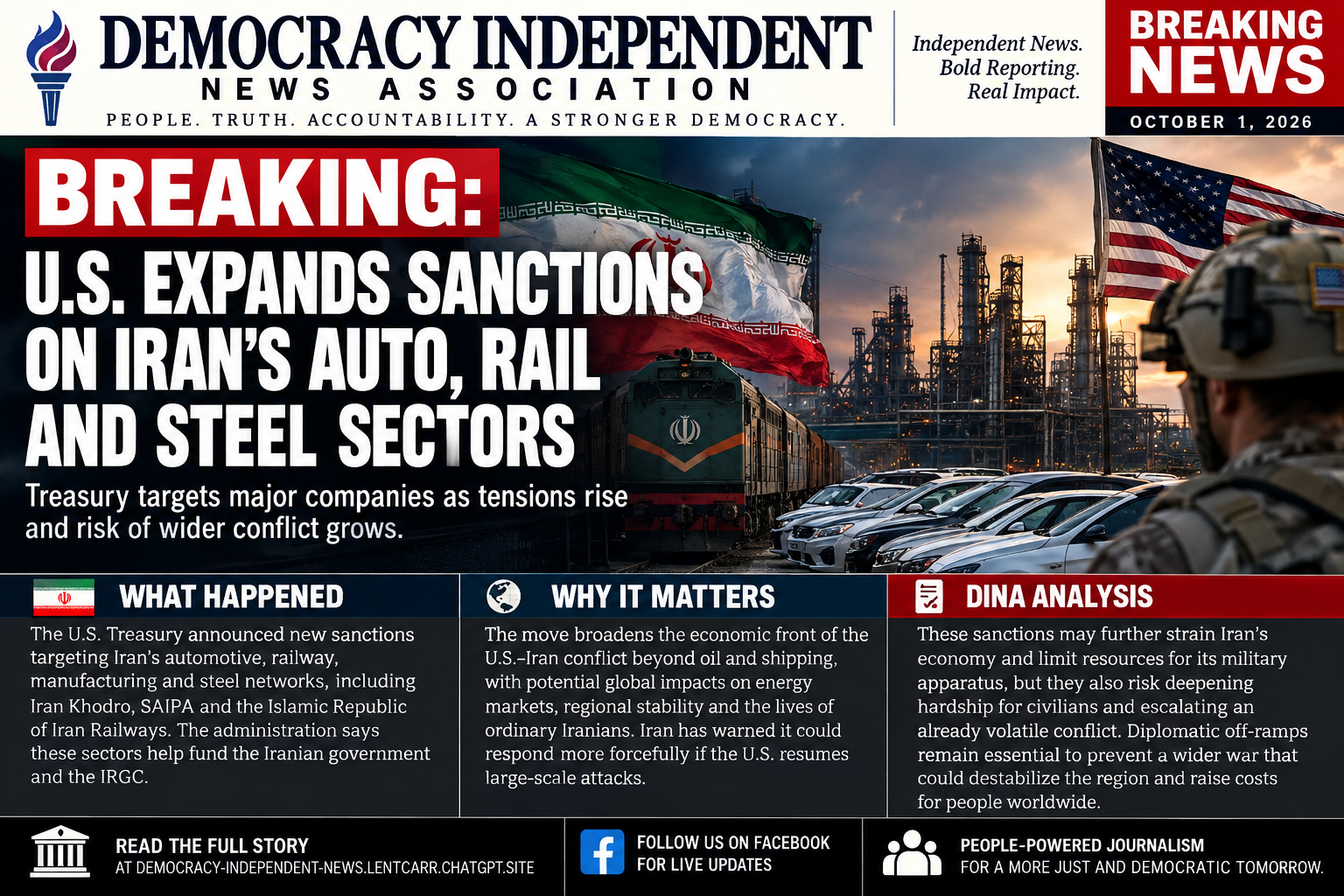
WASHINGTON — The U.S. Department of the Treasury on October 1, 2026, expanded economic pressure on Iran by authorizing sanctions against the country’s automotive and rail sectors and designating a wide network of Iranian companies, foreign suppliers, industrial firms and individuals.
The action reaches well beyond oil. Treasury identified automakers Iran Khodro and SAIPA, the Islamic Republic of Iran Railway Company, manufacturing and steel businesses, and suppliers or facilitators based in several countries. The department said the targeted industries provide revenue, logistics and procurement capacity to the Iranian government and the Islamic Revolutionary Guard Corps.
For readers, the immediate facts are these: the designations restrict dealings subject to U.S. jurisdiction, expose certain facilitators to sanctions risk and widen the economic front of an already dangerous U.S.–Iran confrontation. They do not, by themselves, establish that diplomacy has ended or that every civilian transaction involving the named sectors is prohibited. The controlling details remain the Treasury designations, executive orders and OFAC guidance.
What Treasury changed
The Office of Foreign Assets Control issued two new sectoral determinations under Executive Order 13902 covering Iran’s automotive and rail sectors. Those determinations authorize sanctions against people or entities determined to operate in those sectors. Treasury also relied on Executive Order 13871 for designations tied to Iran’s iron, steel, aluminum and copper sectors.
The October 1 action named major industrial actors, including:
- Iran Khodro Company and SAIPA, which Treasury described as the dominant producers in Iran’s domestic auto market;
- Iran Khodro Diesel, Pars Khodro, Zamyad and two Niroo Motor companies;
- the Islamic Republic of Iran Railway Company, Raja Passenger Trains Company and a major freight operator;
- Heavy Equipment Production Company and its Shanghai subsidiary;
- metals and steel suppliers or facilitators in the United Arab Emirates, Germany, Hong Kong and China; and
- businesspeople and companies Treasury accused of moving Iranian steel and oil revenue through shell-company and banking networks.
Treasury also designated foreign auto-parts suppliers in Indonesia, the United Arab Emirates, Türkiye and Hong Kong. The department’s theory is that sanctioning suppliers and facilitators can constrict the procurement channels that keep Iran’s industrial base operating.
What the sanctions do
As a general matter, property and interests in property of designated persons that are in the United States or within the possession or control of U.S. persons are blocked and must be reported to OFAC. Entities owned 50 percent or more, directly or indirectly, by one or more blocked persons may also be blocked even when they are not separately named.
Sanctions compliance is fact-specific. Companies, banks, shippers and insurers must examine the actual OFAC notices and applicable licenses rather than rely on a headline or a name alone. Treasury’s enforcement framework can also create secondary risk for non-U.S. actors that materially support designated parties or sanctions-evasion networks.
Why this matters beyond Iran
Automotive, rail, machinery and steel networks are deeply connected to civilian employment, transportation and trade. That makes the policy consequential in two directions. The administration argues that these sectors generate revenue and logistical capacity for Iran’s military apparatus. At the same time, broader industrial restrictions can raise prices, disrupt supply chains and intensify hardship for ordinary people who do not control state policy.
The international reach also matters. Treasury’s list names firms outside Iran, signaling that the United States intends to target cross-border suppliers and financial channels rather than only domestic Iranian enterprises. Banks and companies far from the conflict may respond by avoiding even lawful commerce because the cost of a compliance mistake can be severe.
DINA analysis
The public should distinguish three questions. First, what entities and sectors did Treasury legally designate? Second, what conduct does the United States allege those entities performed? Third, will the action change Iran’s conduct or instead deepen economic pressure without creating a diplomatic exit?
Treasury’s press release supplies the administration’s case, but official allegations should not be confused with adjudicated findings. The government bears responsibility for publishing the evidence, licenses, exceptions and compliance instructions necessary for businesses and humanitarian actors to understand the rules.
DINA will watch for the full OFAC entries, general licenses, enforcement guidance, responses from the named companies and governments, and evidence of effects on civilian trade. Economic pressure may constrain state revenue, but policy must also be judged by whether it reduces danger, protects noncombatants and leaves room for de-escalation.
Primary sources and further reading
- U.S. Treasury — “Operation Economic Outcast Targets Iran’s Remaining Industrial Lifelines,” October 1, 2026
- U.S. Treasury OFAC — Iran sanctions program and country information
- U.S. Treasury OFAC — recent sanctions actions
- Executive Order 13902 — additional sectors of Iran
Source note: Descriptions of the designated entities and alleged conduct are attributed to the U.S. Treasury Department. A designation is an executive-branch sanctions action, not a criminal conviction. Readers and businesses should consult OFAC’s controlling notices and obtain qualified advice for compliance decisions.
Democracy Independent News Association (DINA)
Independent Journalism. Public Records. Accountability.