
Breaking News · Federal Accountability · USDA · Government Reorganization · Workforce · Public Services · DINA Analysis
Verification status: The U.S. Government Accountability Office publicly released report GAO-27-108734 on November 9. GAO confirmed that USDA's workforce fell by 20.2% from December 2024 through March 2026 and said the department did not provide documentation showing what analysis informed the specific reorganization decisions announced in July 2025. That finding does not prove USDA performed no analysis; it establishes that GAO could not verify such analysis from the material USDA supplied.
WASHINGTON — November 9, 2026: The U.S. Department of Agriculture did not give federal auditors documentation showing how it assessed service, workforce, economic or property risks before announcing a sweeping reorganization that would relocate at least 2,600 Washington-area positions, the Government Accountability Office said Monday.
The nonpartisan congressional watchdog reported that USDA's workforce decreased from 91,047 employees in December 2024 to 72,671 in March 2026—a net decline of 18,376 employees, or 20.2%. GAO said the department's limited submissions included raw building-attendance data, an older Forest Service financial report and documents showing implementation activity, but not analysis tied to the specific decisions in Agriculture Secretary Brooke Rollins' July 24, 2025 memorandum.
The report was dated November 5 and publicly released November 9. It does not recommend that USDA abandon the reorganization, does not conclude that every relocation would harm services and does not decide the legality of the plan. Much of the reorganization is separately halted under an October federal-court stay while litigation continues.
What GAO found
GAO said it asked USDA in September and December 2025 and again in January, March and April 2026 for planning or analysis conducted before Rollins announced the department-wide plan. The watchdog said USDA did not provide documentation of such analysis.
That left Congress and the public without verifiable answers about whether USDA compared alternatives, estimated economic effects, evaluated the risk of service disruption, planned for critical-skill losses or calculated how it would protect taxpayers when vacating or disposing of federal property.
USDA's July 2025 framework identified four pillars: aligning the workforce with available resources and priorities; moving resources outside the National Capital Region; eliminating management layers; and consolidating support functions. It also made concrete choices about staffing, facilities and office consolidation. GAO's central finding is that USDA supplied the rationale and described the actions, but did not show the underlying decision analysis.
A department already 18,376 employees smaller
The workforce reduction was uneven across USDA. GAO's Office of Personnel Management data show the following changes from December 2024 through March 2026:
- USDA overall: down 20.2%, from 91,047 to 72,671 employees.
- Rural Development: down 38.1%, from 4,954 to 3,066.
- Food and Nutrition Administration: down 35.9%, from 1,848 to 1,184.
- Research, Education and Economics mission area: down 33%, from 8,697 to 5,826.
- Farm Service Agency: down 20.5%, from 3,374 to 2,684.
- Natural Resources Conservation Service: down 24.3%, from 11,817 to 8,951.
Those figures exclude roughly 15,500 nonfederal Farm Service Agency county employees and state and county committee members, who operate under a different personnel system. They therefore should not be used as a direct count of staffing at local county offices.
GAO counted 25,448 separations and 7,197 hires from January 2025 through March 2026. About 52% of the separations followed employees' acceptance of the Deferred Resignation Program.
USDA disputes the watchdog's framing
In a September 30 response included with the report, Rollins called the review politicized and described the department's approach as deliberate but adaptable. She said USDA leadership considered the department's financial condition, workforce growth and underused or deteriorating real estate, and argued that a responsible reorganization must remain responsive rather than fixed in place.
USDA also pointed to announced organizational charts, congressional notifications, building closures, employee relocations and work with the General Services Administration as evidence of implementation and planning.
GAO answered that it took no position on whether USDA should reorganize. Auditors said they reviewed USDA's written comments, legal filings and supporting material and met with department officials, but officials still did not identify documentation showing the analysis that informed the specific July 2025 decisions. GAO said conditions that may justify action and steps taken to carry it out are not the same as a documented comparison of impacts and alternatives before the decision.
Why it matters in North Carolina
Raleigh is one of the hubs named in USDA's reorganization framework, giving North Carolina a direct stake in both the promised benefits and the unresolved risks. Moving federal work closer to farmers and lower-cost regions may improve access and reduce real-estate expenses. But without published baselines, staffing targets, cost estimates and service measures, neither Congress nor the public can test whether the move is saving money or simply shifting costs while expertise leaves the department.
USDA's prior 2019 relocations of the Economic Research Service and National Institute of Food and Agriculture offer a warning, not a prediction. GAO previously found that more than half of each agency's staff left, experience and productivity declined, and the agencies generally returned to prior staffing and productivity levels after two years. Workforce composition changes lasted longer.
DINA analysis
Independent accountability analysis: The most important distinction is between a policy argument and an auditable plan. USDA has articulated why it believes reorganization is necessary. GAO's report shows the department did not give the watchdog enough evidence to determine whether the government tested that argument against service-delivery risks, workforce losses, property costs or realistic alternatives before committing to specific moves.
The absence of documentation supplied to GAO is not proof that no internal analysis ever existed. It is, however, a serious transparency failure in a reorganization touching food safety, nutrition benefits, farm credit, conservation, rural development and agricultural research. A department may choose among competing policies, but Congress and taxpayers need records that make the tradeoffs measurable.
The workforce data raise the stakes. A 20% department-wide contraction and much deeper reductions in several mission areas mean relocation decisions are being layered onto an institution already carrying fewer people. The relevant accountability test is not simply whether a hub opens; it is whether response times, benefit accuracy, inspections, grants, loans, conservation assistance and research output remain stable or improve.
Strongest accountability angle
USDA should publish the predecision record for each major relocation and property action: alternatives considered, projected one-time and recurring costs, expected savings, employee-retention assumptions, critical-position inventories, service-continuity measures, property valuations and performance benchmarks. If those analyses were never completed, the department should say so plainly and produce them before irreversible moves resume.
Congress should also require mission-area scorecards comparing staffing, vacancies, processing times, customer complaints, backlogs and program outcomes before and after each change. Without that baseline, claims of efficiency or harm will remain political assertions rather than testable results.
Urgent follow-up and records to seek
- The complete administrative record supporting Secretary Memorandum SM 1078-015, including decision memoranda, alternatives analyses, cost models and risk assessments.
- Mission-area implementation plans, workforce plans, relocation acceptance rates, vacancy projections and continuity-of-operations measures.
- GSA-USDA correspondence, appraisals, utilization calculations and disposal or lease documents for each affected property.
- North Carolina-specific staffing, lease and build-out records for the Raleigh hub, including projected federal and contractor costs.
- Monthly service and performance data for Farm Service Agency, Natural Resources Conservation Service, Rural Development, food-safety and nutrition programs before and after the workforce reductions.
- The records USDA gave GAO after the draft report, with lawful redactions and a privilege log for any withheld material.
Primary sources and reporting
- U.S. Government Accountability Office — report page for GAO-27-108734, publicly released November 9, 2026
- U.S. Government Accountability Office — full 35-page report, including USDA's written response
- USDA — July 24, 2025 reorganization announcement and Secretary's memorandum
- USDA Rural Development — current reorganization information and litigation updates
- Reuters — November 9, 2026 reporting on the GAO release and USDA response
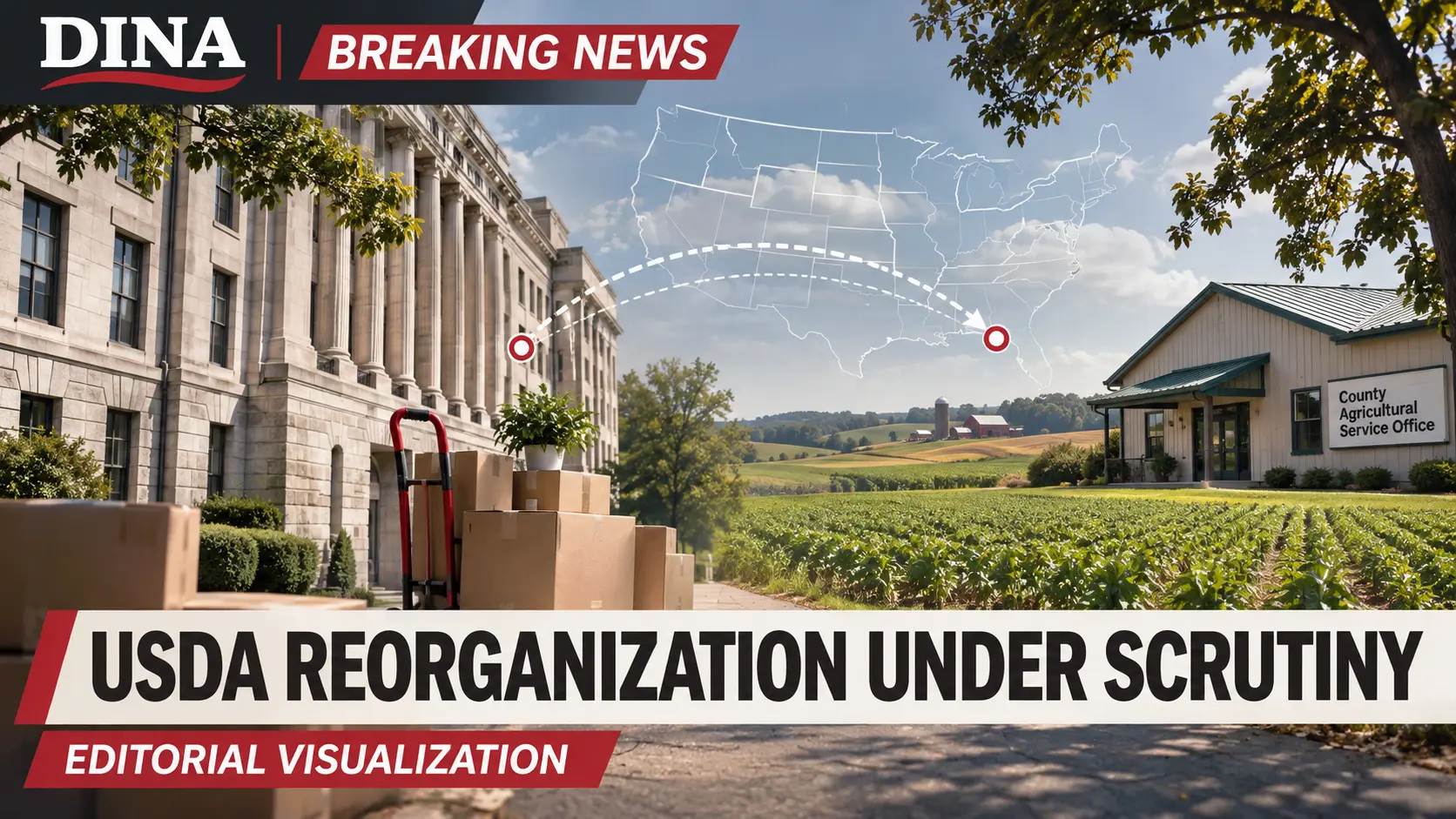
Verification cutoff: November 9, 2026, 11:50 a.m. Eastern. DINA reviewed GAO's public report page and full report, USDA's reorganization materials and current wire reporting. The associated image is an AI-generated DINA editorial visualization; it does not depict an actual relocation, USDA facility, county office, employee, document or item of evidence.