
Breaking news · Russia–Ukraine war · Kramatorsk · U.S. policy · Civilian protection · DINA analysis
UPDATED — KRAMATORSK, Ukraine — Ukrainian President Volodymyr Zelenskyy said Russian strikes killed 78 people and wounded 215 across Ukraine over two days, then accused the United States of “unwillingness” to provide additional help after a Russian bomb strike killed at least 33 people at a Kramatorsk bus stop, according to Ukrainian authorities.
Zelenskyy urged Washington to expand Ukraine's access to the Starlink satellite service so Ukrainian forces could target Russian ballistic-missile launchers. He also criticized U.S. efforts to pursue potential economic projects with Russia while describing the war as diplomatically deadlocked. Reuters reported that Ukrainian negotiators were expected in the United States on Friday and Saturday for talks.
The 78-death and 215-injury totals are figures provided by Zelenskyy for strikes across Ukraine; DINA has not independently verified the nationwide count. They include deaths from the October 7 mass drone-and-missile attack and the October 8 Kramatorsk strike. His criticism of Washington is a political and diplomatic position, not independent proof that any specific U.S. action would have prevented the attacks.
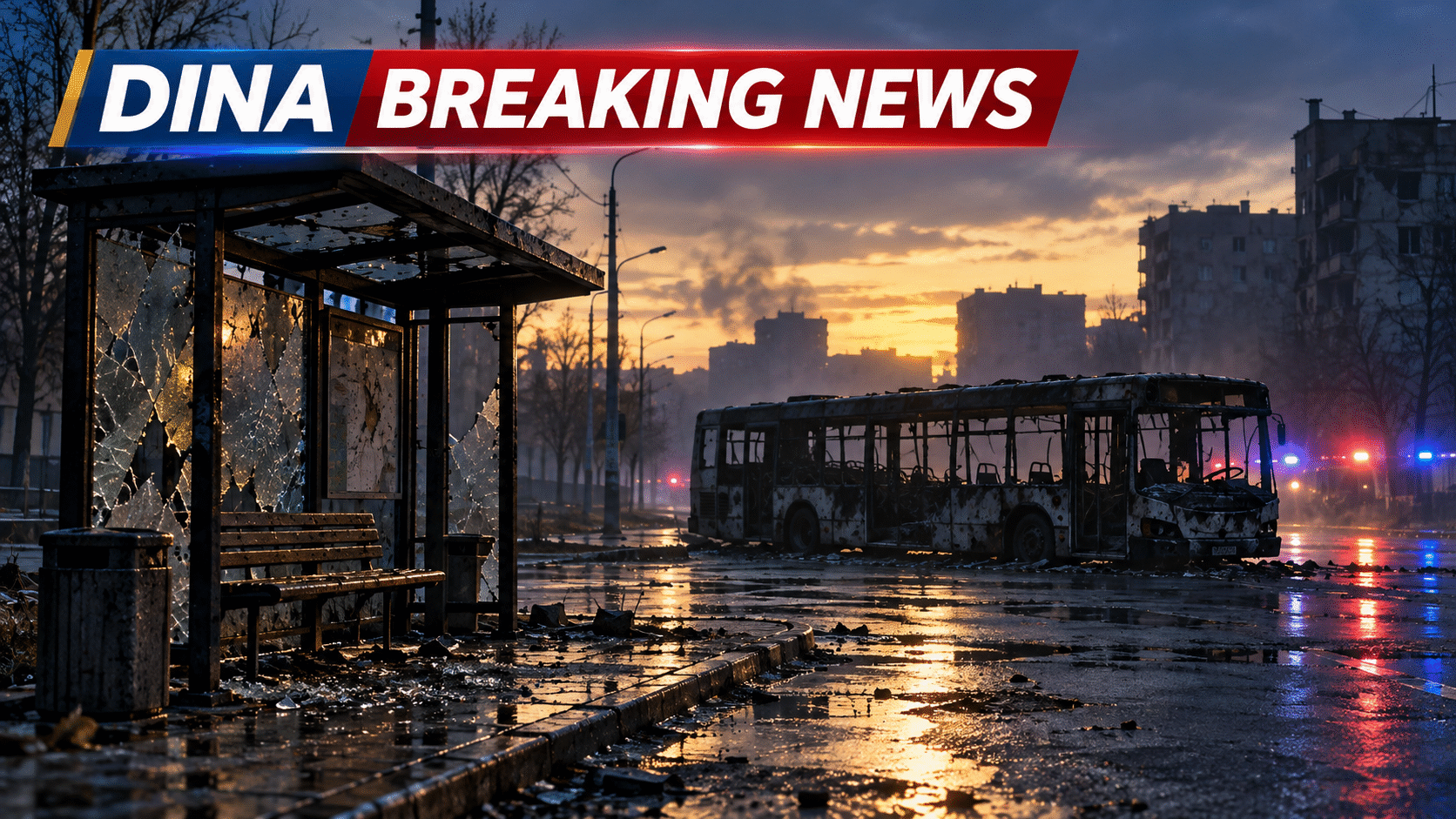
Kramatorsk: A Russian bomb strike killed at least 33 people and wounded 18 on a street where two city buses were operating Thursday, Ukrainian authorities said, in one of the deadliest single attacks of the year.
Reuters reported the updated toll from Ukrainian authorities and published an image supplied by Ukraine's National Police showing a burned bus after the strike. The Associated Press, using an earlier official count, reported 30 deaths and said a guided bomb exploded next to buses carrying passengers near a bus stop. Because casualty counts in mass-casualty emergencies can change, DINA is using the later Reuters figure while identifying it as an official Ukrainian count rather than an independently verified total.
Ukrainian President Volodymyr Zelenskyy described the location as a bus stop. Donetsk regional governor Vadym Filashkin accused Russia of intentionally striking civilians to maximize casualties. Oleksandr Honcharenko, head of Kramatorsk's military administration, made a similar allegation and said follow-up drone attacks complicated rescue work, AP reported.
Russia had not publicly commented on the Kramatorsk strike when Reuters published its report. Moscow generally denies intentionally targeting civilians. DINA has not independently established the munition's launch platform, flight path, intended aim point or whether military personnel or equipment were present nearby. The visible civilian setting and reported passenger deaths require an independent investigation, but they do not by themselves establish the attacker's intent.
What is confirmed — and what remains attributed
- Nationwide two-day toll attributed to Zelenskyy: 78 people killed and 215 wounded. DINA has not independently reconciled every incident included in that total.
- Request to Washington: Zelenskyy publicly asked the United States to expand Ukraine's Starlink access for operations against Russian ballistic-missile launchers.
- Diplomatic criticism: Zelenskyy accused the United States of unwillingness and questioned efforts to explore economic projects with Russia while peace talks remain stalled. These are his stated judgments.
- Official Ukrainian toll reported by Reuters: at least 33 people killed and 18 wounded.
- Earlier count reported by AP: 30 people killed. DINA treats the difference as an evolving casualty count, not a contradiction that can yet be resolved independently.
- Location and civilian presence: Ukrainian police said two city buses were operating on the street; Zelenskyy described the site as a bus stop.
- Weapon description: AP, citing Ukrainian authorities, described the munition as a Russian guided bomb. DINA has not independently verified the weapon type or launch details.
- Operational consequence: Filashkin ordered public transport suspended in Kramatorsk and Sloviansk.
- Intent allegation: Ukrainian officials say Russia deliberately targeted civilians. That allegation has not been independently adjudicated or established by DINA.
- Russian response: Reuters reported no immediate comment from Moscow on this attack.
Why it matters
The update moves the story beyond one attack. Zelenskyy's two-day toll connects the Kramatorsk deaths to a wider wave of strikes and opens a direct dispute with Washington over military assistance, satellite capability, sanctions and the direction of U.S.-Russia diplomacy.
Starlink access is operationally sensitive. Expanding it could improve Ukrainian targeting and air-defense coordination, while also raising escalation, licensing, command-and-control and private-provider accountability questions. Zelenskyy's request does not establish what technical access Ukraine currently has or whether the requested change would have prevented either day's attacks.
Kramatorsk and nearby Sloviansk anchor Ukraine's defensive “fortress belt” in Donetsk. Russian forces have increased drone and guided-bomb attacks on cities in the area as Moscow presses its demand for control of the remainder of the region. The strike demonstrates how pressure on that defensive line is being borne by civilians who still depend on public transit and essential services.
The suspension of buses in two cities is itself a major civilian consequence. It can restrict access to work, food, medical care and evacuation routes—especially for older residents, people with disabilities and families without private vehicles.
Law and accountability
International humanitarian law prohibits intentionally directing attacks against civilians and civilian objects. Parties also must distinguish military objectives from civilians, take feasible precautions and refrain from attacks expected to cause civilian harm excessive to the anticipated military advantage.
A high civilian death toll does not alone prove a deliberate attack. Investigators need the exact impact location, munition fragments, crater analysis, surveillance and satellite imagery, warnings, Russian targeting records and evidence about any asserted military objective. If the bus stop or passenger vehicles were intentionally selected as the object of attack, that would constitute a grave violation and could amount to a war crime.
DINA analysis: preserve evidence before narratives harden
DINA analysis: The first accountability duty is to preserve the scene and the identities of the dead, not to force incomplete evidence into a propaganda frame. Ukraine should release time-stamped incident records and permit independent investigators access consistent with security needs. Russia should disclose the unit, target coordinates, munition and battle-damage assessment for any operation in the area.
Zelenskyy's criticism also creates an accountability test for Washington. The administration should state what assistance Ukraine requested, what was approved or denied, and why. At the same time, casualty figures and grief should not be used to imply—without evidence—that one satellite-access decision caused or could certainly have prevented a particular strike.
The difference between the AP and Reuters casualty figures is a reminder that early numbers change as responders search, identify victims and reconcile hospital records. News organizations should update transparently rather than present each new count as proof that an earlier report was false.
Urgent follow-up
- Obtain the final named casualty list after family notification and reconcile police, hospital and emergency-service records.
- Preserve bus manifests, route schedules, onboard cameras, municipal CCTV and dispatch logs.
- Secure munition fragments, crater measurements, radar data and satellite imagery for independent weapons analysis.
- Determine the time and effect of the reported follow-up drone activity and whether it impeded protected medical or rescue personnel.
- Request Russia's target coordinates, asserted military objective, proportionality assessment and precautions.
- Document how the transit suspension affects evacuations, hospitals, schools, workers and vulnerable residents in Kramatorsk and Sloviansk.
- Ask the U.N. Human Rights Monitoring Mission in Ukraine and other independent investigators whether they have opened an inquiry.
- Request the scope, date and disposition of Ukraine's Starlink-access request, including any technical, legal or escalation assessment by U.S. agencies.
- Ask the White House and State Department to respond specifically to Zelenskyy's allegation of unwillingness and his objection to possible U.S.-Russia economic projects.
- Obtain the agenda and participant list for the Ukrainian delegation's reported Friday and Saturday meetings in the United States.
Related DINA coverage
- Ukraine Strike Toll Rises to at Least 32; 22 Killed in Pryluky
- Russian Bombing in Kharkiv Kills Civilians, Officials Say