
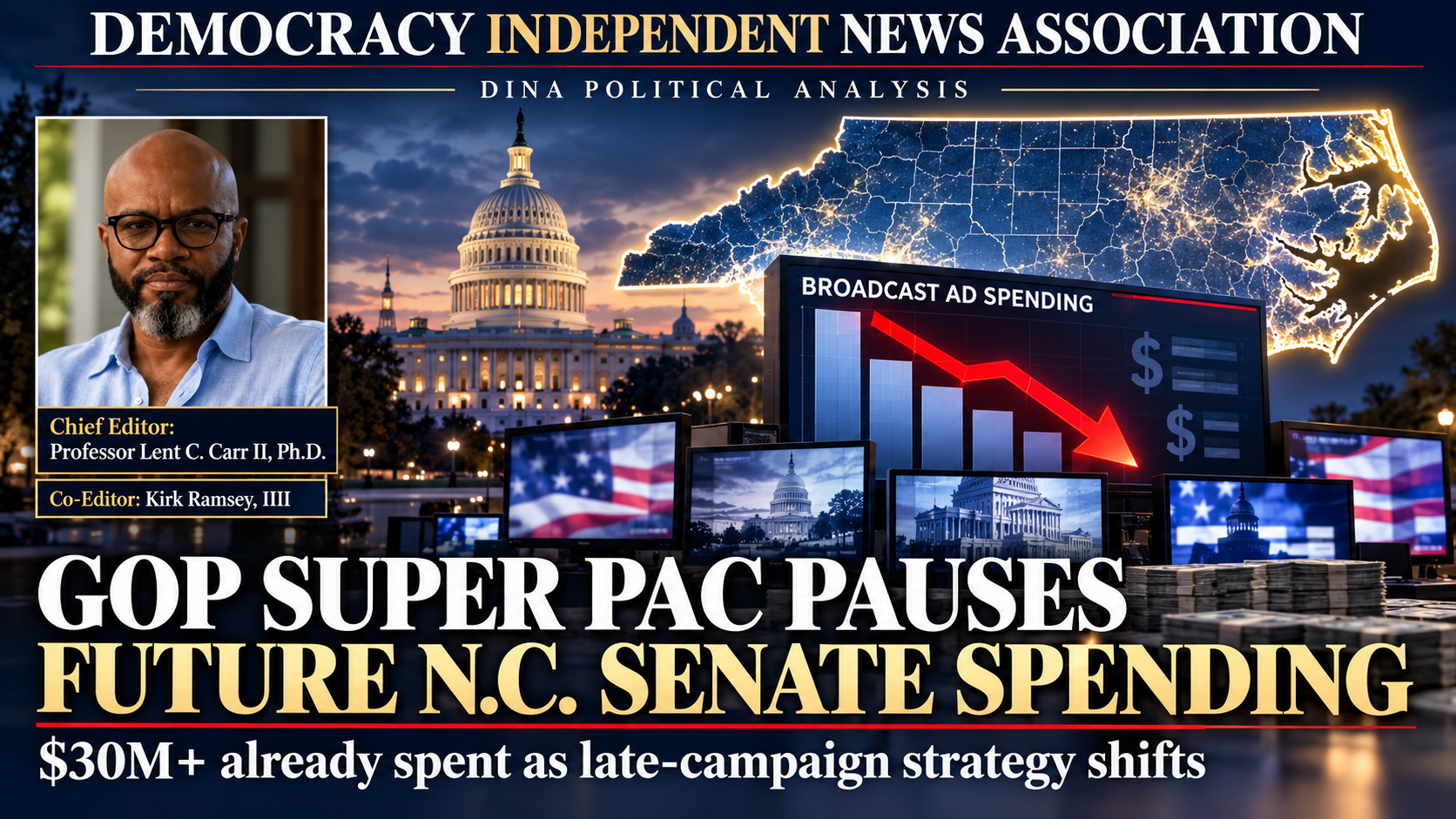
RALEIGH, N.C. — One of the nation’s most powerful Republican outside-spending groups is pulling back from North Carolina at the very moment the state’s open U.S. Senate race is entering its decisive final month. The Senate Leadership Fund has paused planned advertising here after spending more than $30 million in support of Republican nominee Michael Whatley, according to reporting by The Associated Press and Semafor.
The decision frees roughly $18 million in planned North Carolina spending over the closing weeks, according to ad-reservation data cited by AP. The group is adding $8.2 million in Kansas to defend Republican Sen. Roger Marshall, whose race has become unexpectedly competitive.
In April, the same organization announced an initial $71 million North Carolina commitment extending through Election Day. The contrast between that promise and today’s retreat is the clearest evidence yet that national Republican strategists see Democrat Roy Cooper’s advantage as expensive to reverse.
What the shift means—and what it does not
A canceled ad reservation is not an election result. Outside groups move money to maximize seats, and North Carolina remains a closely divided state that Donald Trump carried in 2024. Whatley’s campaign says it has sufficient resources to prosecute the race, while Cooper’s campaign says it is continuing to build an organization focused on earning votes. Republican spending can return, and other conservative groups can fill the airwaves.
Still, the timing matters. Early voting begins October 15. Campaigns are moving from persuasion to turnout, and broadcast inventory becomes more valuable as Election Day approaches. When a super PAC pauses future spending after investing tens of millions, it signals that decision-makers believe the same dollars may save more Republican seats elsewhere.
Polling points in the same direction
A Common Cause North Carolina survey released September 25 found Cooper leading Whatley 51% to 41% among 857 likely voters. The poll was conducted September 17 through 20 by Opinion Diagnostics and reported a margin of error of plus or minus 3.3 percentage points. With leaners included, the memo placed the race at 52% to 44%.
The survey also found Cooper leading unaffiliated voters and voters under age 45, while Whatley led in eastern North Carolina. No single poll should be treated as destiny. The more significant pattern is that the spending pullback aligns with a series of public surveys showing Cooper ahead. National Republicans are not abandoning Senate control; they are triaging a map that has become more difficult.
The hidden story is the power of outside money
North Carolinians should also ask why a small circle of national donors and strategists can decide whether tens of millions of dollars flood or disappear from the state’s information environment. Super PACs may raise and spend unlimited sums independently of candidates. Their advertising can define a race for voters who never see a town hall, policy paper or local interview.
The Federal Election Commission provides independent-expenditure data, but its standard aggregate table warns that the fastest 24- and 48-hour reports are not included in those totals.
DINA supports Democratic efforts to reduce the dominance of big money, require faster disclosure and give voters more public-interest information. A democracy should not depend on billionaires choosing which electorate receives another barrage of negative commercials.
DINA analysis
The Republican retreat is a measurable Democratic opportunity, not a permission slip for complacency. Cooper’s strength appears to rest on an established statewide identity, support among women and younger voters, and an advantage with unaffiliated voters.
Converting that coalition into a Senate seat requires registration, ballot access, early-vote organization and sustained attention to the issues driving households: health care, wages, education, reproductive freedom, voting rights and the cost of living.
The regular voter-registration deadline is 5 p.m. Friday, October 9. Eligible residents who miss it may use same-day registration during early voting, which runs October 15 through 3 p.m. October 31. Election Day is November 3. The clearest answer to outside money is participation that cannot be purchased.
Sources and methodology
- Associated Press — Republican super PAC pauses future North Carolina spending
- Semafor — Republicans pull ad spending from North Carolina
- Senate Leadership Fund — April investment announcement
- Common Cause North Carolina — poll release and methodology
- Federal Election Commission — North Carolina Senate data
- North Carolina State Board of Elections — registration and early-voting deadlines
Source note: The advertising decisions and dollar figures are attributed to the cited reporting and reservation data. A tactical spending decision is not a prediction or declaration of the election outcome.