
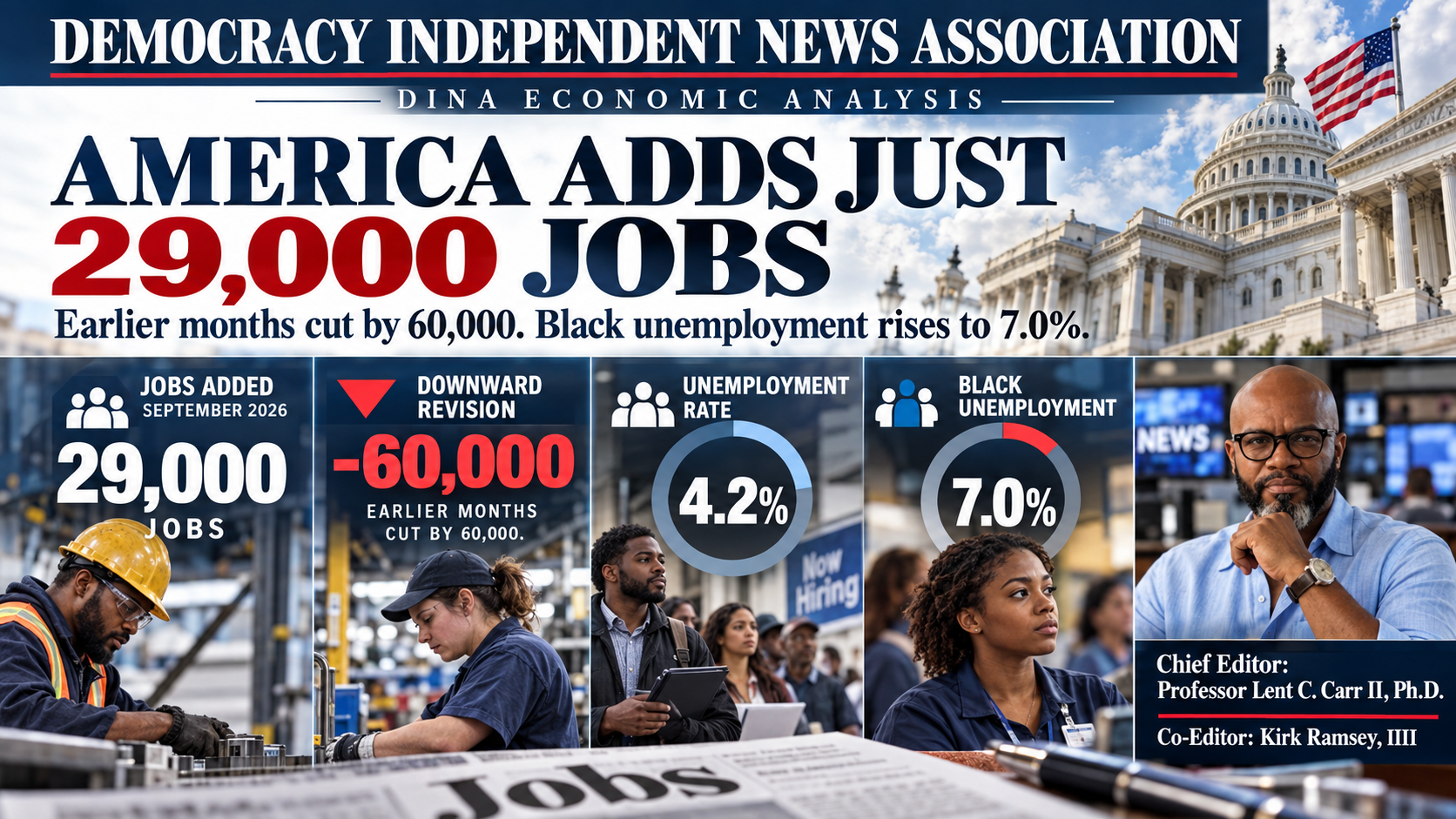
WASHINGTON — The United States added only 29,000 jobs in September, a weak reading that becomes more troubling when paired with downward revisions and a sharp one-month increase in Black unemployment. The national unemployment rate edged from 4.1% to 4.2%, representing 7.1 million unemployed people, the Bureau of Labor Statistics reported Friday.
BLS revised July from a gain of 21,000 jobs to a loss of 10,000 and reduced August from 162,000 to 133,000. Together, the two months produced 60,000 fewer jobs than previously estimated. September’s increase also fell below the average monthly gain of 45,000 over the prior year.
The headline rate conceals a racial warning
Black unemployment rose to 7.0% in September from 6.0% in August. The White unemployment rate was 3.6%. That leaves Black workers facing a jobless rate nearly twice as high.
Monthly demographic estimates can be volatile and should not be mistaken for a settled trend, but the size of the gap demands attention because it reflects a long-running structural inequality, not a new statistical curiosity.
The figures also show 1.9 million people unemployed for at least 27 weeks, accounting for 27.1% of all unemployed workers. About 4.5 million people were working part-time for economic reasons, and 5.8 million outside the labor force said they wanted a job but were not counted as unemployed because they had not recently searched or were unavailable to start.
Where jobs appeared and disappeared
Health care added 17,000 jobs, but that was about half its average monthly gain over the previous year. Construction added 11,000 and manufacturing added 9,000, changes BLS characterized as limited.
Financial activities lost 7,000 jobs and are down 129,000 from their May 2025 peak, most heavily in insurance and related work. Employment across retail, transportation, information, professional services, leisure and hospitality, government and several other major industries changed little.
Average hourly earnings increased five cents to $37.81, a monthly rise of 0.1% and a 12-month increase of 3.0%. The average workweek held at 34.4 hours. Those measures describe a labor market that is not collapsing but is producing too little new opportunity for workers seeking to enter, return or move into better jobs.
A low-hire, low-fire economy
The national picture is contradictory. Layoffs remain limited, and the unemployment rate has stayed within a narrow range since March. Yet hiring is subdued, long-term unemployment is substantial, and prior estimates keep being revised lower.
For a person already in a stable job, that may feel like security. For a recent graduate, a displaced worker, a parent returning to paid employment or a Black worker confronting unequal access, the same economy can feel closed.
That distinction matters politically. A low unemployment rate cannot by itself answer whether wages cover housing, food, energy, health care and child care; whether work is full-time and stable; or whether opportunity is distributed fairly across race, age and geography.
DINA analysis
Democratic economic policy should respond to the people behind the averages. That means defending health coverage and public services, enforcing anti-discrimination law, strengthening collective bargaining, expanding affordable child care and transportation, and directing apprenticeships and infrastructure investment toward communities that private capital repeatedly leaves behind.
It also means resisting austerity at the first sign of slower hiring. Cutting public investment into a cooling labor market would deepen the weakness the report already shows.
The racial unemployment gap should be treated as a national performance measure. When Black unemployment is nearly double White unemployment, leaders should not declare victory based solely on the topline. Full employment is not full if entire communities remain first fired, last hired or shut out of advancement.
Sources and statistical notes
- U.S. Bureau of Labor Statistics — Employment Situation, September 2026
- Reuters — September labor-market analysis
- Bureau of Labor Statistics — Current Employment Statistics overview
Methodology note: Monthly demographic estimates can be volatile. DINA distinguishes the official BLS findings from its policy analysis and will reflect any subsequent BLS correction or revision.