
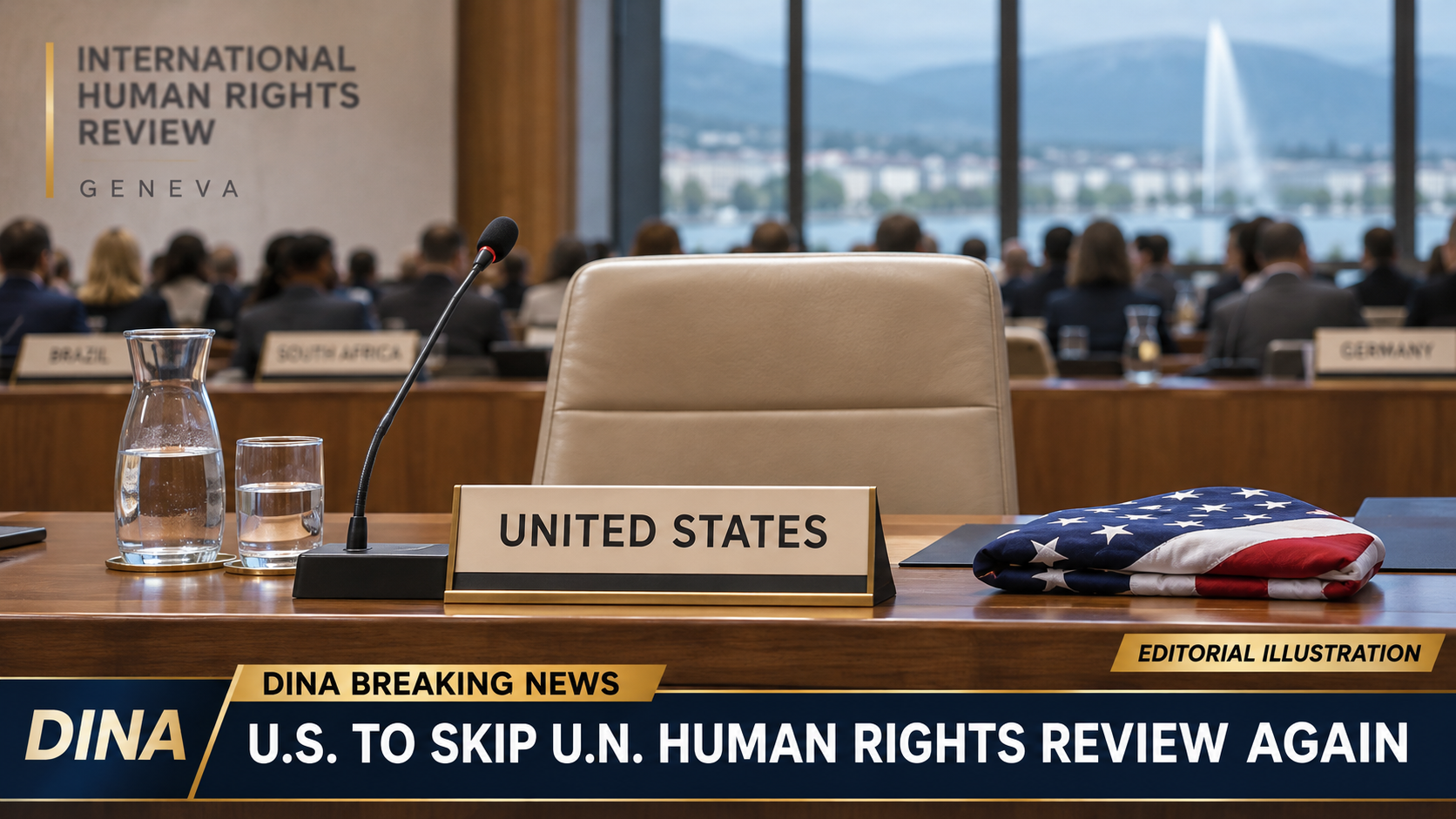
Breaking News · United States · United Nations · Human Rights · Civil Rights · International Accountability · DINA Analysis
Verification status: The official U.N. transcript records that the U.S. delegation was absent when its rescheduled Universal Periodic Review opened on November 10. The Working Group suspended the review, and the Human Rights Council adopted draft decision A/HRC/OM/20/L.1 without a vote, calling on Washington to cooperate and moving the review to the Working Group's fifty-fourth session. The procedural decision does not establish any allegation about the U.S. human-rights record as fact, impose a judicial penalty or compel participation.
Breaking update — November 10, 2026, 10:15 a.m. Eastern: The Human Rights Council recorded the empty U.S. seat, suspended the scheduled review and adopted a decision without a vote rescheduling it to the next UPR Working Group session. Associated Press reports that the next session is in January. No government presented or defended the U.S. record, and the Council did not adjudicate the allegations in civil-society submissions.
WASHINGTON / GENEVA — November 10, 2026: The U.N. Human Rights Council postponed the United States' human-rights review to its next working-group session after the Trump administration stayed away for a second consecutive year.
A State Department spokesperson told both the Associated Press and Reuters that participation would lend credibility to a body the administration considers hostile to the United States and biased in its treatment of Israel. The spokesperson described the Council as “irredeemable” and accused it of failing to confront serious abuses by some member governments. The department did not answer the substantive allegations submitted for the U.S. review in the accounts examined by DINA.
The official U.N. calendar identifies the United States as the subject of the Universal Periodic Review Working Group's November 10 afternoon session in Geneva. The corresponding U.N. Web TV page lists a broadcast for the review. The process was created to examine every U.N. member state's record on a rotating basis, regardless of whether the government is a member of the Human Rights Council.
When the meeting opened, the Council president said the U.S. delegation was not present and that no information had been received indicating Washington intended to participate. He suspended the Working Group session and convened an organizational meeting to consider a new noncooperation decision.
The president said the draft called on the United States to resume cooperation, directed him to continue urging Washington to participate and required reports on those efforts at regular Council sessions. He also said it moved the review to the Working Group's fifty-fourth session and left open consideration of further steps before that session ends.
No Council member requested a recorded vote. The president therefore declared the decision adopted. Associated Press characterized the result as a consensus postponement until January. DINA has not located a final posted copy of the adopted decision at this update cutoff; the official U.N. meeting transcript records the text's operative description and adoption.
A second refusal after a formal U.N. warning
The United States was initially scheduled for review on November 7, 2025. It did not participate. In a formal decision adopted without a vote, the Human Rights Council regretted the U.S. refusal, called on Washington to resume cooperation and moved the review to the Working Group's fifty-third session in 2026.
That decision also left open further steps under the Council's governing framework. It did not impose a judicial sanction, financial penalty or binding judgment against the United States. The Universal Periodic Review produces peer recommendations rather than court orders.
The Associated Press reports that a second refusal would make the United States the first country to completely shun a full regular review since the mechanism began. That characterization requires context: other governments have resisted or interrupted cooperation, and Israel previously boycotted the process before returning. The distinctive issue here is the United States' refusal after its review was formally postponed to give it another opportunity to participate.
What the review would examine
Under the UPR procedure, the government under review ordinarily submits a national report, presents its record, answers written and oral questions, and responds to recommendations from other U.N. member states. The Office of the High Commissioner for Human Rights also compiles information from U.N. bodies and summarizes submissions from civil-society organizations and national human-rights institutions.
Reuters reported that nearly 200 stakeholder submissions addressed issues including migration, racial discrimination, abortion and the death penalty. Those submissions are advocacy and evidentiary materials, not findings that every allegation is true. Participation would give U.S. officials a structured opportunity to dispute, contextualize or accept specific claims and recommendations in a public record.
The administration's refusal does not erase domestic constitutional protections, federal statutes, court review, congressional oversight or treaty obligations. It also does not establish that the United States committed any particular violation. It removes one international peer-review forum through which the government would publicly answer questions about its record.
What is confirmed, alleged and unresolved
- Confirmed: The U.N. scheduled the U.S. review for November 10, 2026, after Washington declined to participate in November 2025. The official transcript records that the U.S. delegation was absent, the review was suspended and draft decision A/HRC/OM/20/L.1 was adopted without a vote.
- Administration position: The department says participation would endorse a Council it views as anti-American, biased against Israel and insufficiently critical of serious rights violators.
- Advocacy allegations: Civil-rights and human-rights organizations have submitted claims concerning migration enforcement, racial discrimination, reproductive rights, capital punishment, protest, press freedom and other policies. Submissions are not adjudicated facts.
- Not yet established: Whether the United States will participate in the fifty-fourth session, whether the Council will take additional measures if it does not, or whether Washington will answer the submitted allegations through another public forum.
Why it matters
The United States has long invoked human rights in diplomacy, sanctions policy, foreign assistance and criticism of other governments. Refusing the same universal review applied to other states weakens Washington's ability to argue that international scrutiny should be reciprocal and evidence-based.
The consequences are institutional rather than immediately coercive. The Council cannot compel U.S. participation, and its recommendations are nonbinding. The adopted decision keeps the review alive and creates another deadline, but withdrawal leaves allegations unanswered in the forum designed to place government responses, supporting evidence and peer recommendations into one public record.
The refusal may also provide political cover for governments that want to avoid scrutiny of their own records. That is a risk, not a proven causal outcome. Whether another state cites the U.S. example should be documented rather than assumed.
DINA analysis
Independent accountability analysis: The administration is entitled to criticize the Human Rights Council's membership, priorities and treatment of Israel. Those objections do not answer the core accountability question: why should criticism of the institution prevent the United States from placing its own evidence and legal defenses on the record?
Participation would not require accepting every allegation or recommendation. The UPR expressly allows governments to explain their policies, reject recommendations and identify factual errors. By staying away, the administration avoids a structured exchange but also surrenders the most direct opportunity to challenge disputed claims before the international audience it says has been misled.
This is not proof that domestic oversight has disappeared. Courts, Congress, inspectors general, the press, civil society and voters remain separate accountability channels. DINA's concern is narrower: a government that asks others to submit to scrutiny should explain, with specific evidence, why it will not do the same.
The Council's choice to postpone rather than conduct a one-sided merits review is procedurally significant. It avoids converting untested submissions into findings while preserving the universality principle. The accountability test now shifts to whether the next session produces actual U.S. participation or another procedural delay.
Strongest accountability angle
The State Department should release the decision memorandum, legal analysis and interagency record supporting nonparticipation. The public should be able to see which UPR allegations officials reviewed, whether agencies prepared responses, which diplomatic consequences were assessed, and what alternative mechanism—if any—the administration will use to answer questions from allied governments and U.S. civil society.
Urgent follow-up and records to seek
- The State Department's written instruction to the U.S. missions in Geneva and New York concerning the November 10 review.
- Any interagency memorandum evaluating participation, nonparticipation, diplomatic costs and the effect on U.S. human-rights policy.
- Draft U.S. responses, talking points or agency submissions prepared for the review before the final decision.
- The Human Rights Council president's communications with the United States since the November 2025 noncooperation decision.
- The official meeting record, attendance list, transcript and procedural decision from the scheduled November 10 session.
- A complete index of stakeholder submissions and the U.S. agencies responsible for the subjects raised.
- Congressional correspondence, oversight requests or appropriations conditions addressing U.S. participation in the UPR.
- Any proposed alternative forum through which the administration intends to answer allied governments' human-rights questions.
Sources
- Associated Press — State Department confirmation and history of the rescheduled U.S. review, November 10, 2026
- Reuters — State Department position, stakeholder submissions and expected procedural consequences, November 10, 2026
- Office of the U.N. High Commissioner for Human Rights — United States Universal Periodic Review record and fourth-cycle schedule
- U.N. Web TV — scheduled United States review, fifty-third UPR session, November 10, 2026
- U.N. transcript — U.S. absence, suspension of the review and adoption of draft decision A/HRC/OM/20/L.1, November 10, 2026
- U.N. Human Rights Council Decision OM/19/101 — noncooperation and rescheduling of the United States review, adopted November 7, 2025
- U.N. General Assembly Resolution 60/251 — establishment and mandate of the Human Rights Council
- U.S. Department of State archive — explanation of the Universal Periodic Review process and government response options
Verification cutoff: Updated November 10, 2026, 10:15 a.m. Eastern. DINA compared the State Department position reported independently by AP and Reuters with the U.N.'s official schedule, prior noncooperation decision, Web TV record and meeting transcript. The transcript is machine-generated and not an official verbatim record, but it is published by the United Nations and directly records the Council president's procedural announcement and adoption of the draft decision. The article distinguishes that confirmed procedure from unadjudicated allegations about the U.S. record. The associated image is an AI-generated DINA editorial illustration; it does not depict the actual Geneva chamber, any identifiable delegate, document or item of evidence.