
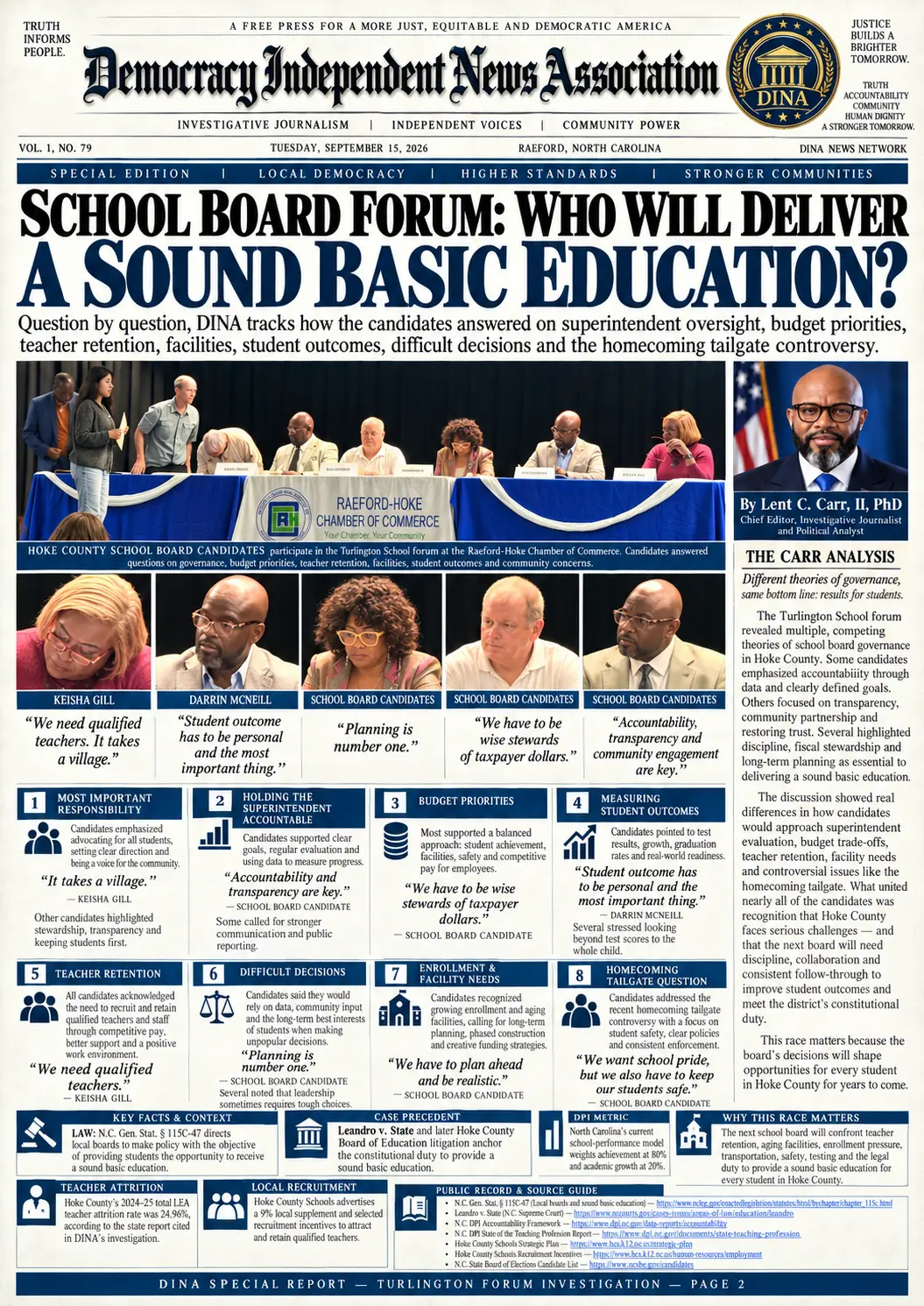
RAEFORD, N.C. — At the Turlington School forum, candidates for the Hoke County Board of Education repeatedly promised accountability, transparency and student-centered leadership. North Carolina law and Hoke County’s own numbers tell voters exactly where to start measuring those promises.
The field included Gary Brigman, Catherine Blue, Angela Southerland, George Small, Gwendolyn Robinson, Roosevelt McPherson, Darrin L. McNeill, Christopher A. Leach, John F. Harry and Keisha Bronson Gill. The forum record supplied for DINA’s review included substantive responses from Brigman, Small, Robinson, McNeill, Leach, Harry and Gill. It did not include answers from Blue, Southerland or McPherson, so this analysis does not attribute positions to them.
The candidates differed in emphasis, but nearly every answer returned to one proposition: the next board will be judged by whether students receive the sound basic education guaranteed by the North Carolina Constitution.
1. The board’s most important responsibility
Candidates spoke of advocating for students, setting clear direction and ensuring that children have a voice. Keisha Bronson Gill captured the community obligation in one phrase: “It takes a village.”
The legal responsibility is more specific. Under North Carolina General Statute §115C-47, a local board governs the school system, determines educational policy, employs the superintendent and helps provide the conditions necessary for instruction. Board members do not manage every classroom. They set policy, hire and evaluate executive leadership, approve budgets and demand public evidence of results.
A candidate who promises to “fix” individual schools should therefore explain how that promise fits the board’s lawful role. Effective boards govern through goals, policy, oversight and resource allocation—not daily micromanagement.
2. Holding the superintendent accountable
Candidates generally supported clear goals, regular evaluation and the use of data. One forum answer summarized the standard: “Accountability, transparency and communication are key.”
That is correct, but incomplete until the board identifies the measures. A serious superintendent evaluation should include student growth, achievement gaps, graduation and attendance, teacher vacancies, staff retention, school safety, exceptional-children compliance, facility milestones and financial controls.
The board should adopt those measures in public, review progress on a published schedule and distinguish confidential personnel matters from performance information the community has a right to see.
3. Budget priorities
Forum participants described a balanced approach: student achievement, facilities, safety and competitive pay. Another answer offered the right principle: “We have to be wise stewards of taxpayer dollars.”
Stewardship is not simply spending less. It is directing limited dollars toward the greatest educational need and disclosing the tradeoffs. Every budget should tell residents what is funded, what is delayed, what outcome is expected and what risk the district accepts by leaving a need unmet.
Hoke County commissioners provide the local share of school funding, while the school board decides how district resources are used within law. That division makes open coordination essential. Neither board should use the other as a shield when facilities, staffing or student services fall short.
4. Measuring student outcomes
Darrin L. McNeill told the forum, “Student outcome has to be personal and the most important thing.” Candidates referred to test results, growth, graduation rates and readiness for life beyond school.
North Carolina’s accountability model has historically placed substantial weight on achievement and a smaller—but still important—weight on academic growth. Those measures do not tell the whole story, but a board cannot ignore them. It should examine performance by school, grade, subject and student group, then ask whether budget and staffing decisions respond to the gaps.
“Whole child” language should add measures, not replace them. Attendance, discipline, career credentials, advanced-course access, literacy, special-education services and postsecondary readiness help complete the picture.
5. Recruiting and retaining teachers
Gill told the audience, “We need qualified teachers. It takes a village.” Every candidate acknowledged the need to recruit and retain qualified educators through competitive compensation, support and a positive working environment.
The data turn that consensus into an emergency. DINA’s review of the state’s 2024–25 employment-trends data found a 24.96 percent total local-education-agency attrition figure for Hoke County—reflecting both educators who left North Carolina public schools and those who moved to another district. The comparable statewide LEA effect was 14.55 percent.
That distinction matters. A teacher who transfers to another North Carolina district is not lost to the state, but is lost to Hoke County. For students, the classroom disruption is real either way.
The district advertises a local salary supplement and recruitment incentives. The next board should publish a retention dashboard showing vacancies, turnover by school and subject, exit reasons, days required to fill positions, and whether local incentives actually reduce departures.
6. Difficult decisions
Candidates said difficult choices should rest on data, community input and the long-term interests of students. One answer put planning first: “Planning is number one.”
That principle will be tested when desirable programs compete for limited funds; when an aging facility requires costly repair; when enrollment shifts; or when a superintendent recommendation draws public opposition.
A board’s obligation is not to avoid controversy. It is to use a fair process, disclose the evidence, state the governing standard and accept responsibility for the vote.
7. Enrollment and facility needs
Candidates recognized growing enrollment and aging facilities, calling for long-term planning, phased construction and creative financing.
Facilities are educational policy. Overcrowding affects schedules and class size. Deferred maintenance affects health and safety. Transportation time affects attendance and family life. Capital decisions must therefore be tied to enrollment projections, building conditions, land-use growth and a public timeline.
The school board and county commissioners should publish a joint, multi-year capital plan showing project priority, estimated cost, funding source, status and any change from the previous year.
8. The homecoming tailgate controversy
The candidates addressed the incident as a question of safety, policy and consistent enforcement. The essential position was stated plainly: “We want school pride, but we also have to keep our students safe.”
The next board should go further. It should publish the policy that governed the event, clarify who held decision-making authority, review communication among administrators and law enforcement, and explain what procedure will apply in the future.
Safety and school culture do not have to be enemies. Clear rules announced in advance protect both. Inconsistent or improvised enforcement damages trust even when officials act from legitimate concern.
The Leandro standard
Hoke County is not incidental to North Carolina’s constitutional education story. It is part of the litigation that produced the Leandro line of decisions, which recognized every child’s right to an opportunity for a sound basic education.
That history gives this election special weight. Board candidates are not merely competing to supervise a local institution. They are seeking authority in the county whose name is attached to one of the state’s defining education cases.
The constitutional promise becomes real only when classrooms have effective teachers, schools are safe, facilities support instruction, resources follow documented needs and the board measures whether students are learning.
The Carr analysis
The forum revealed several theories of school governance. Some candidates emphasized measurable goals and accountability. Others focused on transparency, community partnership and restoring trust. Several highlighted discipline, fiscal stewardship and long-range planning.
Each approach contains part of the answer. None is sufficient alone.
The next board will need the discipline to set priorities, the courage to publish results, the judgment to oversee the superintendent without micromanaging, and the persistence to follow through when public attention moves elsewhere.
The question is not which candidate used the strongest language at Turlington. It is who will convert language into policy, policy into execution and execution into better outcomes for every Hoke County student.
Public record and source guide
- N.C. General Statute §115C-47 — powers and duties of local boards of education
- N.C. DPI — 2024–25 employment trends for public-school educators
- N.C. DPI — School Report Cards and accountability data
- Hoke County Schools — official district information
- Hoke County Board of Education v. State — North Carolina Judicial Branch
Archive note: This canonical web edition restores DINA’s September 15, 2026 school-board forum analysis and its original edition artwork.