
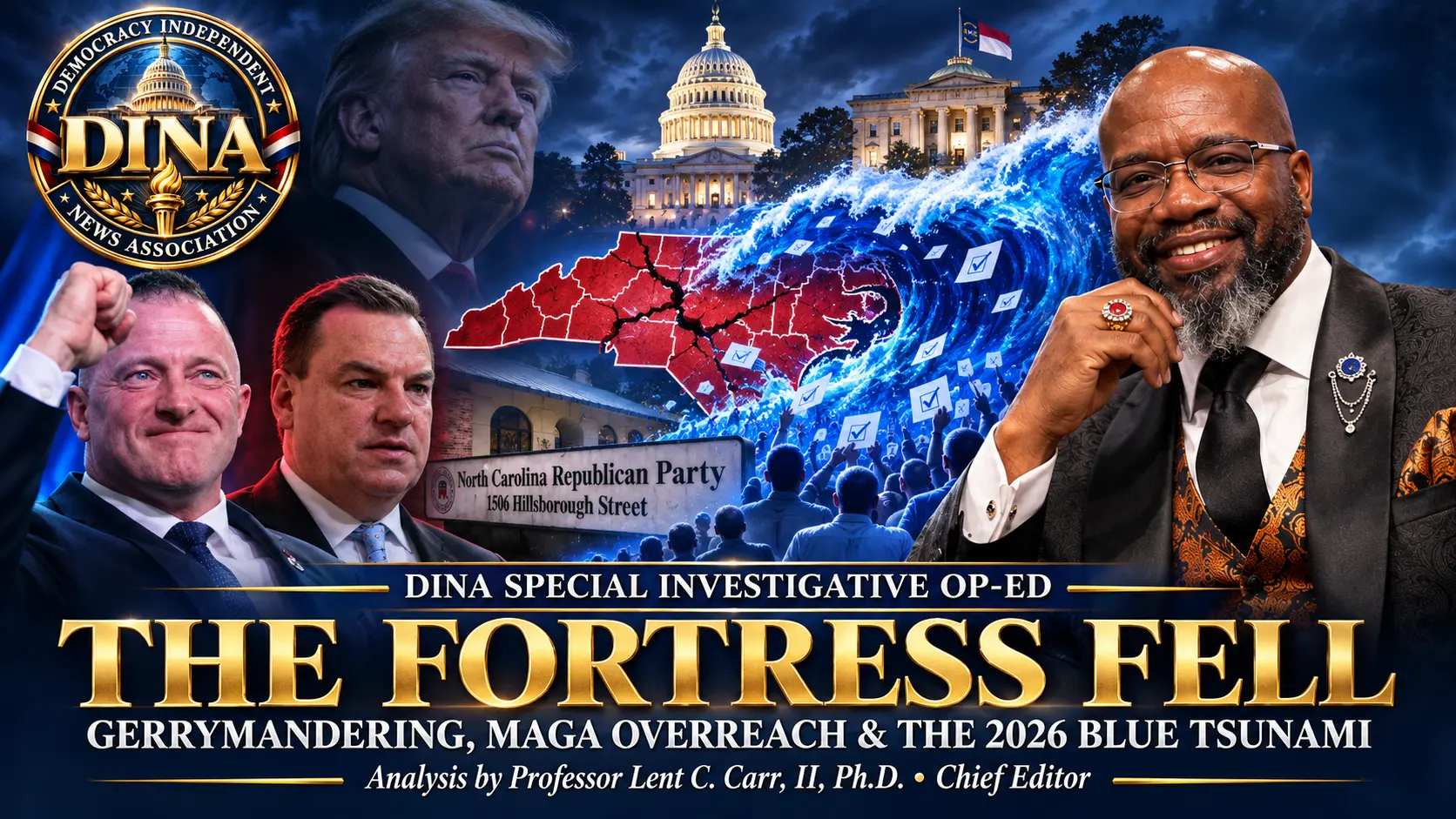
For months, DINA warned that the Republican Party’s greatest threat was not a Democratic slogan, a consultant’s commercial or a late campaign surprise. It was the Republican Party’s own governing conduct. The GOP had mistaken possession of the machinery for possession of the people. It had confused a gerrymandered map with a democratic mandate, a congressional majority with moral permission, a presidential cult with a durable coalition and a law carrying the words “One Big Beautiful Bill” with an economy that working people could actually afford.
Election Night exposed the difference.
The fortress did not merely crack. It failed at its load-bearing points. Democrats won control of both chambers of Congress. North Carolina voters broke sixteen years of Republican control of the state House. Republicans lost their state Senate supermajority. Former Governor Roy Cooper captured North Carolina’s United States Senate seat. Democratic congressional candidates penetrated districts drawn to prevent precisely that result. And in North Carolina’s 9th Congressional District, Richard Ojeda defeated the man entrusted with the Republican Party’s national House campaign money and strategy: National Republican Congressional Committee Chairman Richard Hudson.
With all 169 precincts reporting, Ojeda led Hudson 138,707 votes to 132,692, or 51.1 percent to 48.9 percent—a margin of 6,015 votes. Hudson conceded before the formal canvass, and the Associated Press called the race on November 5. Two years earlier, Hudson had won by nearly nineteen percentage points, while Donald Trump carried the district by about sixteen. Hudson’s campaign reported approximately $4.17 million in receipts through October 14, compared with Ojeda’s $2.93 million. Hudson spent about $3.88 million; Ojeda spent about $2.94 million. The national Republican “purse holder” had more money, more institutional power, incumbency and a map rated R+8. The voters fired him anyway.
That is not a routine turnover. It is a political autopsy.
The electorate did not simply reject a slate of candidates. By lawful ballots, it killed a godforsaken project to confuse domination with order, extraction with prosperity and obedience with patriotism. It delivered a warning to every faction that imagines democratic consent can be replaced by legal engineering: the people may be delayed, divided and burdened, but they cannot be permanently mapped out of their own republic.
The verdict before the certification
The legal count and the political verdict are related but distinct. North Carolina law requires provisional-ballot review, county canvasses and a statewide canvass before certification. Those safeguards matter. A democracy worthy of defense counts every lawful ballot and corrects errors before entering judgment.
But certification is not required to identify the scale of the national repudiation. The Associated Press called Democratic control of the Senate at 11:36 p.m. on November 3 and Democratic control of the House at 1:24 a.m. the following morning. Preliminary national turnout was approximately 124.3 million voters, or 49.42 percent of the voting-eligible population. That is not the all-time midterm record; current estimates place it just below 2018 and as the second-highest midterm turnout rate since 1914. North Carolina’s reported turnout was 53.56 percent—4,223,318 ballots—up from roughly 51 percent in 2022.
The result extended far below Washington. By November 6, the National Conference of State Legislatures reported twelve legislative chambers moving from Republican to Democratic control, including the North Carolina House and both chambers in Arizona, New Hampshire and Wisconsin. Democrats gained governorships in Georgia, Iowa, Nevada, Ohio and Texas. International leaders and newspapers described the outcome as a rebuke of polarization, war and authoritarian populism. What began in precincts and county boards became a global democratic signal.
North Carolina was not a footnote to that story. It was the laboratory in which Republican overreach failed most spectacularly.
The gerrymander that ate its architects
In October 2025, the North Carolina General Assembly enacted a new congressional map for the 2026 election. The redistricting bill did not require the governor’s signature; Article II, Section 22 of the North Carolina Constitution excludes congressional and legislative redistricting bills from the ordinary gubernatorial veto process. Republican state Sen. Ralph Hise stated the partisan objective without disguise: the redraw was intended to add another Republican seat to the congressional delegation.
The map was constructed as a firewall. It became a fuse.
North Carolina entered the cycle with a 10–4 Republican congressional delegation. The new map was designed to make the Democratic-held 1st District substantially more Republican while protecting a wider Republican advantage. Instead, Don Davis survived in the 1st, Ojeda defeated Hudson in the 9th, and Democrats won seats held by Addison McDowell, Brad Knott and Tim Moore, along with the seat vacated by Chuck Edwards. As of this writing, nine Democratic victories had been called in North Carolina’s fourteen districts, with another Democratic gain still possible as close contests moved toward canvass.
The strategic error was elementary but fatal. To manufacture more Republican districts, mapmakers diluted some of their safest Republican constituencies. A gerrymander is not magic; it is a model built on assumed voter behavior. It works by packing one side and spreading the other across districts with calculated margins. When the statewide swing exceeds those margins, the firewall becomes a row of connected doors. The same lines designed to multiply power can multiply losses.
This is the precise political mechanism described in The Political Black Letter Game. In the chapter “Democracy Without Democracy,” I wrote:
“Your vote gets diluted through gerrymandering that ensures safe seats for incumbents while reducing competitive elections that might produce representatives responsive to constituent needs rather than party leadership preferences.”
The legal doctrine explains how the scheme survived long enough to be attempted. In Rucho v. Common Cause (2019), the United States Supreme Court held that partisan-gerrymandering claims present political questions beyond the reach of federal courts. In Harper v. Hall (2023), a newly constituted North Carolina Supreme Court reversed its prior position and held that partisan-gerrymandering claims were nonjusticiable under the state constitution. Racial-gerrymandering and Voting Rights Act claims remain legally distinct, but pure partisan-fairness claims now encounter closed courthouse doors in both systems.
That produced a classic Black Letter Game: a profoundly anti-democratic arrangement could remain procedurally lawful because the institutions capable of testing its democratic injury had declared the central partisan question nonjusticiable. The map was legal. The veto was unavailable. The judicial remedy was restricted. The architects therefore acted as if legality had settled legitimacy.
The voters supplied the missing remedy.
As the manuscript states, “The game functions by training people to equate legality with legitimacy.” The 2026 result broke that equation. North Carolinians did not need a court to tell them that a map drawn to preselect their representatives was an insult. They used the ballot box to overwhelm its tolerances.
The “Big Beautiful Bill” became an ugly receipt
The second Republican failure was economic. Public Law 119-21—the 2025 reconciliation law marketed as the “One Big Beautiful Bill”—was sold as growth, relief and national renewal. Its distributional design told a harsher story.
The Congressional Budget Office estimated that the law would increase cumulative federal deficits by roughly $4.2 trillion over 2025–2034 when debt-service and macroeconomic effects are included. CBO projected a net reduction of about $1.2 trillion in Medicaid outlays through 2035, a reduction of 13.1 million Medicaid enrollees by 2035, and 7.5 million more uninsured people in 2034 from Medicaid-related changes. It also projected approximately $211 billion less in Supplemental Nutrition Assistance Program spending through 2035. CBO’s distributional analysis reached the governing moral fact: resources decrease for households toward the bottom of the income distribution while increasing for households in the middle and toward the top.
That is not populism. It is upward redistribution wearing a hard hat.
By mid-2026, polling showed that the law remained underwater. Navigator Research reported 33 percent favorable and 48 percent unfavorable nationally, with 60 percent saying the Republican budget had increased their costs. The details were even less defensible than the branding: Medicaid and food assistance reductions, higher household exposure and tax advantages concentrated away from the families most vulnerable to rising prices.
The political consequence became visible in the exit data. The AP Voter Poll found that about two-thirds of voters believed Trump’s policies had made the economy worse; roughly eight in ten of that group backed the Democratic candidate for the House. About six in ten voters were very concerned about everyday costs. An October AP-NORC poll found 79 percent disapproved of Trump’s handling of the cost of living and 74 percent disapproved of his handling of the economy.
Republican strategists kept talking about aggregate growth, market indexes and ideological victory. Voters answered with grocery receipts, rent notices, utility bills, medical costs and gasoline prices. A family cannot eat a press release. A rural hospital cannot operate on a slogan. A veteran cannot fill a prescription with a tax-cut talking point.
The Political Black Letter Game anticipated the misdirection:
“Culture wars convert legitimate pain into misdirected rage. They offer belonging without justice. Release without repair. The beneficiaries are clear. Wealth consolidates. Power stabilizes. Accountability disappears.”
For a time, the strategy worked. Cultural conflict consumed attention while economic policy shifted risk downward. But there is a limit to symbolic politics when material conditions become unbearable. In 2026, the wallet defeated the wedge.
War, immigration and the collapse of manufactured consent
The economy was not operating in isolation. Trump’s tariffs, the prolonged Iran war and the administration’s immigration enforcement became mutually reinforcing symbols of a government that demanded sacrifice from ordinary people while refusing accountability at the top.
National polling found that most voters believed the United States had made the wrong decision to enter the Iran conflict. Higher energy prices intensified the cost-of-living crisis. Immigration enforcement, once treated by Republican strategists as an unqualified electoral advantage, crossed a moral and political line for many voters; post-election polling found roughly six in ten saying enforcement had gone too far.
The administration’s theory was that force projects competence. The electorate saw cruelty, chaos and cost.
The Theology of Chains identifies the deeper moral architecture of that politics:
“Christian nationalism tolerates democracy only when democracy preserves hierarchy.”
And later:
“Authoritarianism is framed not as tyranny, but as moral necessity. This is how democracy is hollowed from within.”
Those lines matter because MAGA power was never sustained by policy alone. It required a moral exemption: the claim that domination was permissible because the nation was endangered, that dissent was betrayal, that punishment was restoration and that the leader’s will embodied a sacred national interest. Fear was converted into authorization.
But fear has diminishing returns. When the promised order produces higher prices, war fatigue, masked raids, family separation, institutional corruption and public exhaustion, the performance collapses. Manufactured consent fails when lived experience becomes stronger than propaganda.
Richard Hudson and the defeat of the Republican money machine
No race embodies that collapse more completely than NC-9.
Hudson was not an ordinary incumbent. As NRCC chairman, he was the fifth-ranking House Republican and the highest-ranking North Carolina Republican in congressional history. His job was to recruit candidates, raise money, allocate resources and protect the House majority. He had helped direct hundreds of millions of dollars across the national battlefield. Yet in the closing weeks, the campaign chairman had to divert attention and television money to protect himself in a district Washington had considered safe.
Ojeda’s victory therefore carries three meanings.
First, it is a district verdict. Voters in a military-heavy district chose a retired Army major who centered drug prices, Social Security, veterans, corporate money and opposition to endless war.
Second, it is an institutional verdict. The official responsible for the national Republican House strategy failed to detect or contain the wave in his own electorate.
Third, it is a class verdict. Ojeda was out-raised, outspent and opposed by the incumbent architecture of Washington power. He still won. Money remained powerful; it ceased to be sufficient.
The sea change was not mysterious. Hudson voted for the governing agenda, defended the Republican majority and served as custodian of its campaign machinery. Voters connected national consequence to local representation. They did not merely punish a president hundreds of miles away. They removed the congressman who helped finance and preserve the president’s congressional shield.
Republicans themselves are now saying what MAGA refuses to hear
The scale of the loss has produced unusually blunt dissent inside the Republican Party. At least five prominent voices have publicly rejected the fiction that nothing fundamental happened:
Vice President JD Vance wrote, “The reason we lost is the war,” and acknowledged that some Trump-Vance voters moved to Democrats.
Sen. Ted Cruz called the result a “Watergate-level repudiation” and said tariffs had made goods too expensive.
Sen. Thom Tillis warned, “If you double down on dumb, you’re going to get the same result.”
Rep. Nicole Malliotakis said the administration had gone “too fast, too far” and called for a reset toward the concerns voters had actually expressed.
Rep. Marlin Stutzman called the elevation of Stephen Miller a “bad mistake” and said Republicans must admit they “got beat and got beat badly.”
Former Sen. Mitt Romney reduced the indictment to seven words: “Bad policy, bad character make bad politics.” Ohio Gov. Mike DeWine connected the Iran war to gasoline prices. Florida Gov. Ron DeSantis said the party must become ideas-based beyond Trump’s personal brand.
These are not progressive activists. They are Republican officials describing an extinction-level strategic failure from inside the building.
Replacing Susie Wiles with Stephen Miller is not a correction
The White House response confirms that the warning has not been absorbed. Susie Wiles resigned after the midterm defeat, and Trump announced that Stephen Miller would become chief of staff effective November 9. Trump publicly described the change as simply the right time for a transition, while multiple reports said he had privately blamed Wiles for the losses.
Miller is the architect of the administration’s hard-line immigration program and one of its most maximalist advocates of executive action. His selection signals escalation, not reflection. It replaces a chief of staff credited with imposing operational discipline with the public face of policies that voters had just rejected as excessive.
Precision matters here. Miller denied personal involvement in Project 2025 during the 2024 campaign. Yet America First Legal, which he co-founded, had appeared on Project 2025’s advisory board; personnel affiliated with the organization contributed to the project’s Justice Department chapter, and Miller appeared in a Presidential Administration Academy video. Project 2025 itself was a Heritage Foundation-led structure built around four pillars: a policy agenda, a personnel database, training and a 180-day implementation playbook. Its own leaders described the goal as assembling aligned, vetted and trained personnel prepared to “deconstruct the administrative state.”
Whatever label Trump applies, replacing Wiles with Miller moves the administration closer to the central Project 2025 method: concentrated executive power, ideologically aligned personnel and rapid implementation designed to outrun institutional resistance.
That is why the appointment is a political nuclear warning. The electorate pulled a fire alarm. Trump changed the accelerant.
What The Political Black Letter Game saw before the pundits did
The relevance of The Political Black Letter Game to 2026 is not that one book caused 124 million people to vote. Serious analysis does not confuse intellectual anticipation with sole causation. Its significance is that it named the operating system before Election Night supplied the crash report.
The manuscript identifies five dynamics now visible in the returns:
Legality can camouflage illegitimacy. A gerrymander can be duly enacted, exempt from gubernatorial veto and insulated from pure partisan review while still violating democratic expectations.
Chaos can be governance, not incompetence. Constant disruption overwhelms courts, agencies, journalists and citizens, allowing structural changes to proceed beneath the noise.
Culture war can redirect economic pain. Symbolic enemies keep working families divided while wealth, risk and political access move upward.
Economic insecurity weakens democracy. Voters in survival mode are easier to manipulate—until material suffering becomes so widespread that it creates cross-cultural solidarity.
Procedure does not absolve harm. The Carr Doctrine requires law and policy to be judged by foreseeable human consequences, not merely technical compliance.
The manuscript states:
“At its core, the Carr Doctrine insists on three governing principles. First, human dignity is the supreme legal interest.”
That principle supplies the moral test the “Big Beautiful Bill” failed. Did the law strengthen human dignity, or did it expose low-income households to greater insecurity while increasing resources at the top? Did immigration enforcement protect lawful order, or did its methods abandon proportionality and human worth? Did redistricting protect representation, or did it protect incumbents from representation?
The 2026 electorate did not use the vocabulary of the Carr Doctrine on every doorstep. It applied its test nonetheless: Who benefits? Who suffers? What are the human consequences? Does this government serve us, or merely process us?
The book’s closing proposition is therefore not a victory lap. It is a democratic instruction:
“The Political Black Letter Game ends when you refuse to play, but only when that refusal becomes collective action capable of changing policies.”
Election Night was collective refusal.
What The Theology of Chains adds to the record
The Political Black Letter Game explains the legal and institutional machinery. The Theology of Chains explains how conscience is recruited to defend it.
The latter manuscript traces a recurring American practice: power is moralized so that hierarchy appears righteous and resistance appears sinful. That history extends from religious defenses of slavery and segregation to punitive government and modern Christian nationalism. The argument is not that Christianity is inherently oppressive; it is that religious language has repeatedly been engineered to sanctify domination when power requires moral cover.
Its warning is direct:
“A faith that blesses domination betrays both God and democracy.”
That sentence belongs in the 2026 political record. It explains why the collapse cannot be analyzed only through precinct math. The vote was also a moral recoil against a politics that demanded Christian legitimacy while inflicting fear, exclusion and abandonment. Millions of people of faith refused the proposition that cruelty becomes holy when wrapped in a flag.
The manuscript offers another rule for the 2028 cycle:
“History must be confronted honestly or it will govern silently.”
America cannot defeat authoritarian politics while refusing to name the histories—racial hierarchy, economic extraction, punishment theology and voter exclusion—from which authoritarian appeals draw their power.
Project 2026 and the road to 2028
Project 2025 was built to capture governing machinery. The democratic answer cannot be a temporary coalition held together only by dislike of Donald Trump. A durable counter-doctrine—what I have called Project 2026—must convert resistance into a governing program capable of surviving the next charismatic strongman, the next donor network and the next mapmaking scheme.
The 2028 mandate should include:
Economic security as democratic infrastructure. Restore and expand healthcare access, protect Medicaid and nutrition assistance, reduce prescription costs, defend Social Security and veterans’ care, strengthen labor rights and make wages answer the actual cost of living.
Justice Impact Assessments. Require every major federal and state bill to disclose foreseeable effects on healthcare, housing, poverty, racial equity, rural communities, veterans, education, civil rights and the deficit before final passage.
Representative democracy that cannot be pre-rigged. Establish independent redistricting, protect early voting and ballot access, restore the Voting Rights Act, create enforceable transparency for mapmaking and make election administration a public trust rather than a partisan weapon.
Anti-oligarchy reform. Confront dark money, contractor influence, self-enrichment, revolving-door government and campaign finance structures that allow wealth to buy access unavailable to ordinary citizens.
Truth as public infrastructure. Protect independent journalism, public records, inspectors general, whistleblowers, professional civil servants and empirical agencies whose work permits citizens to distinguish policy from propaganda.
Constitutional restraint and human dignity. Reassert that no president is the state, no party owns the nation, no religious faction has a divine title to public power and no emergency eliminates the constitutional obligation to treat persons as ends rather than instruments.
This is why The Political Black Letter Game will matter even more in 2028. The coming conflict will not be merely Democrat versus Republican. It will be democratic accountability versus managed consent; human dignity versus oligarchic extraction; public law versus personalized power; truth versus spectacle.
The book gives citizens a method: read the rule, identify who wrote it, trace who profits from it, measure who is harmed by it and refuse to confuse legality with justice. That method is portable. It applies to a redistricting statute, a Medicaid work requirement, a tariff, an executive order, a detention policy, a campaign finance loophole or a Supreme Court doctrine.
Readers may obtain The Political Black Letter Game in paperback on Amazon or as a Kindle edition.
The final warning
Republicans can recover from an election loss. They cannot recover from refusing to understand it.
The 2026 blue tsunami was produced by converging forces: unaffordable life, unpopular war, tariff pain, immigration excess, corruption fatigue, attacks on democratic constraints, candidate weakness and a gerrymandering strategy that converted presumed safety into synchronized vulnerability. No single cause owns the wave. Together, they created a national judgment.
The most dangerous post-election development is therefore not Republican defeat. It is Trump’s decision to interpret defeat as a demand for greater extremism. Elevating Stephen Miller after voters rejected the policies he personified tells the country that the administration intends to govern against the warning rather than learn from it.
North Carolina should be studied for decades because it demonstrates both the reach and the limit of anti-democratic engineering. The mapmakers had statutes, data, legislative control, money, incumbency and favorable doctrine. The voters had ballots. In the end, the ballots were enough.
That is the lesson MAGA never understood: democracy is not weak because it is patient. It is patient because legitimacy takes time to assemble. But once citizens recognize that the game is being played against them, patience becomes organization, organization becomes turnout and turnout becomes judgment.
The fortress fell because it was built on a lie—that power could permanently substitute for consent.
The people corrected the record.
Editorial disclosure
Professor Lent C. Carr, II was a candidate in the March 3, 2026 Democratic primary for North Carolina’s 9th Congressional District. Richard Ojeda won that primary and subsequently defeated Republican incumbent Richard Hudson in the general election. This analysis is presented transparently as the author’s political, legal and editorial judgment. Factual claims are sourced below; evaluative conclusions are opinion.
Source record for publication
- North Carolina State Board of Elections, “What’s Next for Finalizing 2026 Midterm Elections?”, November 4, 2026; statewide unofficial results dashboard and historical results files.
- Associated Press, “Calling control of Congress in the 2026 midterm elections.”, November 5, 2026.
- WUNC, “Ojeda defeats Republican campaign chairman Hudson in NC’s 9th Congressional District.”, November 4, 2026.
- Federal Election Commission candidate data for Richard Hudson and Richard N. Ojeda, 2025–2026 cycle, coverage through October 14, 2026.
- North Carolina General Assembly, 2025 congressional map, Session Law 2025-95; North Carolina Constitution, Article II, Section 22.
- Rucho v. Common Cause, 588 U.S. 684 (2019); Harper v. Hall, 384 N.C. 292 (2023).
- Congressional Budget Office, “Distributional Effects of Public Law 119-21”, August 11, 2025; “The Budget and Economic Outlook: 2026 to 2036”; “Effects on Deficits and the Debt of Public Law 119-21”, August 4, 2025.
- AP-NORC Center for Public Affairs Research, “Ahead of the midterms, most voters cite the economy and cost of living as top issues and favor political change.”, October 2026.
- Associated Press, “How Trump and Republicans lost the 2026 midterm elections, according to The AP Voter Poll.”, November 4, 2026.
- University of Florida Election Lab, “2026 General Election Turnout.”, preliminary estimate updated November 6, 2026.
- National Conference of State Legislatures, “2026 State Legislative Elections: The Results and What They Mean.”, November 6, 2026.
- Associated Press reporting on the Wiles–Miller chief-of-staff transition, November 7, 2026; corroborating Reuters reporting, November 6, 2026.
- Heritage Foundation, Project 2025’s four pillars, Mandate for Leadership and Presidential Administration Academy.
- CBS News and Spectrum News reporting on Republican post-election criticism by JD Vance, Ted Cruz, Thom Tillis, Nicole Malliotakis, Marlin Stutzman and others, November 4–8, 2026.
- Professor Lent C. Carr, II, The Political Black Letter Game, master manuscript, chapters 9, 12 and 14.
- Professor Lent C. Carr, II, The Theology of Chains, master manuscript, chapters 6 and 8.