
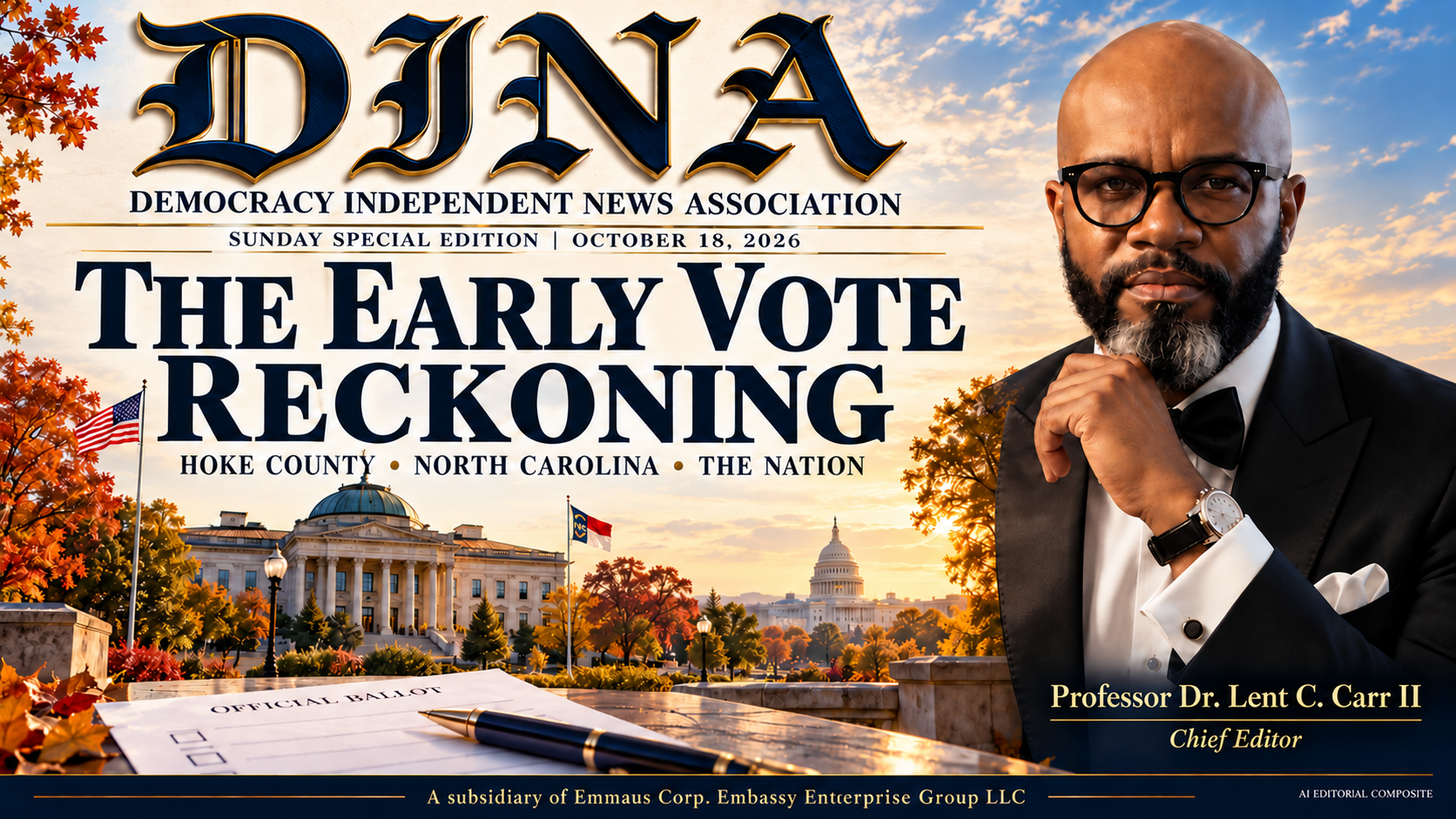
DINA SUNDAY SPECIAL EDITION • OCTOBER 18, 2026
INVESTIGATIVE RECORD REVIEW • POLITICAL SCIENCE ANALYSIS • PROGRESSIVE OPINION
By Professor Dr. Lent C. Carr II, Ph.D., Chief Editor
Democracy Independent News Association A subsidiary of Emmaus Corp. Embassy Enterprise Group LLC
PUBLICATION APPROVED BY THE CHIEF EDITOR — OCTOBER 18, 2026
Data cutoff. North Carolina and Hoke ballot counts in this edition cover ballots cast through Saturday, October 17, as reported by the State Board on Sunday, October 18. They do not include a completed Sunday voting day. National figures use the University of Florida Election Lab’s October 18 morning snapshot, with different reporting dates among states. Party registration is not a record of candidate choice. [1–3,26]
Editorial disclosure. This edition takes a progressive editorial position. Carr sought the Democratic nomination in North Carolina’s Ninth Congressional District earlier in this election cycle. Reporting below is drawn from public records and published research; interpretations and the concluding op-ed are identified as such. No interviews or requests for comment are represented as having occurred for this edition. [44]
Hoke County begins to answer
RAEFORD, N.C. — The most revealing document in Hoke County politics this Sunday is not a campaign questionnaire. It is the election ledger.
Through Saturday, 2,353 Hoke voters had cast early or absentee ballots. Registered Democrats accounted for 1,423, unaffiliated voters 668, Republicans 259, Libertarians two, and the Green Party one. Of the total, 2,321 voted in person, 30 used civilian mail ballots and two used overseas ballots. The report recorded no returned military-category ballots for Hoke at that cutoff. That last figure does not mean military residents were absent from the polls: they can vote in person and appear in the in-person category. [1,2]
The party balance is unmistakable. Registered Democrats supplied 60.48 percent of the ballots already cast; Republicans supplied 11.01 percent. Democrats outnumbered Republicans in the recorded early electorate by approximately 5.5 to one. But those are participation figures, not a declaration that any commissioner, school-board candidate or congressional nominee is winning.
That distinction makes the story more consequential. Hoke has evidence of a mobilized Democratic electorate before it has evidence of an election result. The question is whether that early participation becomes a durable governing coalition—and whether candidates can explain what their stewardship has actually delivered.
The verified local ledger
| Registration | Ballots cast through October 17 | Share of Hoke ballots |
|---|---|---|
| Democratic | 1,423 | 60.48% |
| Unaffiliated | 668 | 28.39% |
| Republican | 259 | 11.01% |
| Libertarian | 2 | 0.08% |
| Green | 1 | 0.04% |
| Total | 2,353 | 100.00% |
Source: DINA aggregation of the State Board’s county demographic count file, reconciled to its October 18 daily report. Percentages are rounded. [1,2]
The weekly Hoke registration file posted October 11 contained 37,729 active and inactive registrants: 13,098 Democrats, 8,193 Republicans, 16,107 unaffiliated voters, 304 Libertarians and 27 Greens. Relative to that earlier registration snapshot, Saturday’s ballots equal approximately 6.24 percent of registrants. Approximate party participation was 10.86 percent for Democrats, 3.16 percent for Republicans and 4.15 percent for unaffiliated voters. Same-day registrations and subsequent changes mean these are baseline comparisons, not exact current-register turnout rates. [3]
There is a historical signal as well. The contemporaneous State Board report after the first three early-voting days in 2022 recorded 1,564 Hoke absentee and early ballots. The current 2,353 is 50.45 percent higher. Opening-day totals, including mail, rose from 796 in that 2022 report to 1,115 in the October 16, 2026 report, a 40.08 percent increase. These comparisons use reports released at the time; later revisions can change historical totals. [4,17]
Who has participated so far
The county file records 1,384 Black voters, 645 White voters, 67 American Indian or Alaska Native voters, 16 Asian voters, ten multiracial voters, 88 in the “other” race category and 143 whose race was undesignated. No ballots appeared in the Native Hawaiian or Pacific Islander category. The figures describe registration records, not how anyone voted. [2]
Black registrants supplied 58.82 percent of Hoke’s early ballots, compared with approximately 34.82 percent of active and inactive registrations in the October 11 file. White registrants supplied 27.41 percent of early ballots. Women accounted for 1,248 ballots, or 53.04 percent; men 982, or 41.73 percent; and undesignated gender 123, or 5.23 percent. Hispanic or Latino ethnicity was recorded for 79 voters; ethnicity was undesignated for 498. Race and ethnicity are separate fields and must not be added together. [2,3]
Political science analysis. This is evidence of uneven early participation across groups. It is not evidence of unanimous preferences within any group. A Black voter is not a Democratic vote by definition; an unaffiliated voter is not necessarily a persuadable centrist. Nor can aggregate participation identify the motives of the individuals taking part.
Age and voting location provide another test
DINA also checked the State Board’s individual ballot-status file, retained only accepted ballots and aggregated the results without publishing personal identifiers. That independent route reproduces Hoke’s 2,353 total and its party counts. It supplies detail absent from the summary file. [53]
| Recorded age | Accepted Hoke ballots | Share of Hoke ballots |
|---|---|---|
| 18–25 | 93 | 3.95% |
| 26–40 | 238 | 10.11% |
| 41–65 | 1,048 | 44.54% |
| 66 and older | 974 | 41.39% |
Source: DINA grouping of the age field in accepted Hoke records. Shares are composition, not turnout rates within each age population. [53]
The Board of Elections office recorded 1,480 in-person ballots and Rockfish Community Center 841. The in-person daily sequence was 1,095 Thursday, 859 Friday and 367 Saturday. Different operating hours make a raw daily comparison an unreliable measure of rising or falling enthusiasm. The file also marks 37 accepted ballots as same-day registrations. [53]
The older composition is a reminder that national enthusiasm among younger adults does not establish their local participation. This table measures behavior already recorded; it does not establish why any age group has participated at its present rate.
The incumbent advantage that a questionnaire cannot measure
Local government is judged partly through words and partly through things residents can use. An incumbent can point to a classroom, a transit facility or a completed sewer connection. A challenger must explain how a proposed alternative would improve upon—or correct—the record already visible.
The official county roster identifies James Leach, chairman; Harry Southerland, vice chairman; Tony Hunt; Allen Thomas; and Mary Blue McCollum as commissioners. The school district identifies Ruben Castellon, chair; Angela Southerland, vice chair; Catherine Blue; Jessica Brown; and Rosa McAllister-McRae as its Board of Education. [6,7]
Among the general-election candidates, Harry Southerland and Allen Thomas are the sitting commissioners seeking another term. Catherine Blue and Angela Southerland are the sitting school-board members on the published general-election candidate list. Their strongest defensible argument is a record of collective public investment, not an assertion that any one of them personally built every project. [5–7]
The accomplishments supported by the record
The Hoke County High School capital project. The district’s project page identifies a $50 million state Needs-Based Public School Capital Fund grant, a $28,406,025 county contribution and a projected combined cost of $78,406,025. It describes an approximately 139,000-square-foot building and a gym with seating for 1,750. Those are the district’s published project figures, not an independently audited final closeout cost. [8]
The August 6 ribbon cutting placed a major, highly visible educational investment before voters ahead of the election. North State Journal’s August reporting also described furnishing and occupancy work still being finished, with demolition, tennis courts, a bus lot and additional parking in a second phase expected through May 2027. The opening ceremony should therefore be credited as a major milestone, without calling the entire campus project finished. [9]
The James A. Leach Aquatic and Recreation Center. The facility is an established public amenity rather than a fresh 2026 promise. The published design record lists spring 2023 occupancy and a $28 million construction cost, with swimming, gymnasium and multipurpose facilities. Its electoral relevance is repeated use: families can evaluate whether a public investment improves daily life. The construction figure is historical and should not be confused with annual operating costs. [46]
The Hoke Area Transit Service facility and the 401 PR Building. The county’s fiscal 2024 audit identifies both projects as completed during that fiscal year. The transit building is particularly important to a service-based evaluation of government: transportation access can determine whether residents reach work, appointments and other services. [10]
The West Gate Pump Station, Industrial Park Sewer Extension and Grow Hoke Sewer projects. The same audit records completion of these three utility projects. They are less photogenic than a ribbon cutting, but water and sewer capacity underpin housing, sanitation and economic development. Their completion supports a concrete infrastructure argument; it does not by itself establish how many jobs they created. [10]
The Hoke Justice Center. County procurement records and the October 5, 2026 agenda document continuing capital business for the center. This is a substantive modernization project, but this review did not establish a final opening date, final project cost or completed closeout. It belongs in the account as a documented project with continuing obligations, not an unqualified completed achievement. [13,47]
Industrial Park waterline extension and regional water coordination. The October 5 agenda includes an engineer’s recommendation and resolution for a tentative waterline award. It also lists a PWC intergovernmental water agreement pending county-attorney approval. An agenda proves that business was scheduled; it does not prove adoption, construction completion or a service already delivered. [13]
School meals that protect family budgets. The district’s 2026–27 nutrition notice says all enrolled students can receive reimbursable breakfast and lunch at no charge through the federally funded Community Eligibility Provision. This is a measurable household benefit. Credit must include the federal program, district nutrition staff and school leadership, rather than treating federal reimbursement as a personal gift from an elected official. [14]
College and career opportunities. Sandhills Community College’s 2026 commencement account reports 73 SandHoke students earning associate degrees. It also reports five Hoke High students earning associate degrees and nine earning cosmetology certificates. Those are tangible educational outcomes. Students, families, instructors and the college share the credit; a board’s contribution is sustaining the institutional conditions that make those opportunities possible. [15]
The continuing public-service budget. The adopted fiscal 2026–27 ordinance appropriates $84,447,715 in the General Fund, including approximately $12.20 million for public schools, $10.93 million for the sheriff, $1.97 million for HATS, $1.30 million for senior services and $2.68 million for recreation. These are appropriations, not a claim that every dollar has been spent or that every program has met its goals. The adopted total also differs from the manager’s earlier $84,673,072 recommendation—a useful reminder to distinguish proposals from enactments. [11]
Why the record can matter more than a campaign exchange
Electoral analysis. These investments give incumbents several plausible advantages: familiarity, repeated contact with residents, institutional knowledge and visible evidence that government can accomplish something. A parent who sees a new school facility has information that no campaign slogan can erase. A transit user has a basis for judging service beyond the length of a questionnaire answer.
The advantage is conditional. A building is a capital asset; good teaching is an operating commitment. A sewer line is capacity; equitable service requires attention to who is connected and what households pay. A recreation center can widen opportunity, but fees, transportation and hours determine who can actually use it. The next term should be judged through those practical tests.
The question is not whether accomplishments exempt incumbents from scrutiny. It is whether scrutiny includes the accomplishments. A fair election account must weigh both.
Questionnaires remain useful and voluntary
The News-Journal’s published candidate page says Allen Thomas answered, Harry Southerland and Angela Southerland did not respond by its publication deadline, and Catherine Blue informed the paper that she would not answer. The paper describes mailing questions, sending reminders and following up with candidates. These are the newspaper’s descriptions of its own process. [16]
A questionnaire can illuminate policy differences. Declining one does not establish incompetence, corruption or a lack of accomplishments; answering one does not establish effective stewardship. The public should read available answers alongside budgets, votes, project records and measurable outcomes. Any claim that a particular question intrudes on confidential material or pending litigation requires examination of the actual question and governing law, not a blanket declaration that officials may refuse all public accountability.
Editorial judgment. Voters should resist a political shortcut that makes cooperation with one newspaper the principal test of fitness for office. They should also resist the opposite shortcut, in which an incumbent treats a successful project as permission to stop explaining decisions. Public achievement and public explanation belong together.
A small document discrepancy with a larger lesson
The county’s tax-information page uses 73 cents per $100 of assessed value. The adopted 2026–27 ordinance’s Section 3 prints “seventy-five cents ($.73)”—a mismatch between words and numerals. The manager’s recommendation also used .73. This report identifies the inconsistency without alleging overcollection or an unauthorized increase. The operative rate and any correction should be confirmed with the county’s tax and finance officials before the discrepancy is characterized further. [11,12]
A separate historical caution matters: public reporting in 2022 described a reduction from 75 to 73 cents. An assertion that the rate has been unchanged at 73 cents for twelve consecutive years would therefore require correction. A stable rate also does not guarantee an unchanged tax bill when assessments, district taxes or fees change. [48]
The local ballot beyond the incumbents
The county Board of Elections’ published general-election list names five commission candidates: Stephanie Carter and David Frump, Republicans; and Deborah McMillan-Evans, Harry Southerland and Allen Thomas, Democrats. The ten nonpartisan school-board candidates are Gary Brigman, Catherine Blue, Angela Southerland, George Small, Gwendolyn Robinson, Roosevelt McPherson, Darrin L. McNeill, Christopher A. Leach, John F. Harry and Keisha Bronson Gill. The list also identifies Roderick Virgil for sheriff and Evelyn M. McLeod for clerk of Superior Court. [5]
Nonpartisan school-board candidates do not become party nominees because a commentator favors them. Nor should every local Republican automatically be assigned the positions of every national MAGA figure. The defensible comparison is what each candidate proposes, what the office can legally do, and what the public record establishes.
In local government, cutting a budget and cutting waste are different propositions. A credible challenger should identify a service, contract or expenditure and explain the change. A credible incumbent should explain operating costs, access, staffing and future maintenance. Voters deserve that degree of specificity from everyone.
North Carolina shows a Democratic participation advantage
The state’s Sunday report puts the opening surge in a wider frame. Through October 17, 501,321 North Carolinians had cast early or absentee ballots: 461,048 in person and 40,273 by civilian, military or overseas mail. The State Board reports 6.36 percent turnout against 7,885,744 eligible registrants. Its updated historical comparison shows 362,643 ballots at the equivalent point in 2022, making the current total 38.24 percent higher. In-person participation is up 51.20 percent, while accepted mail ballots are down 30.23 percent. [1]
That combination matters. Voters can change when and how they vote without changing which party they support. The in-person surge is real; the fall in mail voting means that a comparison confined to one voting method gives an incomplete account.
The statewide party balance
| Registration | Ballots cast | Share of ballots | Turnout within registration group |
|---|---|---|---|
| Democratic | 227,388 | 45.36% | 9.75% |
| Republican | 100,650 | 20.08% | 4.32% |
| Unaffiliated | 172,234 | 34.36% | 5.43% |
| Libertarian | 891 | 0.18% | 1.91% |
| Green | 158 | 0.03% | 3.14% |
| Total | 501,321 | 100% | 6.36% |
Source: State Board October 18 report; rounding can prevent shares from summing precisely to 100 percent. These are voters’ registration categories, not candidate returns. [1]
Democrats and Republicans each account for approximately 29.6 percent of state registrations, yet Democrats supplied more than twice as many early ballots at this cutoff. Unaffiliated voters are the largest registration category statewide, at 40.20 percent. Their behavior will matter greatly, but registration alone cannot tell us how they divide between candidates. [1]
The often-repeated opening-day number is also supported: 201,609 in-person ballots on October 15, plus mail ballots bringing the cumulative total to 237,541. The commonly reported 47 percent increase compares the in-person count with a revised 2022 first-day figure of 137,387. Reports about increases in 94 counties concern the geographical breadth of participation; they must not be rewritten as Democrats winning 94 counties or as a count of Democratic candidate votes. The 94-county comparison is attributed reporting, not a county-by-county replication by this edition. [17,18,50]
The geography is broader than one county
| County | Total early and absentee ballots | Registered Democrats | Registered Republicans | Unaffiliated |
|---|---|---|---|---|
| Hoke | 2,353 | 1,423 | 259 | 668 |
| Cumberland | 11,756 | 6,862 | 1,831 | 3,032 |
| Moore | 5,581 | 1,714 | 1,798 | 2,057 |
| Randolph | 3,894 | 960 | 1,763 | 1,167 |
| Alamance | 7,333 | 3,169 | 1,874 | 2,268 |
| Chatham | 7,339 | 3,524 | 890 | 2,913 |
| Guilford | 22,370 | 11,795 | 3,726 | 6,810 |
Source: State Board county count file through October 17. Minor-party ballots are included in totals but omitted from the three party columns. These are whole-county figures; portions of counties in congressional districts must not be treated as whole-county district votes. [2]
Regional analysis. The contrast between Hoke and Randolph demonstrates why a statewide headline cannot be applied mechanically to every district. Moore’s unaffiliated voters form its largest early registration category, while registered Republicans slightly outnumber Democrats. Cumberland and Guilford show large Democratic participation advantages. Geography distributes political strength unevenly, and district boundaries determine how much of that strength enters a particular race.
The demographic picture statewide also deserves precision. The State Board reports 114,303 Black voters, or 22.80 percent of ballots, and 7.53 percent turnout within that registration group. White voters account for 332,725 ballots, or 66.37 percent, with 6.67 percent turnout. Hispanic or Latino voters account for 13,420 ballots and 3.63 percent turnout; the large undesignated-ethnicity category limits interpretation. Women supplied 52.16 percent of ballots. These figures reveal participation gaps, not predetermined political loyalties. [1,2]
State power is on the ballot too
Hoke’s legislative contests are Democratic Representative Garland E. Pierce versus Republican Ralph Carter in House District 48, and Republican Senator Danny Earl Britt Jr. versus Democrat Catina Hamm in Senate District 24. Statewide judicial races include Democratic Justice Anita Earls versus Republican Sarah Stevens for Supreme Court Seat 1. Governor Josh Stein is not up for reelection this year. [5,19,21,49]
The distinction between offices matters. County officials cannot rewrite federal Medicaid eligibility. A state legislator cannot, acting alone, promise a county project’s completion. Courts do not enact an annual school budget, but judicial decisions can determine the remedies available when constitutional education rights are disputed.
That last point is particularly immediate for Hoke. In Hoke County Board of Education v. State, the North Carolina Supreme Court’s April 2, 2026 disposition vacated the challenged order and dismissed the action with prejudice on jurisdictional grounds. The court’s official digest describes the underlying distinction between the pleaded claims and the later statewide remedy. A progressive criticism can fairly argue that this narrows a route to educational relief; it should not misstate the holding as an abolition of the constitutional right to a sound basic education. [25]
Three constitutional questions deserve more than slogans
The official Legislative Services Office summary identifies three statewide proposals: photo identification for all voters; a state income-tax ceiling of 3.5 percent instead of 7 percent; and a requirement that the General Assembly enact limits on local property-tax levy increases. [22–24]
The income-tax amendment limits future policy capacity. It does not itself guarantee that every household receives a new tax cut. The property-tax amendment does not specify a numerical cap in its constitutional text; the legislature would set the rules and may include exceptions. Its practical consequences depend on that later legislation. [22,23]
Progressive analysis. There is a tension between demanding well-funded schools and emergency services while constitutionally constraining two major revenue sources. A cap can encourage discipline; it can also move costs toward fees, sales taxes or service reductions if no replacement revenue is supplied. Those are risks, not effects already quantified by this report. Tax relief should identify who benefits, what revenue replaces it and which institution bears the shortfall.
The photo-ID proposal would elevate the all-voter requirement into the constitution. Current voting procedures already include photo-ID requirements and exception processes. The relevant debate concerns access, safeguards and constitutional entrenchment—not a claim that no identification rules currently exist. [18,24]
Editorial position. This edition recommends voting AGAINST all three amendments: preserve the ability to finance public needs, require concrete details before placing new local fiscal constraints in the constitution, and avoid adding another constitutional barrier to voting. That recommendation is an opinion based on the distinctions above, not an election-board instruction.
Polling strengthens the Democratic case without settling it
Three different measurements are too often collapsed into one: actual participation, survey preference and forecasts of victory. This edition keeps them separate.
| Contest and source | Field dates and sample | Published finding | Main qualification |
|---|---|---|---|
| U.S. Senate, SurveyUSA for WRAL and WSOC | October 7–11; 643 likely or already-voted respondents | Cooper 54%, Whatley 40% | ±5-point credibility interval; one survey |
| U.S. Senate, Catawba College and YouGov | September 4–15; 885 likely voters | Cooper 47%, Whatley 35%; with leaners 48%–37% | Online survey; subgroup uncertainty exceeds overall error |
| U.S. Senate, High Point University | September 6–16; 706 likely voters | Cooper 50%, Whatley 42% | Approximately ±3.9 points for likely voters |
| N.C. Supreme Court, High Point University | September likely-voter sample | Earls 46%, Stevens 44% | Two-point gap is not a secure lead |
| N.C. Supreme Court, Catawba College and YouGov | September survey | Earls 44%, Stevens 36% | Different survey and electorate; do not average casually |
| NC-09, Lake Research Partners for Ojeda | August 31–September 3; 400 likely voters | Hudson 46%, Ojeda 42% | Democratic campaign-sponsored; ±4.9 points; older than the statewide polls |
Sources: poll releases, SurveyUSA’s commissioning news organizations and the Lake Research Partners memorandum. This is a verified selection relevant to Hoke readers, not a claim to catalogue every survey conducted. [19–21,41]
Analysis. Cooper’s repeated advantage across multiple pollsters is more persuasive than one attractive number. But the judicial figures show why a Senate lead cannot be transferred intact to every contest. Candidate recognition, ballot completion, incumbency and partisan loyalty can produce different outcomes on the same voter’s ballot. Poll errors can also move several contests in the same direction.
The federal picture favors Democrats but is not a national return
The University of Florida Election Lab’s October 18 morning data contain 8,927,980 early votes across 40 states or jurisdictions reporting a positive count: 2,590,038 in person and 6,337,942 returned mail ballots. Those jurisdictions are not synchronized to one reporting hour. [26]
Among records assigned a party-registration category in the tracker’s 24 reporting states, Democrats account for 2,314,702, Republicans 1,339,182 and unaffiliated or other categories 1,045,859—approximately 49.25, 28.49 and 22.25 percent of that categorized subset. This is not a national popular-vote estimate. Some states do not register voters by party, and some available totals lack complete party detail. The categorized subset is smaller than the total vote count even within the reporting states. [26]
The tracker’s North Carolina total is 501,193, slightly below the State Board’s 501,321. DINA uses the State Board figure for North Carolina and preserves the tracker’s national snapshot without silently substituting a later count. Small differences in extraction time and reporting pipelines are a reason to document sources, not evidence of election misconduct. [1,26]
Enthusiasm has independent support
Pew Research Center’s September 28–October 4 survey of 5,062 adults, including 3,917 registered voters, found a national House preference of 44 percent Democratic to 36 percent Republican. Democratic candidate supporters were more likely to say the outcome really mattered, 78 percent to 69 percent, and more likely to describe themselves as extremely motivated, 63 percent to 46 percent. [27]
The October 9–13 ABC News–Washington Post–Ipsos survey likewise found an eight-point Democratic House advantage: 50–42 among registered voters and 52–44 among likely voters. Its 2,545-adult sample put Trump’s approval at 33 percent, against 66 percent disapproval. Silver Bulletin’s October 18 generic-ballot average placed Democrats approximately 8.9 points ahead. These are different instruments and should not be combined as if they were one poll. [29,30]
Pew’s demographic results show a coalition that is strong but uneven: women preferred Democrats 45–31, while men divided 42–42; voters aged 18–29 preferred Democrats 51–23, while those aged 50–64 preferred Republicans 45–39. Black respondents favored Democrats 70–7; Hispanic respondents 51–24; White respondents favored Republicans 44–37. The survey’s Asian estimate, 56–16 Democratic, represents English-speaking Asian adults only. These are national registered-voter preferences with varying subgroup uncertainty, not Hoke predictions. [28]
Political science analysis. The early ballot and survey evidence point in the same broad direction: Democrats currently possess the clearer participation and engagement advantage. But an advantage can reflect earlier voting by habitual supporters, additional participation by less frequent voters, persuasion, Republican abstention—or some combination. The present aggregate data cannot determine the mixture.
Nor does a national Democratic margin translate into an identical number of seats. Congressional districts and Senate state electorates distribute votes differently. With a 53–47 Republican Senate majority, the Democratic caucus needs a net gain of four for an outright majority; three would leave a tie with the Republican vice president able to break it. North Carolina is an important opportunity, not the entire arithmetic. [51]
The federal law behind the political risk
Economic and legal analysis. The measure advertised as the “One Big Beautiful Bill” became Public Law 119-21 on July 4, 2025. The decisive House concurrence passed 218–214: 218 Republicans voted yes, two Republicans and all 212 voting Democrats opposed it. Richard Hudson voted yes. That is an attributable legislative choice, not guilt by association. [31,32]
The central progressive indictment is a distributional one. The law expands resources for many households, including middle-income households, while reducing them for households toward the bottom. A serious critique acknowledges the benefits and then examines who finances them, how durable they are and what public capacity is lost.
The fiscal ledger
| Measure | Published estimate | What the number means |
|---|---|---|
| Federal deficit effect | Approximately +$3.4 trillion, 2025–34 | Relative to CBO’s January 2025 baseline; excludes macroeconomic and added debt-service effects |
| Added debt service | Approximately $718 billion, 2025–34 | Raises the estimated combined deficit effect to approximately $4.1 trillion |
| Lowest-income tenth | Approximately $1,200 less per year, or 3.1% | Average change in resources over 2026–34, in 2025 dollars |
| Middle fifth and sixth tenths | Approximately $800 and $1,200 more per year | CBO finds gains in the middle as well as at the top |
| Highest-income tenth | Approximately $13,600 more per year, or 2.7% | Average resource increase, not a universal individual tax refund |
| Insurance coverage | Approximately 10 million more uninsured in 2034 | CBO’s enacted-law projection, not a count of people who have already lost insurance |
| Expanded SNAP work-rule provisions | Approximately 2.4 million fewer participants in an average month | Projected effect of those provisions over 2025–34; not every SNAP provision combined |
Sources: CBO’s enacted-law cost, debt-service and distributional analyses; its SNAP supplement; contemporaneous reporting of its coverage estimate. Different tables use different periods and concepts. The figures must not be summed into a single “cost to families.” [33–36,45]
The budget arithmetic challenges the claim that reducing assistance necessarily repairs the federal balance sheet. CBO estimates revenue losses of approximately $4.5 trillion and direct-spending reductions of $1.1 trillion over the ten-year window. The reductions in spending do not fully finance the reductions in revenue. Whether supporters consider the tax policy worthwhile is a political judgment; the assertion that the enacted package pays for itself is not supported by this conventional score. [33]
CBO’s resource estimates include more than money in a checking account. Medicaid is an in-kind benefit; losing coverage changes access to care and financial protection, but it is not identical to a cash deduction from a paycheck. The distributional analysis also excludes added debt-service and macroeconomic effects. Those methodological limits strengthen the critique by making its terms explicit. [35]
What the law means for North Carolina
The state health department projects nearly $50 billion less federal Medicaid funding for North Carolina over ten years because of the law. That is a state-agency projection, not a loss already realized in full. The same agency acknowledges the law’s rural-health funding: North Carolina received more than $213 million for the first year of the Rural Health Transformation Program. [38]
Those figures concern different programs and time spans. They cannot be compared as equal accounting categories. They do, however, expose the central policy question: can a limited transformation grant sustain access if the insurance financing beneath providers and patients contracts substantially?
The implementation calendar is crucial. North Carolina’s September guidance says specified noncitizen coverage changes began October 1, 2026, while work or community-engagement requirements and six-month renewals for many expansion adults begin January 1, 2027. There are important exemptions. The law does not terminate every Medicaid beneficiary’s eligibility, and this article should not frighten a family into assuming coverage has already ended. [37]
Economic inference. Coverage losses can become a local-government problem even when Congress makes the initiating decision. Providers can face more uncompensated care; households may delay treatment; county staff may face heavier administrative demands. Those mechanisms explain a plausible route from federal legislation to Hoke’s economy. This review does not assign an unsupported dollar loss to Hoke County or predict a specific hospital closure.
The benefits Republicans can fairly claim
The law contains genuine tax changes. IRS guidance describes temporary deductions for qualified tips, qualified overtime and eligible seniors, subject to rules and phaseouts. For overtime, the deductible amount generally concerns the premium above regular pay required under the Fair Labor Standards Act, rather than every dollar earned during an overtime shift. A deduction lowers taxable income; it is not a dollar-for-dollar credit and does not abolish all payroll taxes. [39]
Hudson has publicly defended the law as tax relief, stronger border policy and fiscal discipline. Those are his stated rationales and should be heard alongside the independent fiscal record. Neither the existence of a beneficial deduction nor an objectionable spending cut alone tells the entire distributional story. [40]
The stronger progressive argument is that benefits should be judged against what households stand to lose. A modest tax benefit offers little security to a family whose access to healthcare or food assistance becomes unstable. Conversely, it would be inaccurate to say every middle-class household loses under the law; CBO does not find that.
Premium increases also require careful attribution. The law’s coverage restrictions, the separate expiration of enhanced Affordable Care Act premium tax credits, insurer pricing and other policy changes are distinct mechanisms. This report does not attribute every premium increase, every rise in grocery prices or every household hardship to Public Law 119-21.
Why the Watergate comparison requires discipline
Historical analysis. Watergate involved a break-in, a cover-up and abuses of presidential power investigated by Congress. The Senate’s historical account documents that criminal and constitutional crisis. Enacting a tax-and-spending statute is a different kind of act. A budget can be lawful and still be economically regressive, morally objectionable or electorally disastrous. [43]
Calling this law the GOP’s biggest blunder since Watergate is therefore an editorial assessment of potential political consequences, not an established historical ranking and not an allegation that voting for it constitutes a crime.
The meaningful comparison is a possible collapse in governing trust. A party asks working people to believe that it represents them, then places its name beside a policy whose projected burdens fall heavily on households with the fewest resources. If voters connect that policy choice to lived insecurity, the damage can extend beyond the bill to the party’s underlying credibility.
That conclusion remains conditional on voters’ judgments and the election outcome. History supplies a question about accountability; it does not supply a completed 2026 result.
Richard Ojeda has a path and Richard Hudson retains an advantage
The Ninth District deserves serious attention precisely because a credible challenge is not the same thing as a favorite’s position.
The district is often described as R+10. Cook’s current published Partisan Voting Index is R+8, and its displayed race rating remains Solid Republican. The Lake Research Partners memorandum uses a different measure when it describes a ten-point Republican registration advantage. Registration balance, survey party identification, presidential margin and Cook PVI are not interchangeable statistics. [41,42]
Lake’s survey of 400 likely voters, conducted August 31–September 3 by telephone and text-to-online, recorded Hudson 46 percent and Ojeda 42 percent, with ±4.9-point sampling error. The four-point deficit is compatible with a competitive contest, but uncertainty is not proof of an exact tie. The survey was commissioned for Ojeda, is several weeks old and should be treated as campaign-sponsored evidence rather than independent confirmation of his standing today. [41]
The memorandum supplies a reason the contest can move: 43 percent could not rate Hudson, and 67 percent could not rate Ojeda. After respondents received negative information about Hudson, Ojeda led 49–43. That is a message-test result, not an initial ballot result. It indicates potential responsiveness inside that survey; it cannot be advertised as evidence that Ojeda already leads the district. [41]
The actual district participation record
Using the congressional-district field in accepted ballot records, DINA counts 29,992 early and absentee ballots assigned to Congressional District 9: 12,935 registered Democrats, 7,542 Republicans, 9,451 unaffiliated voters, 52 Libertarians and 12 Greens. That is approximately 43.13 percent Democratic, 25.15 percent Republican and 31.51 percent unaffiliated. In-person ballots account for 27,850 of the district total; mail accounts for 2,142. [53]
This is more relevant to NC-09 than adding entire counties that are only partly within the district. Hoke contributes 2,353 ballots, approximately 7.85 percent of this district snapshot. The registration pattern supports the conclusion that Democrats have an early participation advantage within the district itself. It still does not reveal a single vote cast for Ojeda or Hudson, and party turnout rates require an appropriate district registration denominator that is not calculated here.
Electoral analysis. Ojeda’s plausible path combines a Democratic-leaning national environment with incomplete candidate definition and a concrete policy contrast on a law Hudson supported. The local turnout record shows that Democratic participation is capable of being substantial in Hoke. It does not establish that the district as a whole has moved far enough to elect Ojeda.
Hudson’s advantages remain substantial: incumbency, a Republican-leaning constituency and the opportunity to consolidate voters who have not participated yet. National polling can create favorable conditions for a challenger without erasing those structural advantages. A district’s partisan index is a historical benchmark, not a ten-point deposit already placed in the ballot box—but neither is it meaningless.
The defensible conclusion is consequential enough: Ojeda has a credible upset route, while the available public evidence still favors Hudson. An argument that needs an invented Ojeda lead would weaken the very challenge it seeks to explain.
Opinion from the Chief Editor
Public service must be measured in lives improved
The moral question in this election is whether government can still be made answerable to the people who live with its decisions.
In Hoke County, that requires giving credit where the record supports it. A major school investment, completed utility infrastructure, transit capacity, meals for students and pathways into college or a skilled occupation are not trivial accomplishments. They are part of the public inheritance that one generation leaves another.
It also requires refusing to turn appreciation into immunity. Incumbents should explain their votes and the costs that continue after an opening ceremony. A newspaper should ask hard questions, and it should recognize that a community’s assessment of public service is larger than one exchange with one newsroom. Challengers deserve a fair hearing; they also owe voters a workable alternative.
At the state level, the promise of cheaper government should be examined alongside the institutions a community depends on. A constitutional tax limit can sound reassuring until a child needs a classroom, an ambulance needs staffing or a county must replace an aging system. A responsible tax policy must account for those obligations before congratulating itself on a cap.
At the federal level, the Republican governing coalition has made a choice that deserves a forceful answer. It has enacted a law whose independent projections show diminished resources at the bottom, gains at the top and a larger federal deficit. Calling the package beautiful does not change the distribution.
For a progressive newspaper, the ethical response is to make those choices visible: who gains, who risks losing, which costs are postponed and which officials accepted responsibility through their votes. The response should be uncompromising about human dignity and exact about evidence.
Sunday’s ledger gives Democrats reasons for urgency and confidence. It gives them no permission for complacency. An early ballot is an act of participation; an enduring majority is built when voters believe that participation can improve their lives.
Hoke’s next chapter will be written through the public institutions it sustains, the promises it tests and the votes still to be cast. The people have begun to answer. Every candidate should be prepared to answer them.
What this edition will watch next
The most informative developments will be whether party participation rates converge, whether the early electorate broadens beyond habitual voters, whether the statewide Senate advantage appears in district-level independent polling, and whether local projects translate into accessible, well-operated services. Election Day participation and final absentee processing can materially change today’s balance.
For Hoke projects, the unresolved records include final high-school costs and phase-two completion, Justice Center occupancy and closeout, the final disposition of the October 5 water items, and clarification of the budget’s tax-rate wording. These are reporting questions, not allegations of wrongdoing. This report has not contacted officials about them.
For voters, North Carolina’s early-voting period continues through 3 p.m. Saturday, October 31. Election Day is Tuesday, November 3, with polls open 6:30 a.m.–7:30 p.m. Eligible voters can use same-day registration during early voting with required residence documentation. Photo-ID exception procedures exist. Use the State Board’s voter lookup and polling-place tools and Hoke’s official election page to verify your ballot, location and current hours. [18,52]
Source record and methods
DINA calculated totals and shares from public aggregate files and checked North Carolina and Hoke totals against the State Board’s October 18 PDF. A separate aggregation of the ballot-level file, filtering ballot_rtn_status to ACCEPTED, independently reproduces the Hoke total and party counts; one cancelled Hoke record is excluded. The district calculation uses the file’s CONGRESSIONAL DISTRICT 9 designation. Only active and inactive records enter the October 11 Hoke registration denominator; removed and denied records are excluded. Early data are preliminary administrative counts, subject to correction. No individual voter names, addresses or inferred candidate choices are published here.
The current State Board report uses revised historical 2022 data. Where this edition separately cites archived reports published in 2022, it explicitly identifies their contemporary vintage; those figures need not match a later revised extraction. The reported 47 percent opening-day increase uses the revised 137,387 baseline, rather than the earlier 135,391 shown in the original October 21, 2022 report.
The federal-law tables identify projections and their baselines. Polls retain field dates, sponsorship and sample distinctions. No complete Hoke candidate-preference poll or independent recent NC-09 survey was established in the reviewed material. This report does not claim that every historical local project or every national poll has been catalogued.
All fifteen Hoke precincts in the accepted ballot file
These are voters’ registered precincts, not the locations where they voted early. Counts do not identify candidate preference. [53]
| Registered precinct | Accepted early and absentee ballots |
|---|---|
| Allendale | 4 |
| Antioch | 91 |
| Blue Springs | 76 |
| Buchan | 32 |
| McCain | 133 |
| Philippi | 251 |
| Puppy Creek | 328 |
| Raeford 1 | 152 |
| Raeford 2 | 100 |
| Raeford 3 | 258 |
| Raeford 4 | 147 |
| Raeford 5 | 91 |
| Rockfish | 240 |
| Stonewall | 84 |
| Wayside | 366 |
| Total | 2,353 |
The portrait masthead is an AI editorial composite based on the Chief Editor’s supplied portrait. Its civic background is illustrative, not a documentary photograph of a local polling event. Publication was approved by the Chief Editor on October 18, 2026.
Sources
[1] N.C. State Board of Elections, October 18 daily absentee and early-voting report, ballots through October 17. Official PDF.
[2] NCSBE, 2026 general-election county demographic ballot counts. Aggregate CSV; data documentation. File last modified October 18 at 08:40:52 UTC; totals reconciled to [1].
[3] NCSBE, Hoke voter registration file, posted October 12 at 00:19:05 UTC, corresponding to the October 11 evening update. Official ZIP; registration documentation.
[4] NCSBE, October 23, 2022 daily report, contemporaneous comparison after three early-voting days. Official PDF.
[5] Hoke Board of Elections, 2026 general-election candidate detail list, August 5. Official list. Check individual sample ballots for contest instructions.
[6] Hoke County, County Commissioners. Official roster.
[7] Hoke County Schools, Meet the Board. Official roster.
[8] Hoke County Schools, Hoke County High School Project. District project record.
[9] Ryan Henkel, North State Journal Hoke County Edition, New Hoke High School nearing completion, August 16, 2026. Report.
[10] Hoke County, Fiscal 2024 audit, management discussion and capital-asset section, printed pages 10–12. Official audit.
[11] Hoke County, Adopted budget ordinance FY 2026–27, printed pages 1–3; and June 1 manager’s recommendation. Adopted ordinance; recommendation.
[12] Hoke County, Tax Rates and Fees. Official information. Website examples are corroborating information, not a substitute for clarification of the ordinance’s inconsistent wording.
[13] Hoke commissioners, October 5, 2026 agenda and attachments. Official agenda. Scheduled items do not establish final action.
[14] Hoke County Schools, Child Nutrition Public Notice for 2026–27. District notice.
[15] Sandhills Community College, 2026 commencement, graduation-statistics section. College report.
[16] The News-Journal, Hoke County Candidate Q&As 2026. Published process and response status. Descriptions of its process are attributed to that publication.
[17] NCSBE, October 16, 2026 daily report, ballots through October 15. Official PDF. Historical Hoke opening-day comparison uses the October 21, 2022 report.
[18] NCSBE, 10 Things for In-person Early Voters to Know, October 9, 2026. Official guidance.
[19] Catawba College and YouGov, September 2026 poll, released September 30. Release and methodological links.
[20] High Point University, Poll 127, September 24, 2026. University release.
[21] Will Doran, WRAL, SurveyUSA Senate poll, October 13, 2026. Commissioning newsroom report and methodology.
[22] North Carolina, Session Law 2026-4, income-tax ceiling amendment. Enacted text.
[23] North Carolina, Session Law 2026-5, local property-tax levy amendment. Enacted text.
[24] Legislative Services Officer, Official summary of three constitutional amendments, August 20, 2026, distributed by county election officials. Official summary.
[25] N.C. Supreme Court, Hoke County Board of Education v. State, No. 425A21-3, April 2, 2026. Official court digest; official docket disposition; opinion text mirror.
[26] University of Florida Election Lab, Michael McDonald, 2026 Early Voting, October 18 morning snapshot. Tracker and limitations; underlying public aggregate CSV. DINA sums the posted fields; party percentages use only categorized ballots. Attribution required; this edition does not grant permission to reuse the underlying dataset commercially.
[27] Pew Research Center, Democratic voters more engaged in midterms, October 8, 2026. Survey and methods.
[28] Pew Research Center, Midterm preferences by demographic group, October 8, 2026. Tables and qualifications.
[29] ABC News–Washington Post–Ipsos, October 9–13 survey topline, released October 18. Questionnaire and topline PDF; study methodology.
[30] Silver Bulletin, Generic congressional ballot average, October 18, 2026. Average and methods.
[31] U.S. Government Publishing Office, Public Law 119-21, approved July 4, 2025. Statute record.
[32] Clerk of the U.S. House, Roll Call 190, July 3, 2025. Recorded vote.
[33] Congressional Budget Office, Enacted-law budgetary effects, July 21, 2025. Cost estimate.
[34] CBO, Deficits and debt effects, August 4, 2025. Debt-service analysis.
[35] CBO, Distributional effects of Public Law 119-21, August 11, 2025. Report; underlying analysis PDF.
[36] CBO, SNAP participation and benefits supplement, August 11, updated August 13, 2025. Supplement.
[37] NCDHHS, Medicaid changes toolkit, September 1, 2026. State implementation dates and exceptions. See also MACPAC’s federal-law summary.
[38] NCDHHS, Rural health innovation fund, September 30, 2026. Funding award and projected Medicaid losses.
[39] Internal Revenue Service, Tips and overtime deductions and 2025 tax changes. Tips and overtime rules; deductions and senior provisions.
[40] Representative Richard Hudson, Economy and Jobs, linking his July 14, 2025 statement applauding enactment. Official position.
[41] Lake Research Partners, NC-09 public polling memorandum, September 2026. Original memorandum. Campaign sponsorship identified in DDHQ’s poll listing.
[42] Cook Political Report, NC-09 2026. PVI and displayed race rating. PVI updated November 17, 2025; displayed rating carries a February 6, 2025 timestamp.
[43] U.S. Senate Historical Office, Watergate investigation. Historical account.
[44] NCSBE, March 3, 2026 official primary results. Official results. Used to verify the author’s prior candidacy disclosure.
[45] Associated Press, CBO enacted-law insurance estimate, July 21, 2025. Contemporaneous report. Coverage estimate is distinguished from earlier versions of the bill and separate ACA policy changes.
[46] Athletic Business, James A. Leach Aquatic and Recreation Center design record. Facility, occupancy and construction cost.
[47] Hoke County, Justice Center furniture and equipment procurement, January 2026. Official procurement record.
[48] The News-Journal, County plans to cut property taxes in budget, May 18, 2022. Historical rate reporting.
[49] N.C. General Assembly, Hoke County representation. Official legislative roster.
[50] Gerald Jackson, The North Carolina Beat, Opening-day early voting report, October 17, 2026, attributing the county comparison to Chris Cooper. Report. The 94-county comparison was not independently reproduced here.
[51] Reuters, North Carolina Senate race and national Senate balance, October 18, 2026. Report.
[52] Hoke Board of Elections, 2026 general election. County information; NCSBE voter lookup; NCSBE upcoming election.
[53] NCSBE, 2026 general-election ballot-status file. Official statewide ZIP. DINA filters accepted records, then groups county, registration party, age, site, registered precinct, same-day-registration flag, return date and congressional-district designation. This edition publishes only aggregates.