
Breaking News · Russia–Ukraine War · Kyiv · Civilian Protection · European Security · White House Diplomacy · NATO · Oleshky · Humanitarian Ceasefire · DINA Analysis
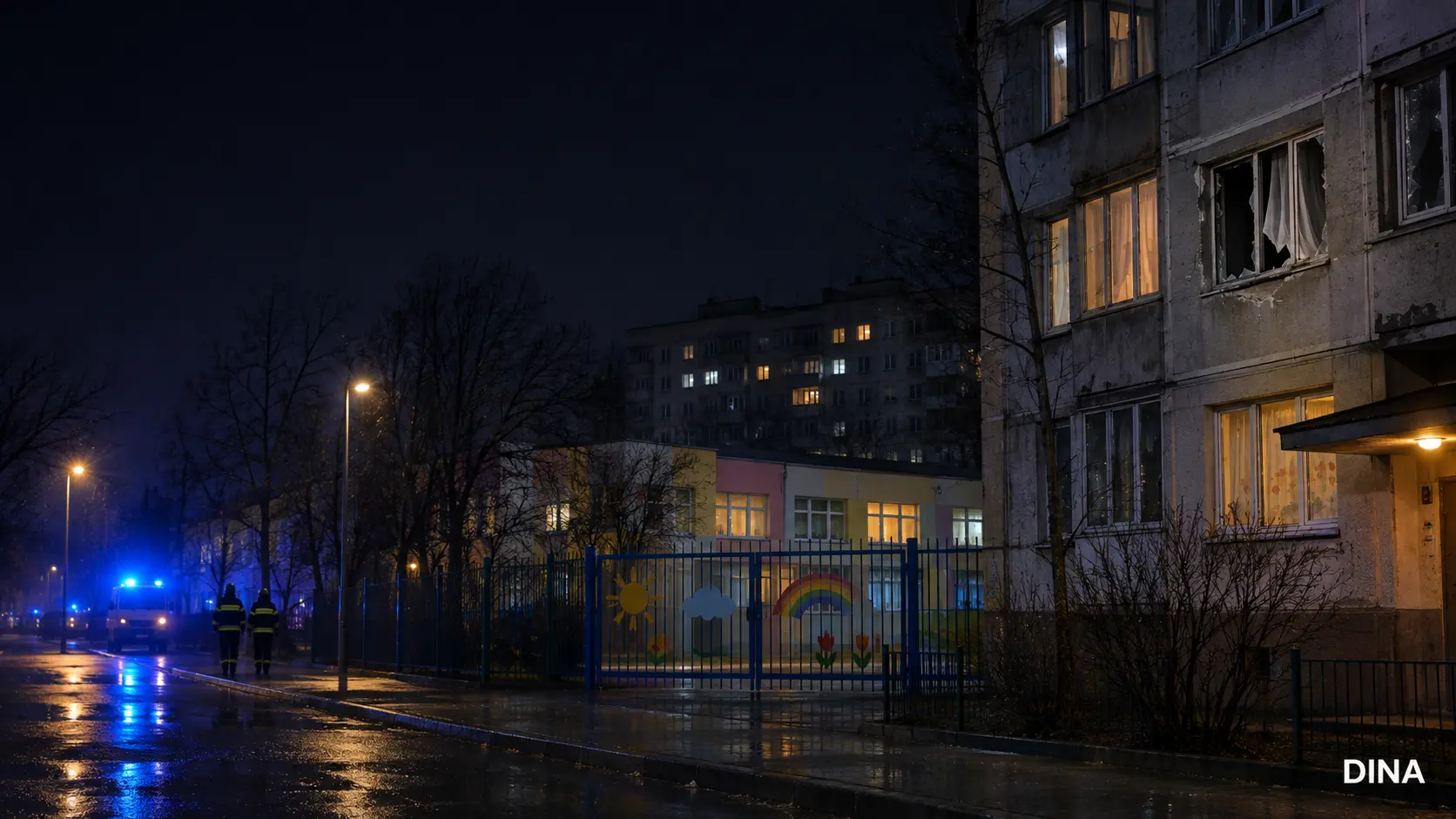
LATEST UPDATE — KYIV, November 7, 2026, 5:30 a.m. ET: Ukrainian authorities say Russia launched 36 ballistic missiles and 172 drones overnight in a nationwide attack that killed at least two people and wounded about a dozen. President Volodymyr Zelenskyy said all 36 missiles targeted Kyiv and the surrounding region. Ukraine's Air Force reported that four missiles and 149 drones were shot down or suppressed in its preliminary accounting.
Ukraine's Energy Ministry reported serious damage to systems transmitting electricity from the Rivne and Khmelnytskyi nuclear power plants to Kyiv and central Ukraine. Zelenskyy said substations in five other regions were also damaged. Kyiv Mayor Vitali Klitschko said several missiles hit the Northern Bridge over the Dnipro River. Power, heat and water supplies were disrupted in the capital as temperatures approached freezing.
Nuclear-safety distinction: The reported damage concerns electrical substations and transmission systems connected to nuclear plants. The public accounts reviewed by DINA do not report damage to reactor buildings, a loss of reactor cooling or an official radiological emergency. Transmission damage can still affect grid stability and off-site power resilience, but it is not evidence by itself of a reactor accident. The International Atomic Energy Agency had not issued a public incident-specific assessment of Saturday's reported damage at this update.
Confirmed public record: Ukrainian civilian and military authorities publicly issued the casualty, weapon, interception and infrastructure accounts, and Russia's Defense Ministry publicly acknowledged carrying out what it called a massive strike. Attributed military assessment: The launch total, weapon types, interception count and impact locations come from Ukrainian officials; DINA has not independently verified them. Allegations by Russia: Moscow says it targeted military-industrial, energy and transport infrastructure and claims the Northern Bridge was being used to move Ukrainian weapons and equipment. Russia has not publicly substantiated those military-use claims. Not established: The public record does not yet reconcile the nationwide casualty totals with local reports, establish the intended target of every weapon, identify the precise equipment damaged at each substation, show how long restoration will take or demonstrate damage to nuclear safety systems.
The Kremlin also named senior diplomatic and military officials for the November 10–11 Abu Dhabi talks. Kremlin aide Vladimir Medinsky is to attend with Deputy Foreign Ministers Sergei Ryabkov and Mikhail Galuzin, military-intelligence chief Igor Kostyukov and General Staff officer Yuri Zhigarlovsky, according to Kremlin spokesperson Dmitry Peskov. The named delegation confirms high-level Russian military participation; it does not establish an agreed ceasefire or negotiating outcome.
Separately, the Associated Press reported that the confirmed death toll from Monday's Russian guided-bomb attack on a former school and shelter used as a humanitarian-aid distribution site in Komyshuvakha rose to 55 after rescuers recovered two more bodies early Saturday. Dozens remained missing. That separate toll is attributed to Ukrainian recovery authorities and remains subject to revision as the search continues.
Strongest accountability angle after the Kyiv attack
The most urgent gap is the absence of a complete, reconcilable strike, casualty and infrastructure record. Ukraine's preliminary Air Force bulletin names the missile families used and reports four missiles neutralized, but it does not itself publish the 36-missile total attributed to Zelenskyy in later public accounts. The public still lacks a weapon-by-weapon launch and impact ledger, the substations' damage assessments, a statement on each nuclear plant's operating and off-site-power status, a bridge inspection, a utility-restoration timetable, evidence supporting Russia's claimed military uses and a statement from U.S. mediators explaining whether the incident changes the Abu Dhabi agenda.
Urgent follow-up and records
- Obtain Ukraine's full launch, trajectory, missile-type, interception and impact-site accounting, including the evidentiary basis for the 36-missile total and whether damage resulted from direct impacts or falling debris.
- Seek a reconciled national and local casualty update, hospital status, emergency-response timeline and structure-by-structure damage ledger while protecting victim identities.
- Request the Energy Ministry, grid operator, Energoatom and IAEA assessments of the affected substations, each nuclear plant's operating status, off-site-power redundancy, radiological monitoring and restoration timetable.
- Obtain the Northern Bridge engineering inspection, closure order and repair estimate, plus energy, heating and water outage maps and restoration timelines.
- Request Russia's strike list, target coordinates, intelligence supporting each claimed military use, battle-damage assessment and civilian-harm assessment.
- Ask U.S., Ukrainian and Russian negotiators whether they will place an immediate reciprocal civilian- and energy-infrastructure pause on the Abu Dhabi agenda.
- Preserve time-stamped emergency calls, air-raid alerts, radar data, munition fragments, authenticated imagery and satellite records for independent review.
Sources for the November 7 Kyiv update
- Reuters — nationwide casualties, weapon counts, energy-transmission damage, Kyiv utility disruption and Northern Bridge damage, November 7, 2026
- Ukrinform — Ukrainian Air Force preliminary accounting of missile types, 172 drones, four missiles and 149 drones neutralized, and recorded impact locations, November 7, 2026
- UNN — Zelenskyy's account of 36 ballistic missiles and substations linking the Rivne and Khmelnytskyi plants to Kyiv and central Ukraine, November 7, 2026
- Reuters — Russia's Defense Ministry account and claimed targets, November 7, 2026
- Reuters — Kremlin announcement of Russia's Abu Dhabi delegation, November 7, 2026
- Associated Press — five injuries, energy damage, utility outages, Northern Bridge closure and Komyshuvakha recovery update, November 7, 2026
- Ukrinform — Kyiv mayor's update raising the injury count to five, including a child, November 7, 2026
- Ukrinform — State Emergency Service damage report, November 7, 2026
- Kyiv City State Administration — official public Telegram channel
- Office of the President of Ukraine — November 6 warning about a potential new attack on energy, bridges and civilian infrastructure
LATEST UPDATE — KYIV, November 6, 2026, 2:48 p.m. ET: President Volodymyr Zelenskyy says Ukraine's operation against targets associated with Russia's oil-refining sector is continuing in response to Russian attacks on Ukrainian energy infrastructure, placing active energy warfare at the center of the dispute four days before planned U.S.-mediated talks in Abu Dhabi.
Zelenskyy said Ukrainian power plants, energy networks, heating systems and water supplies remain under repeated Russian drone and missile attack. Reuters reported that Russian officials have disclosed strikes this week on oil-industry targets or industrial facilities in the Samara, Yaroslavl and Ryazan regions, although Ukrainian officials had not specifically claimed responsibility for every reported strike.
Confirmed policy statement: Zelenskyy publicly said the refinery operation is continuing. Attributed allegations: Kyiv says Russia rejected de-escalation and is preparing further attacks; DINA has not independently verified that intelligence claim. Not established: No new reciprocal energy ceasefire is in force, and the governments have not released a jointly reconcilable strike-and-damage record. In October, Zelenskyy said Ukraine was ready to refrain from striking Russian energy infrastructure if Russia showed the same readiness.
Strongest accountability angle
The public record does not yet show whether Washington has proposed a written energy-infrastructure protocol to both governments. The United States has urged Ukraine to stop refinery attacks, citing pressure on diesel prices, while Ukraine argues that its campaign responds to Russian strikes on power, heating and water systems. The essential question before Abu Dhabi is whether mediators seek reciprocal civilian-infrastructure protection or only restraint by Kyiv.
Urgent follow-up and records
- Request any U.S., Ukrainian or Russian draft defining protected energy facilities and prohibited operations.
- Seek a time-stamped, independently reviewable ledger of claimed strikes, locations, casualties, outages and damage since the October energy-restraint proposal.
- Ask who would investigate disputed drone or missile incidents and what evidence each side would be required to preserve.
- Determine whether the November 10–11 delegations have authority to approve a reciprocal pause or only to discuss one.
- Ask whether any arrangement would protect electricity, heating, water and fuel infrastructure equally, and how civilian needs would be separated from military use.
Sources for the November 6 afternoon update
- Reuters — Zelenskyy says Ukraine's refinery operation is continuing, November 6, 2026
- Office of the President of Ukraine — official October 11 statement offering reciprocal restraint on energy infrastructure
- Reuters — November 10–11 Abu Dhabi talks and publicly described agenda, November 2, 2026
LATEST UPDATE — BRUSSELS/WASHINGTON, November 6, 2026, 12:50 a.m. ET: U.S. presidential envoy Jared Kushner has publicly outlined five goals that U.S., Ukrainian, NATO and European officials are exploring for a possible postwar European security framework ahead of planned Russia–Ukraine talks in Abu Dhabi.
Kushner said the discussions cover permanent security consultations, reliable crisis communications, greater military transparency, reciprocal measures to reduce escalation risks and an enduring long-term European security framework. He said any arrangement must respect sovereignty, territorial integrity and independent decision-making; preserve each country's authority over its own security and alliances; deny any country a veto over another's sovereign choices; and keep NATO central to collective defense.
These are U.S.-described negotiating objectives, not an agreement. DINA found no public record showing that Russia or Ukraine has accepted the five goals, that the parties have agreed on territory or alliance status, or that any new ceasefire or enforceable security guarantee has taken effect. The Office of the President of Ukraine confirmed that President Volodymyr Zelenskyy spoke with Kushner and U.S. envoy Steve Witkoff on November 4, presented Ukrainian proposals and discussed security guarantees, reconstruction and planned November 10–11 talks in Abu Dhabi.
What the five goals add to the public record
The statement supplies the clearest public description yet of the institutional architecture U.S. negotiators want to test: routine consultation, a crisis channel, transparency, reciprocal risk-reduction steps and a durable European framework. Those elements could matter even before a comprehensive settlement if negotiators define who participates, what information must be exchanged and how alleged violations are reviewed.
The sovereignty language is also consequential. Kushner's statement says states retain authority over their alliances and that no country receives a veto over another's sovereign choices. Russia has repeatedly demanded limits on Ukraine's alignment with NATO, while Ukraine has sought binding security guarantees. A U.S. statement of principle does not resolve that conflict, but it creates a benchmark against which any later negotiating text can be measured.
DINA analysis: The five headings remain broad enough for the governments to interpret differently. “Transparency” could mean notification of exercises, force-position data or weapons limits; “reciprocal measures” could range from hotlines to geographic restrictions. Until officials publish definitions, verification procedures and consequences for noncompliance, the framework is a diplomatic agenda rather than a security system.
Strongest accountability questions before Abu Dhabi
- Will the delegations receive a common written text defining each of the five goals, or are they entering talks with separate national proposals?
- Which countries and institutions would participate in permanent consultations and crisis communications, and would Ukraine and affected European states hold equal seats?
- What military information would be exchanged, who would verify it and how would sensitive data be protected from battlefield exploitation?
- What reciprocal risk-reduction steps are under consideration, and would any affect Ukraine's territory, alliance choices or right of self-defense?
- Will the United States, Ukraine and Russia publish participant lists, negotiating mandates, proposals and any joint record after the November 10–11 talks?
Sources for the November 6 update
- Reuters — Kushner outlines five goals for a European security framework, November 5, 2026
- Associated Press — second day of U.S., Ukrainian, NATO and European talks in Brussels, November 5, 2026
- Office of the President of Ukraine — official account of Zelenskyy's call with Witkoff and Kushner, November 4, 2026
LATEST UPDATE — WASHINGTON, November 5, 2026, 11:38 a.m. ET: Representatives of Russia and Ukraine appeared together at the White House on Thursday following the completed six-day Oleshky humanitarian ceasefire. The Associated Press reported that Kirill Dmitriev, Russian President Vladimir Putin's special envoy, spoke at the event and thanked U.S. first lady Melania Trump for her role in securing the limited agreement. Officials from both countries attended.
The event's occurrence is confirmed. The White House had announced on November 3 that the first lady would convene Russian and Ukrainian representatives after the Oleshky mission. Ukraine's presidential office separately acknowledged that the mission was mediated by the United States and Melania Trump and said Kyiv hoped for further de-escalation.
No new ceasefire, peace agreement, territorial arrangement or security commitment was announced in the public accounts reviewed by DINA. Dmitriev's expressions of thanks and Putin's reported role in authorizing the operation are attributed statements by a Russian official. They do not establish that Moscow has accepted a broader pause or changed its war aims.
Why the White House meeting matters
The gathering placed representatives of two governments at war in the same White House event after their personnel successfully coordinated aid delivery and civilian evacuation in Russian-occupied Ukrainian territory. Reuters reported that U.S., Ukrainian and Russian officials are separately scheduled to meet in Abu Dhabi on November 10 and 11. The Oleshky event therefore shows that a narrow humanitarian channel remains open ahead of those talks.
DINA analysis: The public should distinguish three separate things: the completed Oleshky mission, Thursday's White House event and the planned Abu Dhabi negotiations. The first produced a limited humanitarian result. The second publicly recognized that result. The third may address broader de-escalation and postwar security, but it has not yet occurred. Combining them into a single narrative of impending peace would go beyond the evidence.
Accountability questions after the event
- Did the representatives agree to another civilian-protection mission, and if so, where, when and under what security guarantees?
- Will the White House publish a participant list, meeting record, prepared remarks and any written understandings discussed Thursday?
- Will Russia and Ukraine release a jointly reconcilable, privacy-protected Oleshky evacuation and aid ledger?
- Did the gathering address the competing allegations that each side used the pause to strengthen military positions?
- What authority and agenda will the delegations carry into the November 10–11 Abu Dhabi talks?
Sources for the November 5 update
- Associated Press — Putin envoy speaks at White House event attended by Russian and Ukrainian officials, November 5, 2026
- White House — official November 3 announcement of the November 5 event
- Reuters — White House gathering and planned November 10–11 Abu Dhabi talks, November 5, 2026
- Office of the President of Ukraine — official acknowledgment of the Oleshky mission and U.S. mediation, November 3, 2026
LATEST UPDATE — November 2, 2026, 5:33 a.m. ET: The Kremlin says no additional local ceasefires modeled on the six-day Oleshky humanitarian pause are currently planned. Kremlin spokesman Dmitry Peskov also said Moscow assumes Ukrainian forces used the pause to regroup, while acknowledging that he had no specific information about whether Russian forces did the same and referring that question to Russia's Defense Ministry.
Ukraine's General Staff separately alleged that Russian forces used the pause to rotate units, strengthen positions, expand anti-drone defenses along roads and deliver ammunition. DINA has not independently verified either side's military claim. The public ceasefire record reviewed by DINA does not include a complete operative text, military-position logs or a common violation-review report sufficient to determine whether those alleged activities breached the agreement.
The ceasefire expired at 2100 GMT Sunday after the humanitarian mission delivered aid and evacuated civilians. Ukrainian human-rights commissioner Dmytro Lubinets said both sides honored their commitments during the pause and that he and Russia's human-rights commissioner are exploring further humanitarian cooperation. U.S. first lady Melania Trump said the mission evacuated nearly 800 people; the parties have not published a jointly reconcilable, privacy-protected breakdown by destination, medical status or number remaining in Oleshky.
What the new statements establish
Peskov's statement closes one immediate diplomatic question: Moscow is not presently announcing a follow-on ceasefire. It does not rule out future humanitarian coordination, and Lubinets says the two ombudsmen are examining ways to continue similar work. No date, route, security guarantee or second mission has been announced.
The competing regrouping claims should not be reported as proven violations. Peskov described Ukrainian regrouping as an assumption and said he lacked specifics about Russian activity. Ukraine supplied a list of alleged Russian military preparations but did not publish imagery, logs or other independently reviewable evidence with its statement. The public record therefore supports attribution of each claim—not a finding that either side breached the ceasefire.
Why this update matters
The first Oleshky mission showed that the governments could coordinate a narrow civilian-protection operation inside an active war. The Kremlin's statement that no similar pause is planned means that mechanism has not yet become a repeatable channel. Residents who stayed in Oleshky again face the ordinary risks of a front-line occupied city without an announced local ceasefire.
DINA analysis: The mission's humanitarian outcome and the military accusations must be kept separate. A successful evacuation does not resolve whether the sides exploited the pause, and the allegations do not erase the aid delivered or civilian movement completed. The strongest accountability test is a common after-action record: aggregate evacuation and aid totals, the agreed military restrictions, incident logs, and any evidence used to allege misuse.
Urgent follow-up and records for this update
- Request the complete ceasefire terms, including prohibited military activity, geographic boundaries, monitoring procedures and violation-review rules.
- Seek the evidence supporting each side's regrouping or reinforcement claim and distinguish observation from inference.
- Obtain a jointly reconcilable, privacy-protected evacuation count by destination and medical status, plus the number of residents who remained.
- Ask the White House, Ukrainian ombudsman and Russian ombudsman whether a second mission has been proposed and what conditions would be required.
- Request post-mission aid inventories, route-security logs, demining records and any civilian-protection incidents after the ceasefire expired.
Sources for the November 2 update
- Reuters — Kremlin response, regrouping assumption and statement that no similar ceasefire is currently planned, November 2, 2026
- Reuters — Ukraine's reinforcement allegation and ceasefire-expiration details, November 2, 2026
- Reuters — mission outcome, ombudsman compliance statement and reported evacuation total, November 1, 2026
- Ukrinform — Lubinets' statement that the pause ended and both sides honored their commitments, November 1, 2026
LATEST UPDATE — CHERNIHIV REGION, Ukraine, October 31, 2026, 9:22 a.m. ET: Residents evacuated from Russian-occupied Oleshky have crossed into Ukrainian-held territory after a multistage humanitarian mission conducted under the localized Russia–Ukraine ceasefire, according to Ukrainian organizers and Associated Press reporting from the reception area.
The evacuees traveled by bus from Oleshky through Russian-controlled territory, flew from Anapa to Homel, Belarus, and then continued by bus into Ukraine. Ukrainian authorities restricted disclosure of the number of evacuees and the border-crossing location, citing the safety of residents who remained in Oleshky and possible future missions. DINA is therefore not publishing an unverified total.
What actually happened
Ukraine's human-rights commissioner, Dmytro Lubinets, reported Friday that aid had entered Oleshky and that residents who wanted to leave had been transported out. His office said 25 buses with 750 seats and ambulances for people with limited mobility had been prepared. Capacity is not the same as the number evacuated.
Associated Press reported Saturday that evacuees reached Ukrainian-held territory after four aircraft carrying civilians and the Ukrainian delegation landed in Belarus. Reception teams included medical workers, psychological-support staff and humanitarian volunteers. People who chose to travel toward Russia were transported separately, according to Russian and Ukrainian accounts.
The operation is a material implementation milestone: the ceasefire was no longer only an announced or active military pause. It supported aid delivery and completed passage for at least some civilians from occupied territory to the destination they selected. It remains a localized humanitarian arrangement, not a nationwide truce, peace agreement or end to strikes elsewhere in Ukraine.
Why it matters
Oleshky residents had endured severe shortages, mined routes and prolonged isolation. A completed civilian crossing demonstrates that the parties can coordinate a limited safe-passage operation despite the wider war. It does not establish that every resident was contacted, that aid reached every household or that people who remained will receive continuing supplies after the ceasefire ends.
DINA analysis: The operation's immediate humanitarian value is clear, but diplomatic credit should not substitute for a verifiable civilian-protection record. The safest public accounting would disclose aggregate numbers only after officials determine that doing so cannot endanger evacuees, relatives or future missions. It should also separate people who chose Ukraine, people who chose Russia, people who remained, medical evacuations and households that could not be reached.
Strongest accountability angle
The core test is whether each movement was voluntary, informed and free from coercion, filtration, retaliation or forced transfer. Ukrainian, Russian and intermediary officials should preserve consent records, route and incident logs, medical-transfer records and aid inventories for independent humanitarian review while withholding personal information that could expose civilians.
Urgent follow-up and records
- Request a jointly reconcilable, privacy-protected count of residents transported to Ukrainian-held territory, transported toward Russia, medically evacuated and remaining in Oleshky.
- Obtain aid manifests, delivery locations and distribution totals, including food, water, medicines and mobility support.
- Document the consent and destination-selection process and safeguards against detention, filtration, coercion or retaliation.
- Request incident and ceasefire-compliance logs covering mines, drones, shelling, route changes, delays and medical emergencies.
- Determine whether another mission is planned and what security guarantees will protect residents who remain.
Primary and corroborating sources for this update
- Ukrainian Parliament Commissioner for Human Rights — mission preparations and civilian-choice framework, October 30, 2026
- Ukrinform — humanitarian reception hub and Lubinets' Belarus update, October 31, 2026
- Associated Press — evacuees cross into Ukrainian-held territory, October 31, 2026
LATEST UPDATE — October 26, 2026, 11:43 p.m. ET: Russia and Ukraine say the localized ceasefire around Russian-occupied Oleshky has taken effect, moving the arrangement from an announced plan to an active military pause. Russia's Defense Ministry said it stopped shelling toward Ukrainian-held Kherson at 4 a.m. Moscow time Tuesday, while Ukrainian human-rights commissioner Dmytro Lubinets said Ukraine was honoring its commitments.
The Associated Press reports that the pause is intended to last through Saturday or longer. Negotiators said doctors, medicines, food and water are to enter Oleshky before evacuation corridors open for as many as 2,000 stranded residents. No independently verified aid delivery, completed evacuation count, common monitoring report or published violation-review mechanism was available at this update.
The ceasefire remains geographically limited. Russian missile attacks continued elsewhere in Ukraine: AP reported explosions in Kyiv minutes after the pause began, following Monday attacks that killed one person and injured 10 in the capital and killed two people in Kharkiv. The Oleshky pause is therefore not a nationwide ceasefire and does not establish a broader reduction in hostilities.
LATEST UPDATE — October 23, 2026, 9:49 p.m. ET: Ukrainian President Volodymyr Zelenskyy says Ukrainian, U.S. and Russian teams plan to meet in the first half of November as part of a renewed effort to advance broader peace negotiations. Ukraine's presidency said the meeting would be held at the team level and that Europe must be included in the diplomatic process.
Reuters reports that Zelenskyy identified Abu Dhabi as the planned venue, while a U.S. official said the talks could occur in Abu Dhabi or Switzerland. No agenda, participant list, negotiating text or Russian public commitment to a specific venue was available before this update. The localized Oleshky agreement does not itself constitute a nationwide ceasefire or establish that wider peace talks will succeed.
Ukraine and Russia also exchanged 270 servicemembers each Friday, according to Reuters, citing Russia's Defense Ministry. Zelenskyy separately confirmed that 270 Ukrainians had returned from Russian captivity and called the exchange an important result. It was the first prisoner exchange reported since August.
LATEST UPDATE — October 23, 2026, 4:19 p.m. ET: Ukraine's human-rights ombudsman and a chief negotiator in the humanitarian talks, Dmytro Lubinets, told The Associated Press that the ceasefire will begin October 27—two days before the humanitarian mission—and last several days.
Lubinets said the pause will cover the Kherson region and neighboring areas necessary for the operation. AP also reports that Russian Chief of the General Staff Gen. Valery Gerasimov said Russian forces will halt fire on the Kherson axis at 4 a.m. Moscow time Tuesday, conduct engineering reconnaissance and ensure safe movement of the humanitarian convoy into Oleshky.
The new statements resolve the principal timing discrepancy in DINA's earlier report: October 27 is the announced start of the military pause, while October 29 remains the announced start of the civilian humanitarian mission. The complete agreement, precise geographic map, end time and violation-monitoring mechanism remain unpublished.
LATEST UPDATE — October 23, 2026, 12:23 p.m. ET: Ukraine’s lead negotiator, David Arakhamia, has publicly confirmed the humanitarian arrangement. Reuters reports that Arakhamia said on Telegram that the operation will begin once a ceasefire is in place and will create a corridor for residents to leave while allowing aid into Oleshky.
The Ukrainian statement joins the earlier confirmations from Washington and Moscow, substantially resolving whether all three governments acknowledge the operation. Newsmax has also identified itself as the previously unnamed American media organization and says its cameras will receive exclusive access to document the effort.
At that stage, the complete agreement, final implementation dates, detailed security guarantees and monitoring rules remained unpublished. The later AP report supplies a ceasefire start date and planned duration but not the complete operative text.
LATEST UPDATE — October 23, 2026, 11:52 a.m. ET: The Kremlin has confirmed that a U.S.-brokered localized ceasefire agreement was reached for Oleshky. Kremlin spokesman Dmitry Peskov said Russian and Ukrainian militaries are working to determine implementation dates and that all civilians wishing to leave will be permitted to do so. He said the evacuation is expected to take at least several days.
The Russian confirmation materially strengthens the White House announcement, but it also exposes an unresolved timing question. The White House said the ceasefire would begin October 29; Peskov said the militaries were still determining dates. Ukraine had not published a matching public statement or complete operational text before this update.
WASHINGTON — October 23, 2026, 9:50 a.m. ET: The White House announced Friday that Russia and Ukraine agreed to a localized ceasefire in Oleshky, a Russian-occupied city in southern Ukraine, beginning October 29 so humanitarian aid can enter and civilians can be evacuated through a designated safe passage.
The announcement says both countries will temporarily stop “all military action” in Oleshky. It says civilian teams from Russia and Ukraine will visit residents, assess their needs and help people travel to their preferred destination in either country.
What is verified: The White House published the announcement and an October 29 mission date. The Kremlin and Ukrainian negotiators subsequently confirmed the agreement. Russia's Defense Ministry and Ukraine's human-rights commissioner now say the military pause began at 4 a.m. Moscow time October 27. AP reports that it is intended to last through Saturday or longer and that aid is to enter before evacuation corridors open. Ukraine’s lead negotiator previously described the corridor and aid operation. The published U.S. plan says demining work is part of the preparation, and Newsmax says it will have exclusive camera access to document the operation.
What remains unverified: DINA did not locate a complete ceasefire text. The governments have not published signatures, a map, an exact end time, monitoring rules, enforcement provisions, full security guarantees or the names of the national teams. The parties' statements establish that they say the pause has begun; they do not yet establish that aid has reached residents, that evacuation corridors are operating or that either side's compliance has been independently monitored.
A narrow agreement inside an active war
The ceasefire is limited to Oleshky and does not halt the broader Russia–Ukraine war. The city has been under Russian control since the opening phase of the full-scale invasion in February 2022, placing any aid mission and evacuation inside occupied Ukrainian territory.
The planned November talks are a separate diplomatic track. Previous U.S.-led rounds stalled without a comprehensive settlement, while Russia continues to demand Ukrainian territory that Moscow does not fully occupy and Kyiv rejects surrendering land it controls. Announcing a meeting creates an opportunity for negotiation; it is not evidence that the governments have agreed on borders, security guarantees, sanctions, reconstruction or a nationwide ceasefire.
The White House says First Lady Melania Trump and her representative worked directly with Russian and Ukrainian leadership as an intermediary. It says residents who want to leave will receive coordinated transportation and may choose a destination in Russia or Ukraine.
The ceasefire began on the announced October 27 schedule, while the civilian mission remains scheduled for October 29. AP reports that the pause is intended to last through Saturday or longer; Peskov previously said the evacuation would take at least several days. Engineering reconnaissance, demining, route verification, resident notification, vehicle access, medical capacity and rules for armed forces remain central to whether the operation can work safely.
The humanitarian emergency
Oleshky’s remaining residents are reported to be predominantly elderly and in urgent need of medical care, medicine, food and clean water. Associated Press reporting last week described fewer than 2,000 people remaining amid mined roads, drone attacks, destroyed infrastructure and prolonged shortages. The AP reported that the last regular road delivery of food occurred in May and that the International Committee of the Red Cross was prepared to help if both sides agreed and supplied security guarantees.
The Kremlin said October 16 that President Vladimir Putin supported a Vatican initiative to create safe conditions for humanitarian assistance in Oleshky. That earlier statement showed Russian support for a humanitarian initiative but did not itself establish the terms now announced by the White House.
Why it matters
If implemented, the localized pause could create the first organized route in months for large-scale aid and voluntary evacuation from Oleshky. For residents facing winter without dependable food, medicine, water or power, execution matters more than diplomatic credit.
The distinction between an announced agreement and an operating corridor is essential. A ceasefire can fail through disputed geography, unclear start and end times, mines, drone activity, unauthorized armed units or conflicting rules at checkpoints. Independent observation can improve accountability, but only if the observer’s identity, access and reporting conditions are disclosed.
DINA independent analysis
This section is DINA analysis, not independently established fact. Public acknowledgments now exist from Washington, Moscow and Ukrainian negotiators. The October 27 ceasefire start and October 29 mission start clarify the public timeline. But the record remains thin on the instrument that would make the pause enforceable. Without a common text and map, the public cannot compare the parties’ understanding of covered territory, weapons restrictions, end conditions and responsibility for a breach.
The Oleshky arrangement, planned November talks and prisoner exchange are three distinct developments. Taken together, they show functioning channels for limited humanitarian and diplomatic cooperation. They do not establish momentum toward a comprehensive peace agreement. The accountability test is whether officials publish concrete negotiating objectives, include Ukraine and affected European governments in decisions, and avoid presenting meetings or exchanges as territorial or security concessions that have not been made.
The strongest accountability test is civilian choice. Evacuation from occupied territory must be voluntary, informed and free from coercion, filtration, retaliation or forced transfer. Residents who remain must not lose access to aid, while people who leave must be permitted to choose their destination without pressure from either side.
Newsmax’s claimed exclusive camera access resolves the observer’s identity but raises a different transparency issue. If one outlet will serve as the principal outside witness, the White House and Newsmax should disclose who selected and funds the arrangement, whether other journalists may participate and whether Newsmax may report freely rather than produce a controlled pool account.
Urgent records and follow-up requests
- Publish the complete written commitments from Russia and Ukraine, including signatures or official authorizations.
- Release the ceasefire map, start and end times, covered weapons and forces, notification procedures and violation-attribution rules.
- Identify the civilian teams, demining authority, medical partners, transport providers and destination-processing officials.
- Publish Newsmax’s selection process, funding, access agreement, pool-sharing rules and editorial-independence protections.
- Explain how residents will give informed consent, select a destination and refuse evacuation without losing aid.
- Disclose how the operation will protect residents from mines, drones, shelling, detention, filtration, forced transfer and retaliation.
- Request situation reports for aid delivered, households contacted, evacuations completed, incidents and any suspension of the corridor.
- Publish the November meeting's confirmed venue, participants, agenda, negotiating mandate and any written proposals circulated to the parties.
- Disclose what role European governments will have and whether any territorial, sanctions, security-guarantee or reconstruction proposals will be discussed.
Sources
- Reuters — Russia and Ukraine confirm the localized ceasefire has begun, October 27, 2026
- Associated Press — ceasefire duration, humanitarian sequence and attacks elsewhere in Ukraine, October 27, 2026
- White House — announcement of the localized Oleshky ceasefire, October 23, 2026
- Reuters — report on the White House announcement, October 23, 2026
- Reuters — Kremlin confirmation and implementation-timing statement, October 23, 2026
- Associated Press — October 27 ceasefire timing and operational sequence, October 23, 2026
- Associated Press — conditions facing civilians in Oleshky, October 17, 2026
- Reuters — Kremlin statement supporting a Vatican humanitarian initiative, October 16, 2026
- Office of the President of Ukraine — planned trilateral team meeting and prisoner-exchange statement, October 23, 2026
- Reuters — Oleshky ceasefire, planned November talks and 270-for-270 exchange, October 23, 2026