
Breaking news · Federal accountability · U.S.–Iran conflict · Oil markets · CFTC · Government ethics · DINA analysis
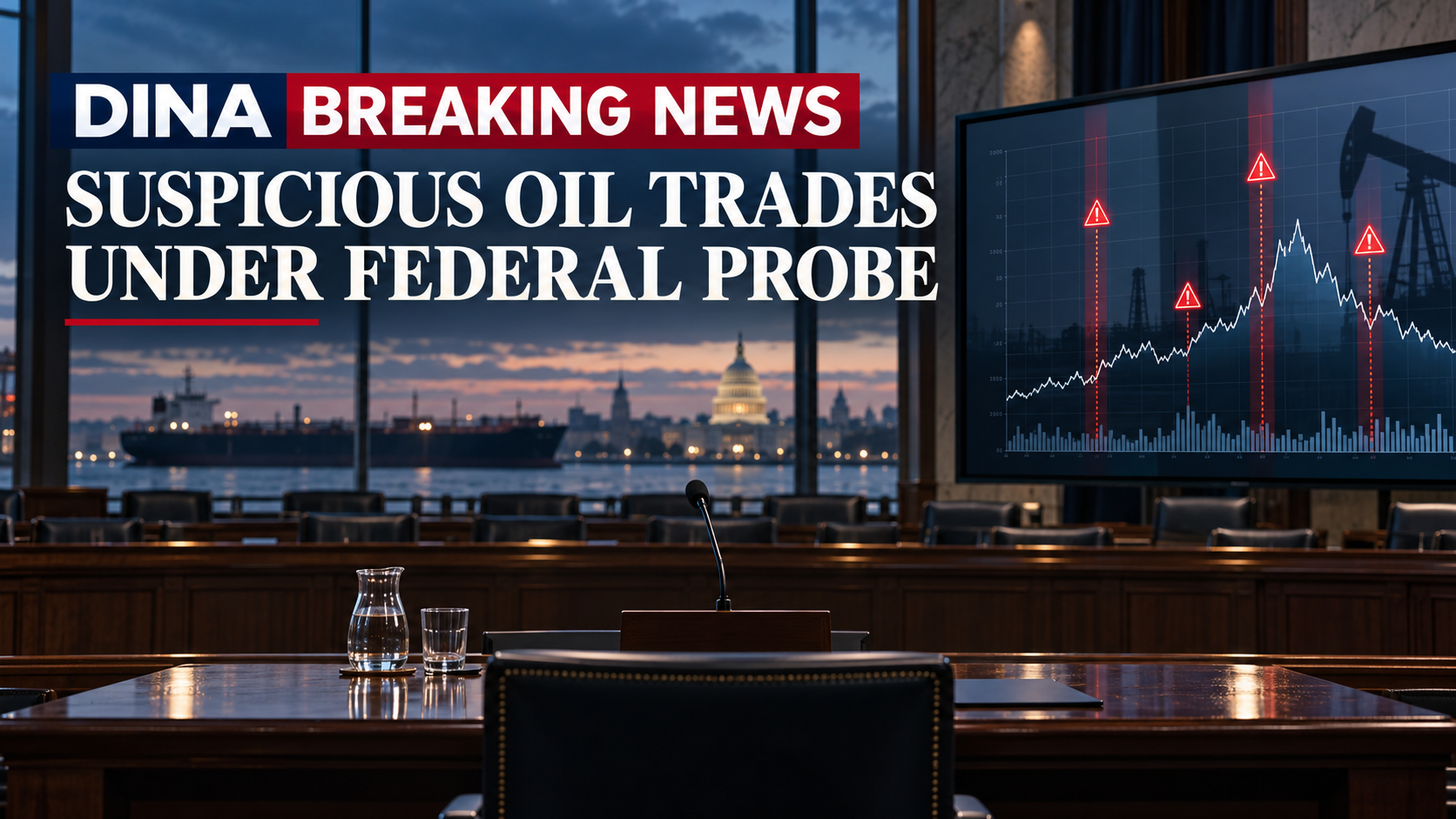
WASHINGTON — October 22, 2026, 3:06 p.m. ET: The U.S. Commodity Futures Trading Commission is investigating suspicious oil-market trading surrounding U.S. decisions in the war with Iran, the agency's enforcement director said Thursday, publicly confirming that the inquiry remains active after new questions about political interference.
CFTC Enforcement Director David Miller disclosed the investigation at a New York conference, according to Reuters. He was responding to Bloomberg News reporting that a political appointee told market-surveillance staff to retract a referral to the enforcement division involving trades placed shortly before President Donald Trump announced in March that he was backing away from threatened strikes on Iranian power plants.
What is confirmed: Miller said the CFTC is investigating suspicious oil-trading activity connected to the Iran war. He also said the agency is scrutinizing prediction-market trading around elections, including the risk that candidates could trade on their own contests.
What is not established: The existence of an investigation does not prove that any trader possessed nonpublic information, manipulated a market or violated federal law. The CFTC has not publicly identified a target, filed a charge, named a trading firm or released the underlying surveillance analysis. Bloomberg's account of the retracted referral remains attributed reporting; it is not an adjudicated finding.
The referral dispute
Bloomberg reported October 13 that billions of dollars in contracts anticipating falling oil prices and rising equities were placed roughly 15 minutes before Trump's March 23 post reversing his threat to strike Iranian energy infrastructure. The report said Mel Gunewardena, a senior adviser to CFTC Chair Michael Selig, instructed a market-oversight supervisor to retract the staff referral.
Gunewardena's precise role, the reason for the instruction and the referral's status have not been publicly documented by the commission. Reuters reported Thursday that Miller declined to address individual CFTC staff members while confirming the broader investigation.
Sen. Elizabeth Warren, the ranking Democrat on the Senate Banking Committee, said last week that Gunewardena should answer congressional questions about the investigation and any enforcement action. Warren's statement is a demand for oversight, not evidence that misconduct occurred. Earlier bipartisan concerns about well-timed Iran-war trades prompted lawmakers to seek public updates from the CFTC.
Prediction markets widen the accountability problem
Miller said the enforcement division is also watching election-related prediction markets and indicated that candidates wagering on their own electoral outcomes would raise enforcement concerns. He did not announce a case involving the November midterms.
The commission has separately proposed rules addressing event contracts tied to war, terrorism, assassination and other restricted activity. The proposal distinguishes a contract settled by a wartime act from a conventional commodity contract whose price may be affected by war. That distinction does not eliminate insider-trading or manipulation concerns when someone allegedly uses material nonpublic information.
Why it matters
Oil prices affect household fuel bills, shipping, food prices and public finances. If confidential military or presidential information reaches a trader before the public, the potential harm is larger than an unfair windfall: it can undermine market integrity and create incentives to monetize national-security decisions.
The investigation also tests the independence of a regulator responsible for derivatives markets during a period of war-driven volatility. A surveillance referral can be mistaken or incomplete, but an instruction to withdraw one should have a documented legal and evidentiary basis—especially when the disputed trades preceded a presidential announcement capable of moving global prices.
DINA independent analysis
This section is analysis, not a finding that any named official or trader violated the law. Miller's confirmation changes the public record: the matter is not merely a congressional request or press allegation; the CFTC's enforcement division says an investigation is underway. The most important unanswered question is whether the retracted referral delayed, narrowed or otherwise affected that investigation.
The democratic-accountability standard should be straightforward. Regulators must be free to preserve and test surveillance evidence without partisan interference, while people and firms under scrutiny retain due-process rights and the presumption that no violation occurred until established by evidence.
A progressive public-interest response should focus on transparency, equal enforcement and protection of working families from manipulated energy markets—not on declaring guilt before facts are proved. Congress should obtain the referral, its withdrawal instruction and the current investigative scope under appropriate confidentiality protections, then publish as much of the record as lawfully possible.
Strongest accountability questions
- Who ordered the market-surveillance referral withdrawn, under what authority and for what written reason?
- Did the enforcement division receive the same underlying data through another channel, and was any investigative step delayed?
- What contracts, exchanges, dates and trading patterns are within the current CFTC inquiry?
- Has the commission referred any evidence to the Justice Department, an inspector general, the Office of Government Ethics or another regulator?
- Did any federal official, contractor, campaign participant or person with access to nonpublic military information trade directly or through an intermediary?
- What preservation orders were issued for communications, surveillance files and transaction records?
- How will the CFTC enforce restrictions when a candidate trades on a market concerning that candidate's own election?
Urgent records and follow-up requests
- Request the retracted referral, withdrawal instruction, internal legal analysis and chain-of-custody record, with necessary investigative redactions.
- Seek calendars, emails and messages among CFTC leadership, market-oversight staff and enforcement officials concerning the March 23 trades.
- Request aggregate figures for subpoenas, preservation demands, witness interviews and referrals connected to Iran-war oil trading.
- Ask the CFTC inspector general and Office of Government Ethics whether they opened reviews of political interference or misuse of nonpublic information.
- Track congressional hearing requests and testimony from Chair Michael Selig, David Miller and Mel Gunewardena.
- Request written guidance governing candidate, campaign, federal-employee and contractor participation in election prediction markets.
Related DINA coverage
- Iran Says Seven Vessels Hit as Guards Threaten Wider Response
- Treasury Sanctions Law Firm, Shipping Agents and Nine Vessels in Iran Shadow-Fleet Crackdown
- Trump Says U.S. Will Not Attack Iran Before Election Day as Treasury Sanctions 17 Vessels
Sources
- Reuters — CFTC enforcement director confirms suspicious Iran-war oil-trading investigation, October 22, 2026
- U.S. Senate Banking Committee minority — Warren statement on the reported CFTC referral dispute, October 13, 2026
- U.S. Sen. Raphael Warnock — senators request a public CFTC update on suspicious oil-futures trades, May 28, 2026
- Commodity Futures Trading Commission — proposed rule concerning prediction markets and event contracts, June 9, 2026