

Investigative report · Opinion & legal analysis
ROCKFISH, N.C. — A campaign promise about school safety has a short shelf life when a parent is waiting for a late bus, a teacher is trying to stop a fight, or a principal needs help that has not arrived. At the September 29 Rockfish candidate forum, the central question reached beyond who could deliver the strongest applause line: who would accept responsibility for making Hoke County's public institutions work together?
The recovered forum material describes candidates talking about transportation, pay, school growth, security, public projects, taxes and water. Beneath those subjects lies a single test. A commissioner can approve money without directing deputies. A school board can adopt rules without filling a sheriff's vacancy. A sheriff can supervise officers without setting the education budget. Children experience the consequences of all three.
This investigation connects those campaign positions to the adopted county budget, the official candidate list, school-safety statutes, sheriff's releases and the latest decision in the Hoke County education litigation. Its conclusion is an editorial judgment: Hoke deserves a public, measurable agreement among its governing institutions, with prevention and education treated as seriously as emergency response.
Download the illustrated report (PDF) · Download the Facebook and Substack publication copy
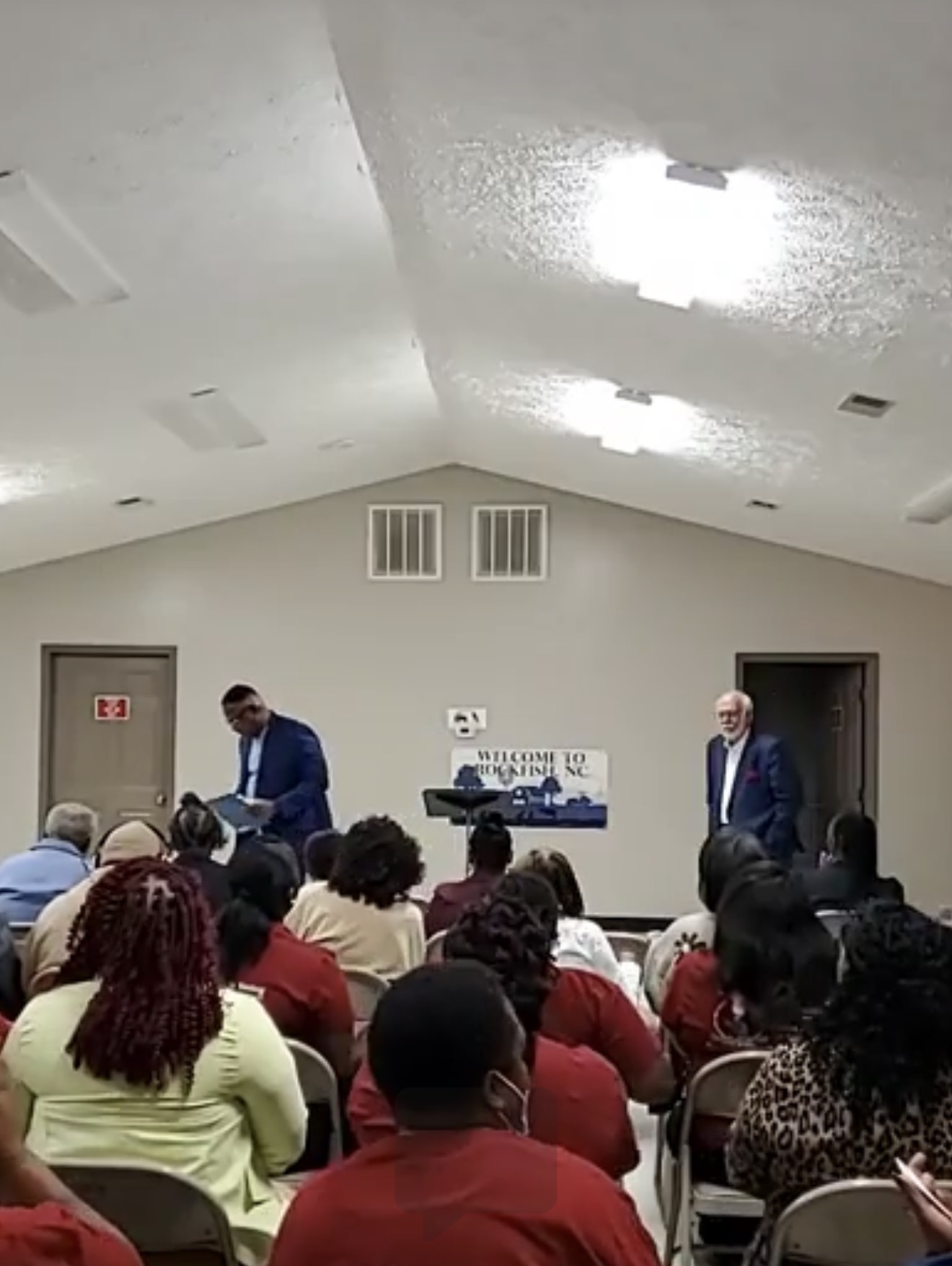
The first question: can children get to school, learn and come home safely?
Transportation was one of the clearest subjects in the recovered school-board material. Gary Brigman's notes emphasized his stated 34 years in Hoke education, bus-driver shortages, expansion to accommodate growth and possible reuse of older facilities. His emphasis on experience and continuity gives voters a practical question to ask: what staffing and facility milestones would that experience deliver during the next term?
Darrin L. McNeill's recovered remarks also identified the bus-driver shortage. He described experience connected to criminal justice, social work and gang investigations, and proposed consulting parents, staff and students while reviewing policy. The material attributes concerns about fighting and gangs to him. It does not establish an independently verified countywide gang trend. A candidate's diagnosis requires evidence: incident classifications, referrals and a defined reporting period.
Catherine Blue's recovered notes offered an incumbent's account of improvements: a claimed 3 percent teacher-supplement increase, bus pay rising from $15 to $18, safety grants and cameras or monitoring measures. Those are consequential assertions. This edition did not recover the dated salary schedules, grant awards or implementation records needed to verify every component. If comparable hourly pay did move from $15 to $18, the mathematical increase would be 20 percent. A claim about a “3 percent” supplement also needs a baseline: a relative increase and a three-percentage-point increase are different promises.
Other excerpts describe an education-support employee with 18 years of experience urging protection for teachers and students, and another speaker calling for officers, safety protocols, attention to attendance and test performance, and preparation for college, trades or work. Their identities could not be reliably established. An inconsistent rendering of another speaker's name cannot responsibly be converted into the identity of a person on the ballot.
These positions can be compared without manufacturing a debate. Brigman's recovered emphasis is capacity and continuity; McNeill's is consultation and policy review; Blue's is an asserted record of pay and security improvements. The unanswered question for each is implementation. How many drivers are needed? Which routes miss their targets? Which safety positions are funded, filled and actually assigned? Which school buildings can serve enrollment growth without creating new operating burdens?
A sound answer would connect recruitment to pay, predictable hours, training and retention; connect security to response procedures and prevention; and connect construction to staffing and long-term operating costs. A new building does not substitute for a reliable bus route or an adult who has time to intervene before a conflict escalates.
The commissioner exchange: growth, taxes and a record of public investment
The recovered commissioner notes place David Frump, Harry Southerland and Allen Thomas in that sequence. They are reporting summaries, not an authenticated word-for-word transcript. The available material frames a familiar political disagreement: whether Hoke's growth and projects demonstrate necessary investment or a government moving faster than infrastructure and household finances can bear.
Frump's recovered position challenged growth management, water capacity, taxes and commissioner compensation, and discussed additional wells. His argument is strongest when it asks whether development approvals and service capacity are aligned. It needs project schedules, demand forecasts and rate records to become an established fiscal indictment. The compensation figures in the notes are not treated here as verified current payroll.
Southerland's recovered position defended investment in wages, schools and public facilities as preparation for growth. Thomas's notes emphasized his stated 12-year record and projects involving recreation, shelter, vehicle services, the high school and the justice center. A completed project can be a real public benefit. Its ribbon cutting still cannot establish its final cost, debt burden, utilization or effect on another department's operating needs.
Neither side earns an automatic factual victory. A taxpayer deserves documented costs rather than a collection of alarming numbers. A parent deserves an operating plan rather than a collection of buildings. The appropriate comparison is between adopted appropriations, contracts, debt schedules, service performance and the commitments candidates are asking voters to renew.
Stephanie Carter and Deborah McMillan-Evans appear on the official commissioner ballot. The recovered material does not supply reliably attributable forum answers for either. That is a reporting limitation, not a finding that either candidate was absent, declined to answer or lacked a position.
What the county has actually appropriated
Hoke's adopted fiscal 2026–27 ordinance provides the most useful baseline for this debate. Its first two pages list the following General Fund appropriations:
| Budget line | Adopted appropriation |
|---|---|
| Public schools | $12,201,417 |
| Sheriff | $10,929,330 |
| Jail | $6,771,681 |
| General Fund total | $84,447,715 |
These are appropriations, not audited spending totals. The schools line is a county budget line, not the entire school system's budget; the sheriff line does not by itself identify the number of school resource officers. The jail is a separate appropriation. Capital financing and other funds cannot be inferred from this abbreviated table.
The accountability question is therefore specific: which share of the available resources supports which positions, equipment and services, and what remains unfunded or unfilled? A large department total can coexist with a school assignment gap. A school allocation can coexist with competing transportation, staffing and maintenance needs.
The state-office excerpts: affordability claims need records, too
The recovered state-office segment includes an affordability argument about wages, manufacturing, taxes and water bills, followed by a response emphasizing cooperation and public projects. The transcription does not establish both speakers' identities consistently enough for personal attribution. The official House District 48 ballot lists Ralph Carter, Republican, and Garland E. Pierce, Democrat; that fact alone cannot assign every line in an imperfect transcript to one of them.
One supplied excerpt states: Your water bill has gone up 40% one year, 30% next year. That is crazy.
The rate schedules and comparable household bills needed to authenticate that claim were not recovered. If two successive increases applied to the same underlying charge, 40 percent followed by 30 percent would compound to 82 percent, rather than simply 70 percent. That calculation does not prove any Hoke customer experienced those increases: usage, fixed charges and the relevant billing periods must be checked.
A separate health claim in the excerpts predicted autism in half of children born by 2032. The cited primary evidence does not support that prediction. The CDC's April 2025 surveillance report estimated autism identification in about one in 31 eight-year-olds across its 2022 surveillance sites. A measured prevalence in a specified age group and surveillance network is not a forecast about half of future births. The prediction is unsupported by that report; it should not be presented as established science.
Claims about securing road, water, sewer, courthouse or school funding also require award documents, appropriation language and completion records. Bipartisan relationships may explain a candidate's strategy. They do not verify a particular dollar claim. This edition does not repair uncertain speaker identities by guessing from biography or political affiliation.
School violence: the public alarm and the limits of the available record
The community concern deserves attention even when a social-media account is incomplete. A September 23 report by The Union Star described a Facebook account of fighting at the new Hoke County High School and demands for more school resource officers. The story relayed assertions about a principal being outnumbered and limited officer coverage. This is secondary reporting of a social-media account, not an authenticated sheriff's incident report. It does not independently establish the incident date, staffing deployment or every allegation.
Two earlier official releases demonstrate that school safety has also involved adult access and weapons concerns. An October 27, 2025 sheriff's release described an investigation involving a firearm in a vehicle on school grounds and an arrest. A November 2025 release described a parent boarding a school bus on November 19, followed by an arrest on November 25 on warrants concerning trespass and impeding a school bus. These releases report law-enforcement allegations; they do not establish convictions.
Those 2025 events are documented background, not substitutes for the two recent incidents flagged for this assignment. The recent events could not both be identified and corroborated from the available official record. A reference in the recovered forum material to a teacher being attacked also lacks the reliable date and incident identification needed to connect it to a current case. This edition does not merge separate events into a single escalating narrative.
The implication is narrower and stronger than rumor: a safety plan must cover buses and adult access as well as student conflict. Prevention requires trusted reporting channels, supervision, behavioral support, clear response roles and follow-through. It also requires protecting teachers without treating the whole student population as a criminal threat.
The Facebook dispute cannot replace a chain of responsibility
The reporting brief described tensions in “What's Happening Hoke” among commissioners, school-board interests and Sheriff Roderick Virgil. A complete, authenticated thread was not recovered. No specific accusation, quotation or motive is assigned to an official on that basis. A post reporting conflict is not itself a finding that a particular official refused cooperation.
The underlying governance problem can still be examined. Separate elected institutions make public explanations essential. An assertion that “we funded it” leaves open whether a position was filled. An assertion that “we need more officers” leaves open whether a specific request, cost and deployment agreement exists. An assertion that “the schools handle it” leaves open when school discipline becomes an immediate law-enforcement matter.
For Virgil, the relevant questions concern assignments, vacancies, training, coverage and response procedures. For the school board, they concern policies, access controls, discipline, prevention and how principals obtain help. For commissioners, they concern appropriations, authorized staffing and the financial tradeoffs presented in public. These are questions for records and performance, not findings of personal wrongdoing.
What North Carolina law assigns to each institution
The school board. N.C.G.S. § 115C-47 places local education responsibilities with the board, including policy and administration within state law. Section 115C-429 governs submission of the school budget and county action on local appropriations. The ordinary deadlines are May 15 for submission, subject to the date fixed by commissioners, and July 1 for the county determination, subject to permitted agreement. These provisions make budget coordination a recurring obligation.
The commissioners and sheriff. Under § 153A-103, commissioners determine the number of salaried employees in the sheriff's office and set compensation subject to law; the sheriff has exclusive authority to hire, discharge and supervise office employees. Appropriation authority and operational supervision are distinct. A commissioner cannot simply direct a deputy's daily assignment by announcing a preference at a forum.
School resource officer agreements. Section 162-26.5 permits sheriff agreements to provide school resource officers and addresses nonpublic-school financing. The related staffing provision in § 153A-103 includes a specific nonpublic-school agreement exception. These provisions should not be converted into a blanket rule requiring an officer in every public school. A proposal for that coverage needs an actual staffing and funding agreement.
Preparedness and prevention. Section 115C-105.49 requires an annual schoolwide tabletop exercise and drill based on the school's risk-management plan, including lockdown practice. Section 115C-105.51 addresses anonymous reporting for secondary schools, coordination and training. Section 115C-105.53 addresses school plans and emergency access for law enforcement. These are concrete subjects for compliance review; this article does not establish that Hoke failed any requirement.
Student dignity and lawful intervention. Section 115C-391.1 supports positive behavioral interventions and regulates restraint and seclusion. It allows reasonable force in specified circumstances, including breaking up a fight, while limiting its use. A safety policy should protect staff, intervene when necessary and respect those restrictions.
Transparency has defined limits. Section 132-1.4 distinguishes protected investigative records from certain public incident information. School security diagrams and raw anonymous tips have separate protections under the education statutes. Section 143-318.11 permits closed meetings for specified purposes. Officials can explain funding, staffing and general corrective action without publishing student identities or exposing security vulnerabilities. A lawful confidentiality limit does not itself establish a cover-up.
Hoke's constitutional case changed in April 2026
Any current education analysis must account for a major change in the litigation carrying Hoke County's name. Leandro v. State, 346 N.C. 336 (1997), and Hoke County Board of Education v. State, 358 N.C. 605 (2004), recognized the opportunity for a sound basic education and addressed its denial to at-risk Hoke students. Those principles concern educational opportunity, not merely the existence of a school building.
On April 2, 2026, in docket 425A21-3, the North Carolina Supreme Court vacated the April 17, 2023 order and dismissed the action with prejudice. The majority held that a statewide facial challenge had not been properly pleaded and that decisions entered after July 24, 2017—including the 2022 decision—were void for lack of subject-matter jurisdiction. The official opinion listing and published opinion text document that ruling.
It would therefore be inaccurate to describe the 2022 remedial funding decision as an enforceable current order. The earlier educational-right principles and the state Constitution's education provisions remain relevant, while the available judicial remedy must be described in light of the 2026 disposition. Our editorial inference is that elected officials now face an even more direct political test: identify unmet needs and act through budgets and administration rather than promise relief from an order the court has nullified.
Academic results need a Hoke baseline
Safety and learning belong in the same conversation. DPI's September 2 release on 2025–26 accountability results reported a statewide graduation rate of 88.8 percent. That statewide figure does not establish Hoke County's performance. A responsible local comparison needs the district's school-level results, student groups, growth measures, attendance and graduation data for the same reporting periods.
The school-safety institutional reference also needs updating: DPI states that the Center for Safer Schools moved to the State Bureau of Investigation in December 2024. The SBI's school-safety resources are the current reference point. Candidates should identify the guidance and assistance they actually plan to use.
Who is on the ballot—and whose remarks are recoverable?
The State Board of Elections' September 21 general-election candidate list verifies the roster below. The evidence column concerns only the material recovered for this story. “No attributable answer recovered” does not mean “did not attend.” School-board candidates are listed as nonpartisan; party labels are not inferred for them.
| Contest | Candidate | Recovered forum evidence |
|---|---|---|
| Commissioner · Republican | David Frump | Summary: growth, water, taxes and compensation. |
| Commissioner · Republican | Stephanie Carter | No attributable answer recovered. |
| Commissioner · Democrat | Allen Thomas | Summary: record and public projects. |
| Commissioner · Democrat | Harry Southerland | Summary: wages, facilities and growth investment. |
| Commissioner · Democrat | Deborah McMillan-Evans | No attributable answer recovered. |
| School board · nonpartisan | Gary Brigman | Notes: experience, transportation and facilities. |
| School board · nonpartisan | Catherine Blue | Notes: asserted pay and safety improvements. |
| School board · nonpartisan | Angela Southerland | No attributable answer recovered. |
| School board · nonpartisan | George Small | No attributable answer recovered. |
| School board · nonpartisan | Gwendolyn Robinson | No attributable answer recovered. |
| School board · nonpartisan | Roosevelt McPherson | No attributable answer recovered. |
| School board · nonpartisan | Darrin L. McNeill | Notes: transportation, consultation and safety. |
| School board · nonpartisan | Christopher A. Leach | No attributable answer recovered. |
| School board · nonpartisan | John F. Harry | No attributable answer recovered. |
| School board · nonpartisan | Keisha Bronson Gill | No reliably attributable answer recovered. |
| Sheriff · Democrat | Roderick Virgil | Relevant officeholder; no forum answer authenticated. |
| Clerk of Superior Court · Democrat | Evelyn M. McLeod | No attributable answer recovered. |
| House District 48 · Republican | Ralph Carter | State-office excerpts have unresolved attribution. |
| House District 48 · Democrat | Garland E. Pierce | State-office excerpts have unresolved attribution. |
| Senate District 24 · Republican | Danny Earl Britt Jr. | No attributable answer recovered. |
| Senate District 24 · Democrat | Catina Hamm | No attributable answer recovered. |
The accountability standard DINA recommends
Editorial analysis: Public investment is necessary in a growing county. Fair wages, reliable transportation, educational opportunity and prevention should be central commitments of Democratic governance. That commitment also requires scrutiny of Democratic incumbents. A party label cannot certify a safety plan or excuse a missing explanation. Republican criticism earns weight when it supplies accurate records and workable alternatives.
DINA recommends a joint public work session of commissioners, the school board and the sheriff, supported by a written implementation agreement. The meeting should identify funded school-safety positions, vacancies and general coverage standards; transportation shortages and recruitment milestones; costs and funding sources; responsibility for each action; and a public reporting schedule. Sensitive deployment details and student information should remain protected.
Within 30 days, officials should publish a baseline of authorized and filled positions, aggregate incident categories, bus staffing and the steps already scheduled. Within 60 days, they should resolve the funding and assignment decisions that require agreement. At 90 days, they should report what changed, what remains incomplete and who must act next. These are DINA's proposed deadlines, not statutory deadlines or existing official commitments.
The records needed to test the forum promises are equally concrete: adopted and amended budgets; applicable compensation schedules; SRO agreements and vacancy totals; grant awards and equipment acceptance records; comparable water-rate schedules; and public portions of incident records for the recent events under discussion. This article identifies those records. It does not imply that requests have already been submitted or that officials have refused them.
Hoke's July 7, 2026 Stage 1 voluntary water-conservation notice cited drought, seasonal use and ongoing system demand. That notice supports asking hard questions about capacity. It does not establish contamination, a total supply failure or the percentage changes alleged in a campaign speech. Growth planning and honest communication should move together.
At the forum, candidates sought permission to govern. After the forum, the public is entitled to something more durable than a performance: a record that can be checked. A teacher should know how help is summoned. A parent should know whether a bus shortage is improving. A taxpayer should know what an appropriation purchased. A student should be able to learn without becoming the backdrop for an adult political dispute.
The real contest is whether Hoke's leaders will turn separate powers into shared results—and make those results visible to the people who pay for them.
Reporting and artwork notes
Prepared under the byline of Lent C. Carr, II, Ph.D., Chief Editor, Independent Investigative Journalist and Political Analyst, Democracy Independent News Association. The report uses supplied forum excerpts and recovered reporting notes, linked primary records, and clearly labeled secondary reporting. The cover is DINA editorial artwork based on supplied images. The original forum photograph appears above.
The article does not authenticate a complete recording, every questionnaire response, every alleged exchange or both recent school incidents. New verified material may support an expanded reconstruction or correction. No direct quote is assigned to a named candidate where the recovered speaker identification is uncertain.
Source directory
- NCSBE candidate lists and September 21, 2026 general-election PDF, Hoke contests and districts 24/48.
- Rockfish event announcement; supplied forum excerpts and reporting notes. A full recording was not authenticated.
- Adopted FY 2026–27 county budget ordinance, appropriation pages 1–2.
- The Union Star's September 23 school-fight report, secondary account of social-media claims.
- Sheriff releases: October 2025 firearm investigation and November 2025 school-bus investigation.
- Governance statutes: 115C-47, 115C-429, 153A-103 and 162-26.5.
- Safety and disclosure statutes: 115C-105.49, 115C-105.51, 115C-105.53, 115C-391.1, 132-1.4 and 143-318.11.
- North Carolina Constitution, Articles I and IX; April 2, 2026 opinion listing and opinion text.
- DPI's September 2, 2026 accountability release; Center for Safer Schools transfer notice; SBI school-safety resources.
- CDC autism surveillance report, April 17, 2025, reporting 2022 surveillance.
- Hoke's July 7, 2026 voluntary water-conservation notice.