
Breaking News · Russia–Ukraine War · Energy Infrastructure · Civilian Protection · U.S. Foreign Policy · DINA Analysis
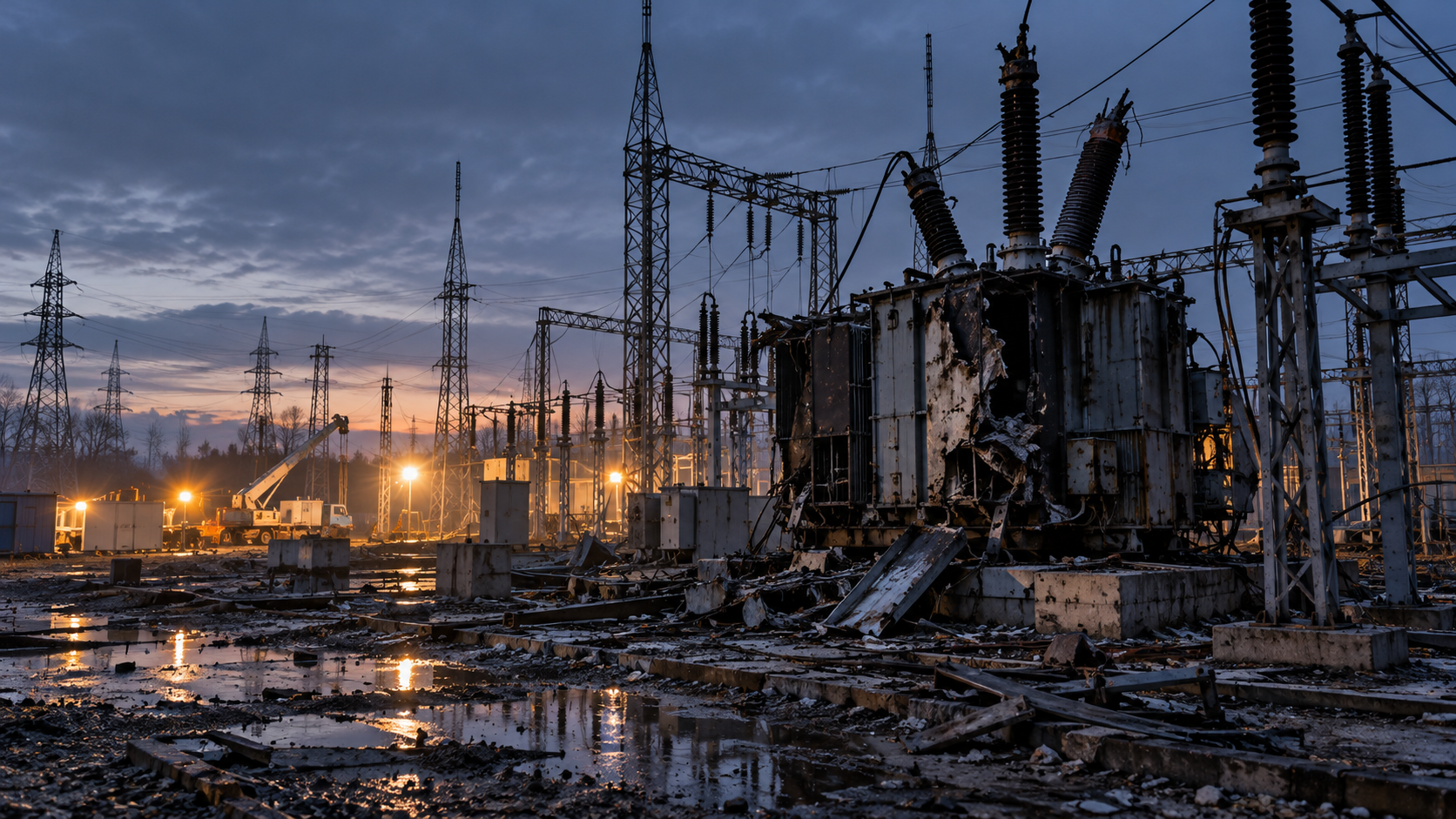
KYIV — Updated October 20, 2026, 8:18 a.m. ET: Russia expanded attacks on Ukraine's energy system into western regions that Ukrainian authorities said had not previously been targeted in the current campaign, producing new waves of power outages as winter approaches. Deputy Energy Minister Artem Nekrasov said facilities were struck in the Kirovohrad, Zhytomyr, Lviv, Rivne, Ternopil, Khmelnytskyi and Odesa regions. Reuters attributed the account to Ukraine's Energy Ministry and local authorities; DINA has not independently verified the complete target or damage list.
Ukraine's largest private energy company, DTEK, said three of its facilities in the Odesa region were hit overnight and 32,700 families remained without electricity Tuesday. That figure is the company's public count and may change as restoration work proceeds.
Secretary of State Marco Rubio separately acknowledged Tuesday that a shipment of U.S.-made air-defense interceptors purchased for Ukraine by European allies may not have been delivered. He denied that any nondelivery resulted from a deliberate political directive to harm Ukraine. Rubio's statement narrows the dispute but does not establish where the shipment is, what approval remains outstanding or when the interceptors will reach Ukrainian forces.
Why this update matters: The widening geographic footprint turns the reported collapse of the energy pause into a broader winter-security emergency. It also gives new urgency to the unresolved interceptor question: Washington now concedes that a delivery may not have occurred while rejecting Kyiv's allegation of politically motivated withholding.
KYIV — Updated October 20, 2026, 3:00 a.m. ET: At least 10 people were reported killed as Russia launched one of its broadest air assaults against Ukraine in months, firing 16 ballistic missiles at Kyiv and the surrounding region and more than 200 drones across the country, Reuters reported, citing Ukrainian officials. The reported toll includes six people, among them two children, killed in a drone strike near Kharkiv. DINA has not independently verified the complete casualty count or weapon totals, and both may change as authorities complete searches and damage assessments.
Ukrainian officials said more than 500,000 households lost power and rolling blackouts were imposed after energy infrastructure was damaged nationwide. President Volodymyr Zelenskyy said Ukraine received no advance warning from its partners before the first ballistic-missile wave; an air-force spokesperson said warning arrived before a later attack. Secretary of State Marco Rubio has denied that the United States paused intelligence sharing, leaving an unresolved dispute over whether all warning channels and intelligence products operated continuously.
Earlier reports said a Russian strike killed a woman in Kyiv and damaged a subway station, a 25-story residential building and a medical facility, Mayor Vitali Klitschko said. Reuters later reported a wider national toll of 10 deaths, including two people killed in Kyiv and the surrounding region, two in Kryvyi Rih and six near Kharkiv. Those figures remain attributed to Ukrainian officials.
The new strike followed a weekend of mass aerial attacks. Ukrainian President Volodymyr Zelenskyy said Russia struck Ukraine's energy, oil and gas infrastructure 76 times during the week after President Donald Trump announced an energy ceasefire. The Associated Press reported that Ukraine launched more than 1,000 drones toward Russia in a vast overnight operation that set fires at oil facilities in St. Petersburg.
Conflicting official accounts: Zelenskyy told NBC's Meet the Press that U.S. intelligence sharing with Ukraine had been blocked for a period and then restored. Rubio told reporters in Samarkand, Uzbekistan, that there had been no pause and questioned the basis for Zelenskyy's statement. President Donald Trump previously said intelligence sharing had continued. No public operational record currently reconciles the competing accounts.
What is confirmed: Zelenskyy publicly made the 76-strike allegation and identified substations in the Vinnytsia, Zhytomyr, Khmelnytskyi and Odesa regions as targets of the latest attacks. Reuters reported his statement but did not independently verify the count. Neither Kyiv nor Moscow has formally confirmed the ceasefire arrangement Trump announced.
What remains attributed: Russia's Defense Ministry said its forces intercepted 1,015 Ukrainian drones across 15 regions, occupied Crimea and the Black Sea. That figure is a Russian military claim. AP reported fires at the Petersburg Oil Terminal and the Ruchi oil depot, along with one death and five injuries associated with the wider attack. DINA has not independently verified the complete drone count, damage assessment or responsibility for every reported casualty.
Latest attacks on Ukraine's power system
Western expansion: Ukraine's Energy Ministry said overnight and morning attacks hit power facilities in seven regions, including Lviv, Rivne, Ternopil and Khmelnytskyi in the west. Deputy Energy Minister Artem Nekrasov said some consumers lost electricity. DTEK reported that three Odesa-region facilities were hit and that 32,700 families remained without power. Neither the Ukrainian government nor DTEK had published a complete facility-by-facility damage inventory at the time of this update.
Nationwide update: Reuters reported that Russia fired 16 ballistic missiles at Kyiv and the surrounding region and more than 200 drones in attacks extending from Kharkiv and Dnipro in the east to Odesa in the south and Volyn and Rivne in the west. Ukraine's air force said it downed 247 targets: four cruise missiles and 243 drones. Each weapons and interception figure is an official Ukrainian account that DINA has not independently verified.
Casualties and damage: Ukrainian officials reported 10 people killed. Regional Governor Oleh Syniehubov said a drone attack near Kharkiv killed six people, including two children. Officials reported two deaths in Kyiv and the surrounding region and two more in Kryvyi Rih. Klitschko said the Kyiv attack struck a subway station on the capital's left bank and damaged a high-rise residence, nonresidential buildings and a medical facility. Reuters independently reported hearing explosions but attributed the casualty, weapon and damage details to Ukrainian authorities.
Power outages: Reuters reported that more than 500,000 households lost electricity and that rolling blackouts were introduced for homes and businesses. Ukrainian Prime Minister Sergii Koretskyi said the energy sector was the main target and that Russia had struck Ukrainian energy infrastructure more than 2,000 times since mid-July. The aggregate strike count is a Ukrainian government claim.
Zelenskyy said tens of thousands of families remained without electricity after the latest strikes and that repair crews were working continuously. He also said residential buildings were hit. His office's public statement described the energy attacks as deliberate and urged the United States and other partners to increase pressure on Moscow.
Reuters reported that the alleged 76 attacks occurred during the week after Trump announced a halt to strikes on energy infrastructure. The absence of a jointly published agreement, monitoring mechanism, start time or enforcement procedure makes it difficult to determine whether the announcement ever became an operational ceasefire accepted by both belligerents.
That distinction matters. Continued attacks can demonstrate that a ceasefire failed, that one or both parties never accepted it, or that the public announcement overstated private negotiations. The available record does not yet establish which explanation is correct.
Ukraine's large-scale strike on Russia
AP reported that Ukraine launched more than 1,000 drones in one of its largest attacks of the war. Fires were reported at two St. Petersburg oil facilities, while other reported targets included a logistics center and a data center. Russia said it intercepted 1,015 drones; the scale of that claim has not been independently verified.
The same reporting said Russian attacks on Zaporizhzhia killed one civilian and injured two people, including a child. As with all fast-moving wartime casualty reports, figures can change as emergency crews complete searches and authorities revise their assessments.
The reciprocal attacks show that energy infrastructure remains an active theater of war despite Washington's public claim of a pause. They also intensify the dispute between Trump and Zelenskyy over Ukrainian attacks on Russian oil facilities, U.S. sanctions policy and the economic consequences of disrupted energy supplies.
Rubio denies pause that Zelenskyy says occurred
Zelenskyy said in the NBC interview that U.S. intelligence sharing had been interrupted but was later restored by the American side. Reuters reported that Ukraine relies on U.S. intelligence to detect fast-moving ballistic missiles fired at Ukrainian cities.
Rubio rejected that account on Monday, saying intelligence was never interrupted. His denial is the clearest on-record response from a senior U.S. official, but it does not by itself establish whether all intelligence products flowed normally, continuously and without restriction. Ukrainian officials previously said some Russian missile attacks arrived without warning.
On Tuesday, Rubio said a consignment of interceptors funded by European allies may not have been delivered, while denying a deliberate political effort to deny Ukraine defensive weapons. The distinction is important: his statement disputes motive but leaves the delivery status unresolved. The public record still does not identify the shipment's current location, the precise authorization chain or an expected delivery date.
The public record therefore contains a factual dispute between the two governments. The unanswered questions include whether any products were delayed, narrowed, technically unavailable or restricted without a formal policy suspension. Those distinctions matter because early-warning data can determine how quickly air-defense crews and civilians respond to ballistic-missile launches.
Why it matters
Electrical substations, oil terminals and gas systems are not abstract military targets. Damage can cut heat, light, water pumping, communications and medical services for civilians as winter approaches. Strikes on Russian export infrastructure can also affect global fuel markets, shipping and prices paid by households far from the battlefield.
The escalation raises a central diplomatic question: whether the United States announced a ceasefire before the parties had agreed on enforceable terms. A peace initiative without written obligations, verification and consequences can create political expectations while leaving civilians exposed to continuing attacks.
DINA independent analysis
This section is DINA analysis, not a statement of independently established fact. The reported exchange suggests the energy ceasefire is either nonfunctional or never fully constituted. Public declarations cannot substitute for a documented agreement that identifies prohibited targets, permitted defensive actions, monitoring authorities and remedies for violations.
Ukraine's allegation that Russia conducted 76 attacks requires transparent incident-level evidence. Russia's claim that it intercepted 1,015 drones requires the same scrutiny. Wartime governments have strong incentives to shape public understanding of battlefield events, so neither side's aggregate figure should be treated as independently proven solely because officials announced it.
The strongest accountability concern falls on all three governments involved in the public ceasefire narrative. Moscow and Kyiv should disclose whether they accepted the same terms. Washington should publish what it understood each side had committed to and what verification, if any, accompanied the announcement.
The intelligence dispute adds a separate accountability problem. Public denials and allegations cannot substitute for a documented timeline showing what information was available, when it was transmitted and whether any operational restrictions changed. DINA does not treat either government's statement as independently proven without that record.
The latest attack sharpens that question. An absence of warning before one missile wave, followed by warning before another, could reflect a policy restriction, a technical or collection failure, delayed transmission, or limits inherent in detecting ballistic launches. The public record does not yet establish which explanation applies. That uncertainty should not be collapsed into either government's broader political claim.
Strongest accountability questions
- Did Russia and Ukraine separately agree in writing to halt attacks on energy infrastructure?
- What targets, geographic areas and dates were covered by the announced arrangement?
- Can Ukraine publish an incident-by-incident record supporting the 76-strike count?
- Can Russia provide location-specific evidence supporting its claim of 1,015 intercepted drones?
- What civilian infrastructure protections and notification channels were established?
- Did the White House receive confirmation from both governments before announcing the ceasefire?
- Did any intelligence product, warning channel or Starshield-related capability experience a delay, restriction, outage or policy change, even if the United States did not classify it as a formal pause?
- What records support Zelenskyy's account of an interruption and Rubio's denial that any pause occurred?
- How many households remain without electricity, heat or water because of the latest strikes?
- What weapon struck the Kyiv subway station, residential tower and medical facility, and which air-defense warnings were available before impact?
- What accounts for the reported lack of warning before the first ballistic-missile wave and the arrival of warning before the second?
- Can Ukrainian authorities publish a location-by-location casualty and damage record supporting the national total of 10 deaths and the reported outage affecting more than 500,000 households?
- Which facilities were struck in the four newly identified western regions, and how many households and essential services remain without power?
- Where is the European-funded interceptor shipment Rubio said may not have been delivered, what approval remains outstanding and when is delivery expected?
Urgent records and follow-up requests
- Request the White House, State Department and National Security Council record of the announced energy ceasefire and each party's acceptance.
- Request the White House, State Department, Pentagon and intelligence community timeline for intelligence products and warning channels supplied to Ukraine, with operationally sensitive details redacted.
- Seek the briefing materials, talking points and interagency records supporting Rubio's statement that no pause occurred.
- Seek Ukraine's incident list for the reported 76 attacks, including times, coordinates, facility types and verified damage.
- Track satellite imagery, grid-operator notices and regional emergency reports for the four Ukrainian regions identified.
- Obtain official Russian emergency and port records for the St. Petersburg oil-terminal fires and reported casualties.
- Request independent assessments from the International Atomic Energy Agency where attacks affect nuclear-grid stability and from humanitarian agencies tracking civilian outages.
- Request Kyiv's incident report, emergency-response timeline, verified casualty list and damage inspection for the subway, residential and medical sites struck early October 19 local time.
- Request Ukraine's air-force after-action account for the two missile waves, including warning receipt times, launch detections and any known technical gaps, with operationally sensitive details redacted.
- Track regional emergency-service revisions to the reported deaths near Kharkiv, Kyiv and Kryvyi Rih and obtain the national outage and restoration timeline from Ukraine's energy ministry and grid operator.
- Request Ukraine's Energy Ministry, Ukrenergo and regional operators' facility-level outage and restoration records for Kirovohrad, Zhytomyr, Lviv, Rivne, Ternopil, Khmelnytskyi and Odesa.
- Request the State Department, Pentagon, NATO and participating European governments' transfer and approval records for the interceptor shipment Rubio said may not have arrived.
Sources
- President Volodymyr Zelenskyy — public statement on attacks against Ukraine's energy sector, October 18, 2026
- Reuters — Zelenskiy says Russia attacked Ukrainian energy sector 76 times in past week, October 18, 2026
- Associated Press — Blaze at St. Petersburg oil sites as Kyiv launches more than 1,000 drones at Russia, October 18, 2026
- Reuters — U.S. resumes intelligence sharing with Ukraine after pause, Zelenskyy says, October 18, 2026
- Reuters — Zelenskyy says Ukraine got no warning as Russian missiles rain in, updated October 19, 2026
- Reuters — Rubio denies U.S. paused intelligence sharing with Ukraine, October 19, 2026
- Reuters — Russia expands attacks on energy facilities to western Ukraine, October 20, 2026
- Reuters — Rubio says Ukraine interceptors may not have been delivered, but not for political reasons, October 20, 2026