
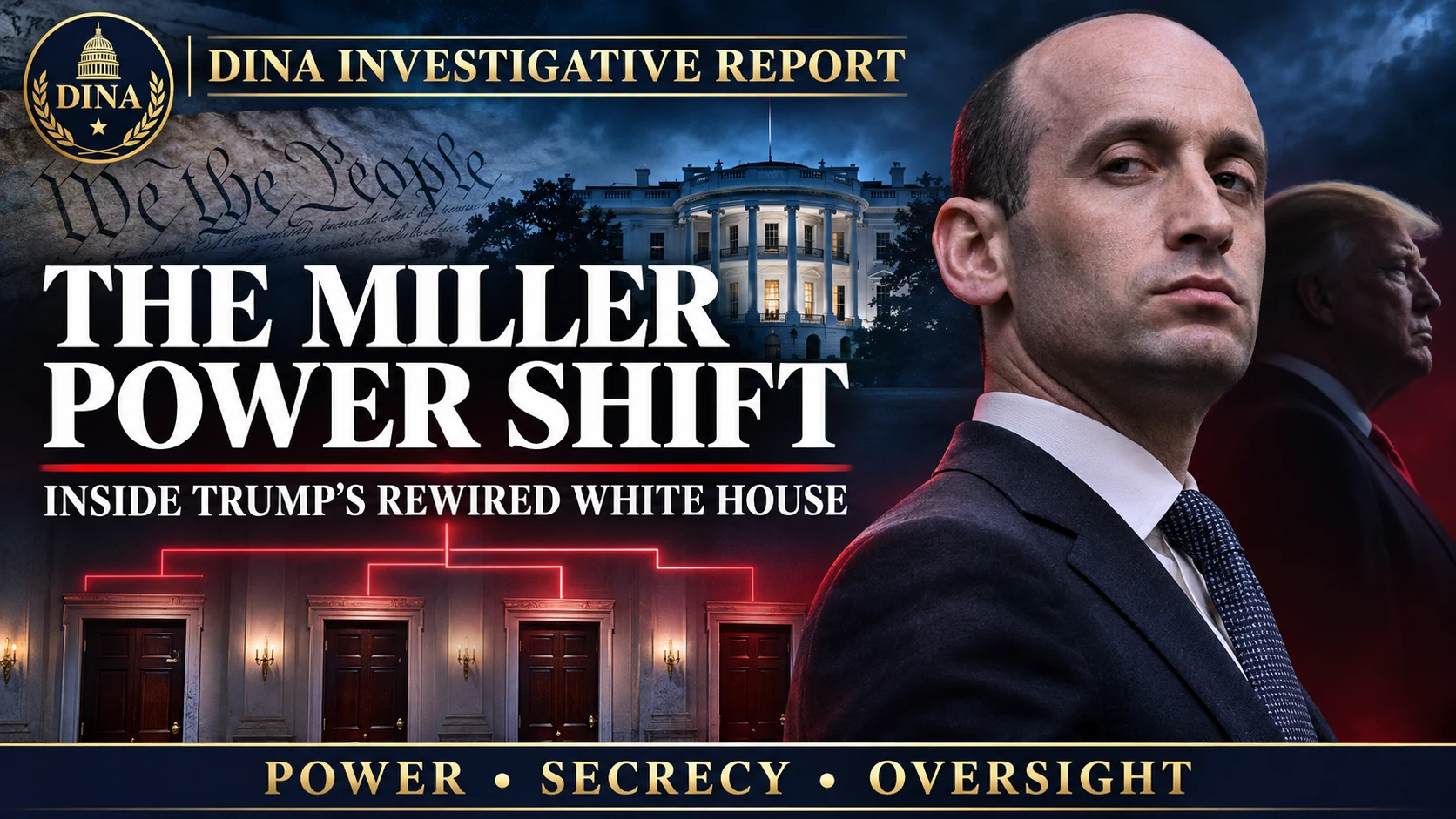
DINA Investigative Report · White House Power · Government Ethics · Constitutional Analysis · Chief Editor’s Op-Ed
Washington, D.C. — Stephen Miller did not arrive at the center of presidential power as an unknown administrator. He arrived as one of Donald Trump’s longest-serving ideological strategists, a principal architect of the administration’s immigration program and an advocate of unusually expansive executive authority. Now, after a punishing midterm election and a collapse in public confidence, Trump has placed Miller in the office designed to decide who reaches the president, which papers reach his desk and which institutions are allowed to slow him down.
That is why the first week of the Miller White House cannot be covered as an ordinary personnel story.
The question is not simply whether Miller will run a disciplined West Wing. The question is what discipline means when the person imposing it has spent years seeking legal and administrative mechanisms to move policy faster, concentrate control and overcome resistance from Congress, courts, career officials and the public.
It is also a question of democratic legitimacy. Miller has supporters who view him as focused, capable and loyal. But current polling shows that public skepticism is not a media invention. A November 9 YouGov survey of 7,860 U.S. adults found only 19% held a favorable view of Miller, compared with 37% unfavorable; another 43% said they did not know. A Reuters/Ipsos poll conducted November 6–9 found only 32% approved of Trump’s job performance while 65% disapproved. Trump’s approval on immigration—Miller’s signature policy arena—stood at 38%.
A government may lawfully appoint an unpopular aide. It may not treat unpopularity as permission to govern without transparency, lawful process or accountability.
What changed—and what remains unproven
The White House formally announced Miller’s appointment on November 6, describing him as a trusted adviser with institutional knowledge and unwavering commitment to Trump’s agenda. Miller began the role on November 9 after Susie Wiles left the chief-of-staff position for Trump’s political operation.
On November 14, The Washington Post and CNN separately reported that Miller’s office had issued two consequential internal memoranda.
The first reportedly changed the White House’s command structure and communications system. Cabinet secretaries would receive greater freedom to direct their agencies’ public messaging, reversing Wiles’s tighter centralized-approval process. At the same time, policy decisions would reportedly be funneled through a smaller circle involving Miller, newly promoted deputy chief of staff for policy Caleb Orr and Secretary of State Marco Rubio, who also serves as national security adviser.
The Post reported that the National Economic Council and Domestic Policy Council were not identified in the memorandum, raising questions about whether their influence had been reduced. A White House official disputed that inference and said those entities continued to fall under the deputy chief of staff for policy.
The second memorandum reportedly bars White House personnel from meeting registered lobbyists on the White House complex without advance approval from the White House Counsel’s Office. It directs outside stakeholder contacts toward the Office of Public Liaison.
Officially confirmed
Trump appointed Miller chief of staff effective November 9. The White House publicly praises his loyalty, experience and role advancing the president’s agenda.
Independently reported
Two internal memoranda changed communications and policy routing and restricted certain lobbyist meetings. The Post and CNN reported overlapping core details.
Still unresolved
The complete text, enforcement rules, exception records, off-site coverage, disciplinary consequences and practical effect on agency legal review have not been made public.
DINA has not independently authenticated a complete original copy of either memorandum. That limitation matters. Reporting may reliably establish the broad structure, but the public cannot test exceptions, definitions and enforcement language until the administration releases the documents.
The central paradox: decentralized speech, centralized power
The reported design contains an important contradiction.
Cabinet secretaries would receive more freedom to speak, but a narrower White House circle would control which policies move. Public communication may become decentralized while substantive authority becomes more concentrated.
That structure can make an administration faster. It can also make it harder to determine who made a decision, which objections were raised and whether professional expertise survived political review. When policy is coordinated through personal loyalty rather than transparent institutional channels, departments can appear autonomous while responding to a single ideological command center.
The chief of staff is not a Senate-confirmed officer with an independent statutory mandate. The office derives its practical power from proximity to the president: control of access, scheduling, paper flow, staffing and internal enforcement. In modern government, those functions can shape national policy without producing a public vote or formal order.
Congress must therefore look beyond organizational charts. It should ask who can stop a legally questionable proposal, who records dissent, whether agency counsel retain direct access to decision-makers, and whether inspector-general findings can reach the president without political filtering.
The lobbyist ban may be narrower than the headline
The reported lobbying restriction deserves scrutiny rather than reflexive praise.
The federal Lobbying Disclosure Act does not classify every corporate executive, lawyer, political donor, consultant or influence broker as a registered lobbyist. Under 2 U.S.C. § 1602, a lobbyist generally must be compensated for services involving more than one lobbying contact and spend at least 20% of the relevant three-month period on lobbying activities for that client.
That definition leaves substantial territory outside the label. An executive communicating on the executive’s own behalf, a consultant staying below the time threshold, a donor with direct access or an adviser operating through informal relationships may possess enormous influence without being treated as a registered lobbyist.
The reported memorandum also governs meetings on the White House complex. It does not, based on the descriptions made public, clearly prohibit meetings at hotels, clubs, political events, private residences or other federal offices. Nor does it close the Office of Public Liaison channel; it appears to institutionalize that channel as the designated point of contact.
None of this proves the rule is a sham. It proves the administration has not supplied enough public information to establish that it is meaningful.
If Miller intends to prevent pay-to-play politics, he should publish the memorandum, disclose every exception approved by White House Counsel, include virtual and off-site contacts, preserve visitor and communications records, and explain how the policy reaches corporate officers and consultants who influence government without registering under the federal statute.
The family-and-business question requires facts, not insinuation
The Washington Post reported that Miller’s wife, Katie Miller, performs public-affairs consulting for corporate clients and has publicly attacked major artificial-intelligence chatbots while holding a significant financial interest in Elon Musk’s competing xAI enterprise. She has denied being paid for her social-media statements and is not a registered lobbyist. CNN reported that people familiar with the transition said she advocated for her husband’s promotion; a White House official said she has no role in White House decision-making.
DINA does not present marriage, consulting work or an investment as proof of misconduct. It does present them as reasons for written recusals, financial transparency and a verifiable firewall—particularly when the administration is shaping artificial-intelligence, technology, procurement and trade policy.
The appropriate questions are straightforward:
- What clients or financial interests could be affected by policy routed through Miller’s office?
- What screening arrangements and recusals have been adopted?
- Will those safeguards be available for public inspection?
- Does the new lobbyist rule cover informal advice from politically connected consultants and family members?
These are governance questions, not accusations. The fastest way to answer them is disclosure.
Why immigration makes the trust problem more urgent
Miller’s power cannot be separated from the policy record that made him nationally known. He has helped design the administration’s aggressive deportation program and pushed agencies to use every available lever to deter, arrest and remove immigrants. Supporters describe that record as border enforcement. Critics describe it as an assault on due process, civil rights and human dignity.
Current public opinion is sharply divided—but it is not a mandate for unlimited force. AP-NORC reported in August that only 29% approved of the way Immigration and Customs Enforcement was enforcing immigration laws, while 49% disapproved. Fifty-five percent said Trump had gone too far in deploying federal immigration agents into American cities, and about half said the administration had gone too far in deportations and restrictions on legal immigration.
A separate February Navigator survey found Miller with a net-negative approval rating and reported 42% supported firing him while 29% opposed. Navigator is a Democratic-aligned research project, so its institutional perspective should be disclosed; its findings nevertheless reinforce the broader evidence that Miller does not enter the chief-of-staff office with broad national trust.
The more contested the policy, the greater the obligation to preserve legal review, document operational orders and allow independent oversight. The government’s power to detain, deport, surveil and use force cannot depend on private directives that disappear into the West Wing.
The legal boundary: speed is not immunity
Miller’s reported assignment is to identify actions Trump can take without Congress, particularly through executive orders, foreign-policy decisions and aggressive use of existing statutory authority. That strategy is politically understandable after the president’s party lost Congress. It is not legally unlimited.
When an agency converts a presidential demand into final agency action, the Administrative Procedure Act authorizes courts to set aside action that is arbitrary or capricious, contrary to constitutional rights, beyond statutory authority or adopted without required procedure. Appropriations remain controlled by Congress. Criminal enforcement must satisfy constitutional protections. Executive privilege is qualified rather than absolute. Records created in conducting presidential business remain subject to federal preservation duties even when immediate public disclosure is restricted.
The danger is not that every executive order is unlawful. Presidents of both parties use executive authority. The danger arises when the White House treats legal review as an obstacle to be routed around rather than a safeguard that protects the public and the presidency itself.
A smaller policy circle can increase coherence, but it can also create confirmation bias. If dissenting attorneys, scientists, economists, diplomats and career administrators are filtered out before a proposal reaches Trump, the administration may produce faster decisions that are more vulnerable in court and more destructive in practice.
A government preparing for oversight—or preparing to resist it?
The political context cannot be ignored. Democrats will control both chambers of Congress in January. House Oversight Committee Ranking Member Robert Garcia has already said Democrats will continue investigating Miller and challenge administration policies in Congress and the courts. Jeffries and Schumer condemned the appointment, while Republican Representative Marlin Stutzman called the promotion a mistake after the party’s midterm defeat.
At the same time, the White House has signaled a combative posture toward incoming investigations. That raises the possibility that the new organizational design is not only about policy delivery; it may also be about document control, message discipline and preparation for subpoenas.
Congress should not respond with televised outrage alone. It should build a disciplined oversight record:
- Request the two memoranda and all implementing guidance.
- Obtain the list of personnel reassigned, removed or newly empowered.
- Demand logs of lobbyist exceptions and Office of Public Liaison referrals.
- Examine whether agency counsel, inspectors general and ethics officials retain unfiltered reporting channels.
- Preserve communications involving immigration operations, artificial-intelligence policy, trade, Venezuela and federal contracting.
- Use subpoenas only with clear legislative purposes and precise document definitions that can withstand judicial review.
Oversight is not revenge. It is the constitutional price of exercising public power.
Chief Editor’s opinion: loyalty is not legitimacy
I do not question Stephen Miller’s intelligence, work ethic or capacity to understand the machinery of government. Those qualities are precisely why his concentration of power deserves exceptional scrutiny.
The White House praises Miller because he is loyal to Donald Trump. But the chief of staff’s ultimate obligation is not to a personality, movement or election slogan. Every public official operates within a constitutional order built on divided authority, lawful administration and the proposition that government belongs to the people.
Miller is distrusted by a substantial portion of the country because Americans have watched immigration become a theater of force, executive power become a substitute for democratic persuasion and legal boundaries become targets for creative circumvention. Trump is distrusted because his administration repeatedly asks the public to accept claims of necessity while withholding the documents required to judge them.
The answer is not to declare Miller guilty of misconduct that has not been proved. The answer is to refuse blind trust.
Release the memoranda. Publish the exception rules. Preserve the records. Disclose the conflicts. Respect subpoenas grounded in legitimate legislative purposes. Let inspectors general work without retaliation. Let agency lawyers record dissent. Let courts review final actions. Let the public see who enters the room and whose interests leave with a government decision.
If the Miller reorganization is genuinely designed to serve working Americans, transparency will strengthen it. If it is designed to concentrate power, shield influence and outrun oversight, transparency will expose it.
Democracy does not require the people to trust powerful officials on command. It requires powerful officials to submit themselves to systems worthy of the people’s trust.Lent C. Carr, II, Ph.D., DINA Chief Editor
The unanswered questions DINA will continue pursuing
- Will the White House release both restructuring memoranda in full?
- Who has authority to grant lobbyist-meeting exceptions, and will the approvals be public?
- Does the restriction cover virtual contacts, off-site meetings, political events and presidential properties?
- What role will the National Economic Council and Domestic Policy Council retain?
- What written ethics safeguards govern financial interests involving Miller’s household?
- What executive actions are being prepared for immigration, trade, artificial intelligence and Venezuela?
- Will agencies retain independent legal, scientific and inspector-general channels?
- Will the administration preserve documents requested by the incoming Congress?
Sources and reporting record
- The White House — President Trump Names Stephen Miller as 33rd White House Chief of Staff, November 6, 2026.
- The Washington Post — Stephen Miller faces first crisis as White House chief of staff, November 14, 2026.
- CNN Newsource via KRDO — Inside Stephen Miller’s aggressive first week as Trump’s chief of staff, November 14, 2026.
- YouGov — Stephen Miller favorability question, survey conducted November 9, 2026.
- Reuters/Ipsos Post-Election Survey — Topline and methodology, November 6–9, 2026.
- AP-NORC — Trump’s approval on immigration remains steady, August 2, 2026.
- Navigator Research — Americans Continue to Sour on ICE, February 4, 2026.
- House Oversight Democrats — Ranking Member Robert Garcia statement, November 6, 2026.
- U.S. House Clerk — Lobbying Disclosure Act records and guidance.
- 2 U.S.C. § 1602 — Lobbying Disclosure Act definitions.
- 5 U.S.C. § 706 — Judicial review under the Administrative Procedure Act.
Editorial transparency: This report combines verified public records, attributed reporting, legal and political analysis, and the Chief Editor’s clearly labeled opinion. DINA has not independently authenticated the complete internal memoranda and does not present unproved conflicts, criminality or constitutional violations as established fact.