
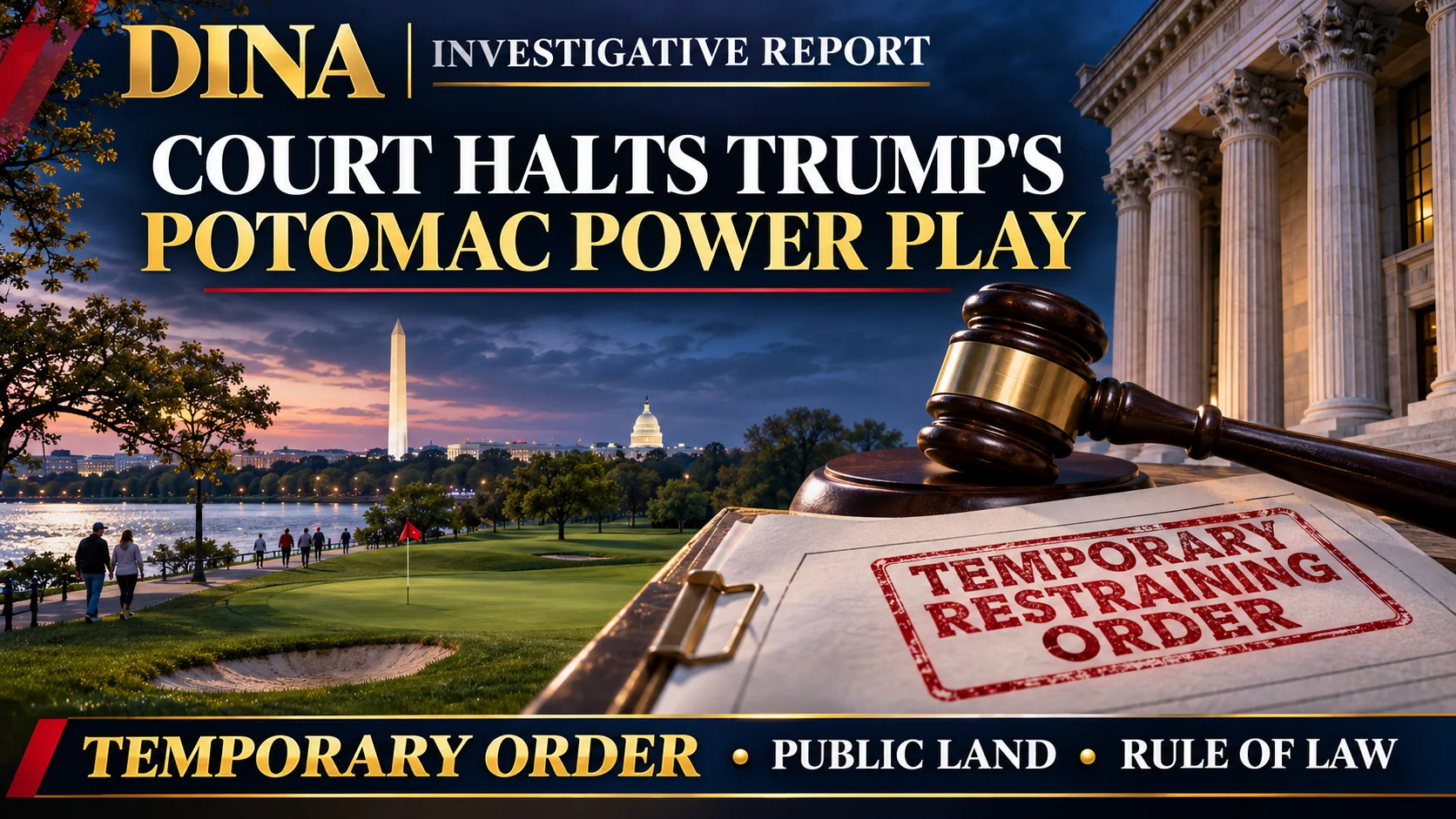
DINA Investigative Report · Federal Courts · Public Land · Administrative Law · Government Accountability · Chief Editor’s Op-Ed
WASHINGTON — November 14, 2026: A federal judge has stopped the Trump administration—for now—from closing East Potomac Park and its historic public golf course to begin a presidentially promoted redevelopment along the Potomac River.
In a sharply written 30-page order, U.S. District Judge Ana C. Reyes found that the government’s stated explanations for the closure were likely pretextual and that the National Park Service probably violated both the National Environmental Policy Act and the Administrative Procedure Act in its haste to meet President Donald Trump’s November 15 deadline.
The ruling preserves public access through November 28, 2026, unless the court acts sooner. It is a temporary restraining order, not a final judgment on the legality of the proposed golf-course redesign. The project has been halted at the threshold; it has not been permanently canceled.
The court did not merely pause construction—it questioned the government’s story
The most consequential part of the ruling is not the two-week pause. It is the court’s conclusion, based on the current record, that the administration’s public-safety and operator-related explanations did not credibly account for why nearly the entire park had to close on the precise date Trump selected.
The National Park Service cited deteriorating seawalls, unsafe facilities and the expiration of the existing operator’s authority. Reyes found that reasoning unpersuasive. The seawall had been identified as hazardous since 2019 and previously managed with fencing rather than a park-wide shutdown. More than 30,000 people had recently been permitted to run a marathon around the same perimeter. The government also helped create the operator problem by ending National Links Trust’s role effective November 15 and then citing the resulting absence of an operator as a reason to close the property.
The order describes that sequence as reversing cause and effect “by design.” It finds that the Park Service terminated the operator arrangement to further Trump’s directive that work on the Fazio design begin immediately.
That is a grave preliminary finding. Agencies may carry out lawful presidential policy. They may not reverse-engineer administrative explanations to disguise the actual basis of a decision or bypass procedures that exist to protect the public.
Trump’s social-media posts became evidence against his own administration
Trump publicly announced on October 18 and again on October 26 that the East Potomac course would close November 15 so redevelopment could begin. He described a “World Championship Public Facility” capable of hosting events such as the U.S. Open, PGA Championship, Ryder Cup and Presidents Cup.
Government lawyers nevertheless maintained that no final redesign decision had been made. The court found the president’s own declarations difficult to reconcile with that position. Trump’s posts indicated that the design and implementation schedule were settled, while the National Park Service’s formal closure record omitted the presidential directive and relied instead on safety and operational explanations.
The problem is larger than inconsistent messaging. Under the Administrative Procedure Act, an agency must disclose and defend the actual grounds for its decision. A court cannot meaningfully review a public explanation that conceals the real policy command.
What the temporary order requires
- East Potomac Golf Course must remain accessible to the public, subject to routine closures and genuinely necessary responses to imminent safety threats.
- The remainder of East Potomac Park south of Buckeye Drive—including Ohio Drive, trails, recreation areas and shoreline access—must remain open except near active seawall repairs or a documented imminent hazard.
- If the government imposes an emergency restriction, it must notify the court and plaintiffs within 24 hours and provide a sworn declaration from a senior National Park Service employee explaining the danger, scope and expected duration.
- The government was ordered to distribute the ruling to affected Interior and Park Service personnel and contractors by noon November 15.
- The plaintiffs must post a one-dollar bond by November 20.
The order does not require the government to operate the golf course for play or retain a particular concessioner. It does prevent officials from using the absence of golf operations as a reason to exclude the public from the land.
Likely NEPA and Administrative Procedure Act violations
Reyes concluded that the administration likely violated the National Environmental Policy Act and the Administrative Procedure Act. National Park Service regulations ordinarily require notice-and-comment rulemaking before closing national parkland, absent an applicable exception. The court found no qualifying exception and said no such public process occurred.
The court also found that the likely pretext behind the closure rendered the decision vulnerable as arbitrary and capricious. Those findings do not finally establish liability, but they are more substantial than a generic preservation-of-the-status-quo order. The judge assessed the record and concluded that the plaintiffs were likely to succeed on core legal claims.
Environmental review is often portrayed as bureaucratic delay. Here it serves its democratic purpose: forcing an administration to disclose what it intends to do with public land, study foreseeable consequences, consider reasonable alternatives and receive public input before irreversible work begins.
The Justice Department’s response—and the limits of the ruling
The Justice Department said the order does not prevent planning for a “world class” golf course and promised to defend the administration’s agenda. That statement is accurate in one important respect: the court preserved the property but did not prohibit every planning conversation, repair or preparatory act.
Trump attacked the judge before the ruling and contended that the course was dangerous. He also promised Washington-area residents a 50-percent discount on future rates. A presidential promise of discounted access does not answer the statutory questions. Price policy cannot replace environmental review, historic-preservation analysis, procurement transparency or lawful administrative procedure.
The administration may seek a stay, appeal, submit a revised closure decision or attempt to cure the procedural deficiencies. Any new filing must be examined carefully. Repackaging the same decision with additional paperwork would not necessarily cure a process the court has already described as driven by an arbitrary presidential deadline.
A separate inquiry into candor and professional responsibility
The litigation carries another accountability issue. Reyes has said that an inquiry will proceed into whether Interior, Park Service or Justice Department personnel misled the court or failed to satisfy professional obligations in connection with notice requirements and explanations for earlier tree removal.
The judge has considered appointing former U.S. Attorney Jessie K. Liu as a special master, while Justice Department lawyers objected that no special master was necessary or authorized without government consent. Reyes has not made a final appointment and no official or lawyer has been found to have committed misconduct.
That distinction must remain clear. An ethics inquiry is not a disciplinary judgment. But courts depend on government counsel to present agency actions accurately and in good faith. When a judge finds likely pretext in the underlying agency record, questions about the candor of representations to the court become even more serious.
Public land is not presidential property
East Potomac Park is not an empty parcel waiting for an executive vision. It is federal public land used for golf, walking, cycling, fishing, picnics, playground access and waterfront recreation. The government holds it in trust for the public under laws that distribute authority among Congress, federal agencies and the courts.
The proposed redesign may eventually survive legal scrutiny. A championship course is not inherently unlawful. But the policy case for a project cannot excuse the method used to impose it. Public land cannot be governed as if it were a private resort property, and a presidential social-media directive cannot silently substitute for a reasoned agency decision.
Affordability also belongs in the analysis. The plaintiffs contend that transforming a municipal-style public course into a championship venue would change its character and price ordinary residents out of access. Trump disputes that claim. The administration should therefore publish the complete financial model: anticipated fees, resident discounts, operating subsidies, concession arrangements, capital costs and any private funding or donor participation.
The money, contracting and access questions still unanswered
DINA’s investigation identifies several records the public deserves before any work resumes:
- The complete redevelopment plan, including the Fazio design, phasing schedule and all alternatives considered.
- The project’s total lifecycle cost and every federal appropriation, transfer, donation or private contribution expected to finance it.
- All solicitations, bids, awards, task orders and modifications involving design, construction, landscaping, security and concession operations.
- The National Environmental Policy Act and National Historic Preservation Act records supporting the project.
- Any ethics reviews involving contractors, donors, presidential properties or private organizations with a financial interest in championship golf.
- A binding public-access and pricing plan showing whether the redeveloped facility would remain genuinely accessible to working residents.
These questions do not presume corruption. They recognize that a high-profile presidential project on public land creates an elevated obligation to disclose who benefits, who pays and which laws authorize each irreversible step.
Chief Editor’s opinion: the rule of law interrupted a vanity deadline
I see this ruling as a necessary defense of democratic government against the conversion of public administration into personal command.
Donald Trump wanted the park closed on November 15. His agencies worked backward from that demand. According to the court’s preliminary findings, they ended an operator’s role, invoked safety problems that had existed for years and omitted the president’s redevelopment directive from the formal closure record. That is not neutral administration. It is government reorganizing its explanation around the will of one man.
The issue is not whether Trump has aesthetic preferences or whether a redesigned course might attract prestigious tournaments. Presidents may advocate. Agencies must still obey the law. Public servants must still state the real reasons for government action. Environmental and historic-preservation safeguards must still operate before public resources are transformed.
The administration’s haste is especially troubling because the public would bear the loss immediately while the promised benefits remain speculative. Roads, trails, fishing areas, playgrounds and waterfront access would close now. The championship venue would arrive later—if the design, funding, construction and operating assumptions all hold.
The court did what checks and balances are supposed to do: it required the government to stop before the damage became the argument for allowing the project to continue.
Public land is not a presidential trophy, and administrative law is not decorative red tape. When government acts for the people, it must tell the people the truth about why it acts.Lent C. Carr, II, Ph.D., DINA Chief Editor
What happens next
The immediate deadline is November 28, when the temporary restraining order expires unless it is extended, modified, stayed or replaced by another order. The court remains available for emergency clarification, and the administration could seek expedited appellate relief.
DINA will track:
- any motion to stay, appeal or dissolve the restraining order;
- the government’s compliance notices and any asserted emergency closures;
- the possible appointment of a special master and scope of the ethics inquiry;
- new environmental, historic-preservation or Federal Register filings;
- contracts, funding records and public-access commitments; and
- whether the November 28 deadline produces longer preliminary relief or a return to unrestricted administrative action.
Primary and corroborating sources
- U.S. District Court for the District of Columbia — Temporary Restraining Order, Document 159, filed November 14, 2026.
- Associated Press — Judge temporarily blocks Trump from moving ahead on Washington public golf course redevelopment, November 14, 2026.
- The Washington Post — Judge says inquiry into government lawyers will proceed, November 14, 2026.
- National Park Service — East Potomac Golf Links visitor information.
- 5 U.S.C. § 706 — Scope of judicial review under the Administrative Procedure Act.
Editorial transparency: This report distinguishes the court’s preliminary findings, the plaintiffs’ allegations, the administration’s position and DINA’s analysis. The DINA masterhead is conceptual editorial artwork, not a documentary photograph or an image of the actual court filing. No misconduct or final illegality is presented as established beyond the court’s temporary ruling.