
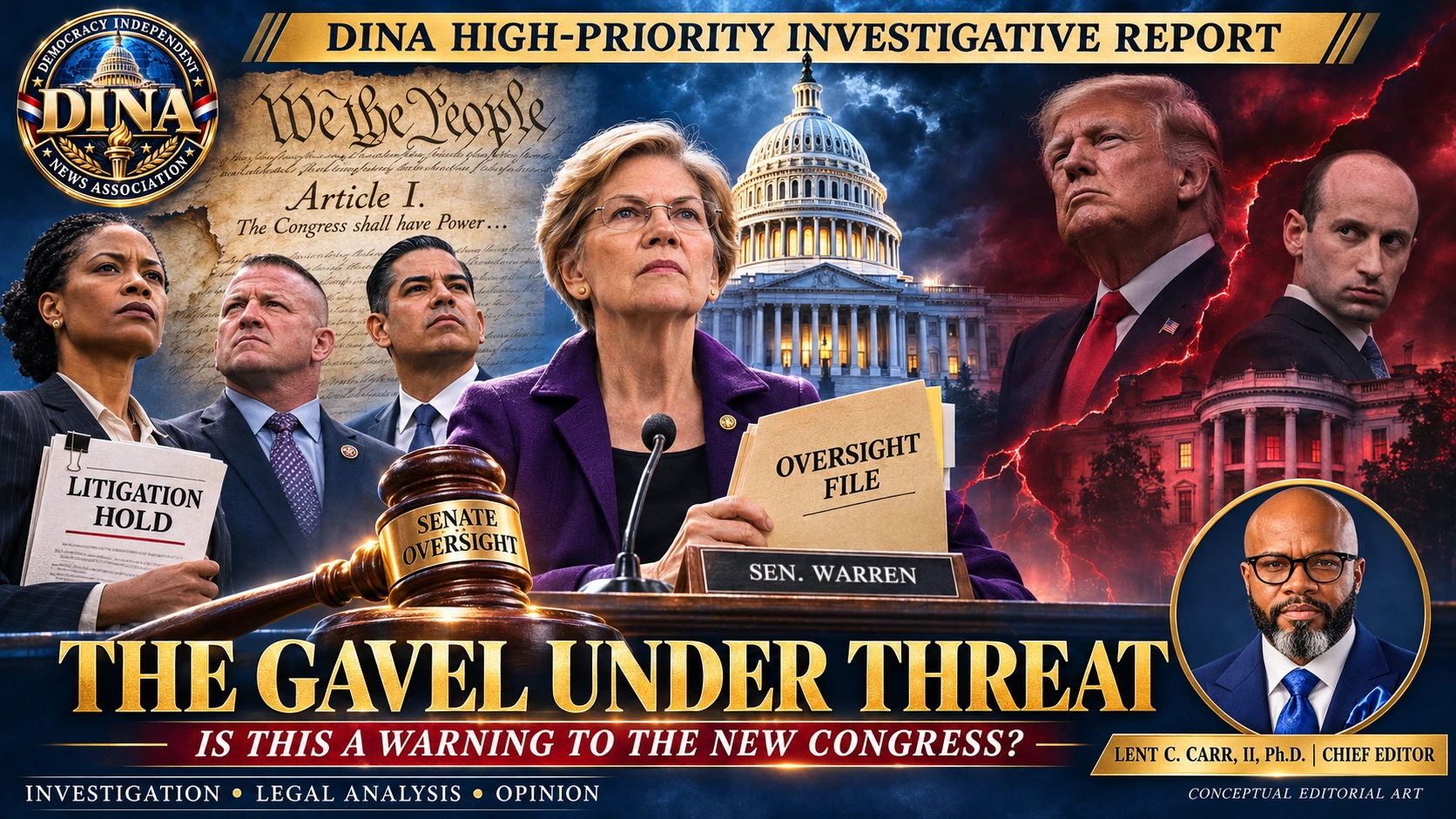
DINA High-Priority Investigative Report · Constitutional Law · Congressional Oversight · Political Science · Chief Editor’s Op-Ed
The urgent finding
What happened to Senator Elizabeth Warren on November 15 cannot responsibly be dismissed as ordinary partisan letter-writing.
Aaron F. Reitz, the United States attorney for the Southern District of Texas, publicly issued what he styled as a litigation-hold letter demanding that Warren, her Senate staff, consultants and campaign personnel preserve communications concerning her anticipated investigations of people and companies associated with President Donald Trump. The letter reportedly invokes the Reconstruction-era civil-rights statutes 18 U.S.C. §§ 241 and 242, demands written confirmation by 6 p.m. Eastern on November 23, and warns of sanctions or other legal consequences for noncompliance. Reitz accused Warren of intending to “weaponize” congressional investigations and employed the racially loaded imagery of a gavel wielded “like a tomahawk.” Anadolu’s November 15 report reproduces the material terms and language of the letter.
Minutes after Reitz posted the letter, newly installed White House Chief of Staff Stephen Miller amplified it and highlighted the same federal criminal statutes. The public record identified by DINA does not establish that Miller ordered the letter, that the White House and Reitz secretly coordinated it, or that prosecutors opened a formal criminal investigation. It does establish something narrower and still alarming: a senior White House official publicly embraced a prosecutor’s warning aimed at a sitting senator preparing to investigate Trump-linked financial relationships. The Daily Beast reported the sequence and noted that the letter itself did not say Warren was under investigation.
The Warren demand did not arise in isolation. It followed:
- a November 10 letter from White House Counsel Will Scharf warning incoming House Oversight Chairman Robert Garcia that planned subpoenas and investigations could amount to “blatant criminality”;
- a similar preservation demand by Reitz to Senator Richard Blumenthal over his inquiries into White House ballroom donors; and
- public statements by President Trump describing Democratic investigations as “extortion” and demanding that the Justice Department examine them.
The White House’s own letter cited Congressman-elect Richard Ojeda’s November 7 statement that he could not wait to see Defense Secretary Pete Hegseth “squirm in a hearing room.” That fact matters: the administration was not merely contesting a subpoena already issued. It was assembling the rhetoric of incoming lawmakers as evidence against the oversight program of a Congress that had not yet convened. Read the White House counsel’s November 10 letter.
The most defensible conclusion is therefore also the most consequential: this appears to be a preemptive warning to the incoming Congress. That is an inference from the timing, targets and repeated legal threats—not proof of a criminal conspiracy. But the pattern is now too coherent to describe as a single prosecutor freelancing in a vacuum.
Why Warren’s inquiry has an obvious legislative purpose
On November 12, Warren, Garcia and Blumenthal sent Trump fundraiser Meredith O’Rourke a detailed information request concerning more than $800 million reportedly coordinated for Trump-backed projects, including a White House ballroom, presidential library, Freedom 250 events and a Garden of Heroes. The lawmakers identified corporations that allegedly donated before receiving contracts, regulatory relief or other favorable government action. They asked whether existing ethics, bribery and anticorruption laws are adequate and requested answers by November 25. The official Warren release and source letter state those legislative questions expressly.
Those facts are allegations and reported correlations, not findings that any donor or official committed bribery. But the proposed subjects—federal contracting, regulatory enforcement, executive ethics, conflicts of interest and the adequacy of anticorruption law—sit at the heart of Congress’s Article I responsibilities.
The nonpartisan Congressional Research Service explains that oversight exists both to inform legislation and to check executive power. Its Congressional Oversight Manual says Congress may investigate the administration of existing law, contemplated legislation, corruption, waste and inefficiency. Read the Congressional Oversight Manual.
The Supreme Court has imposed limits: Congress has no free-standing police power to expose private affairs merely for punishment, and an inquiry must be connected to a legitimate legislative task. But the same Court has repeatedly recognized that Congress cannot legislate effectively without information. In Trump v. Mazars, the Court reaffirmed that each chamber may secure information needed for legislation, while directing courts to weigh separation-of-powers concerns when a subpoena seeks a president’s personal records. Read the Supreme Court’s opinion in Trump v. Mazars.
That doctrine does not convert an executive official’s disagreement with investigative tone into a veto over oversight. A court—not the White House counsel, not a political appointee and not a social-media repost—ultimately decides whether a contested subpoena crosses constitutional lines.
The Speech or Debate Clause is not ornamental
Article I, Section 6 provides that senators and representatives “shall not be questioned in any other Place” for speech or debate in either chamber. The protection reaches more than floor speeches. Supreme Court precedent recognizes immunity for acts within the legitimate legislative sphere, including committee work and authorized investigations.
The protection is powerful, but it is not limitless. Political statements, campaign conduct, press activity and some informal fact-gathering by individual members may fall outside its absolute shield. A 2025 CRS analysis emphasizes that the Clause is principally a protection from intrusion, not an independent source of investigative authority, and that individual-member inquiries may present harder questions than formal committee action. Read the CRS legal analysis.
That nuance is precisely why the incoming committees should document their legislative purposes, adopt clear authorizing votes where appropriate and conduct disciplined investigations. It is not a license for the executive branch to threaten criminal exposure before those committees have issued, litigated or enforced a subpoena.
Georgetown law professor Josh Chafetz, who studies Congress’s constitutional powers, called the White House theory “completely laughable” and said he had never seen criminal liability proposed for the use of congressional oversight power. His assessment appears in the Los Angeles Times.
Molly Nixon, a Cato Institute senior fellow on executive power, likewise said a criminal charge based on a member’s vote to issue a subpoena would be extraordinarily unlikely to survive. CBS News reported her analysis and the broader confrontation.
Reitz’s use of §§ 241 and 242: serious statutes, strained theory
Sections 241 and 242 are not rhetorical decorations.
Section 241 criminalizes an agreement by two or more people to injure, oppress, threaten or intimidate someone in the exercise of a federal right. Section 242 criminalizes a willful deprivation of federal rights under color of law. The Justice Department’s own guidance stresses that § 242 requires proof of a protected right, willfulness and action under color of law; its training materials explain that the civil-rights statutes demand specific intent tied to a right made specific and definite by law. Read DOJ’s statute summary. Read DOJ’s legal overview.
Those laws can reach public officials. A congressional title does not immunize genuine conspiracies to strip citizens of constitutional rights. The First Amendment also protects political association, and an investigation designed solely to punish lawful support for a president would raise grave constitutional concerns.
But Reitz’s publicly reported theory appears to leap from the possibility of abusive oversight to a threat of civil-rights prosecution before a subpoena has been tested, a court has found unlawful compulsion, or any person has been shown to have suffered a willful deprivation of a specific right.
Texas A&M criminal-law and civil-rights professor Jenny Carroll described the theory as “a total misapplication of that law.” Democracy Docket reported her analysis.
There is another jurisdictional question the letter does not publicly answer: what concrete connection places Warren’s anticipated Senate oversight within the Southern District of Texas? Reitz may possess facts not disclosed publicly. DINA found no public explanation of venue, no docket, no subpoena and no charging instrument. Those absences do not prove bad faith; they do make the public threat look more political than prosecutorial.
Is this obstruction of justice?
The Chief Editor’s characterization—political bullying obstruction of justice—describes the democratic injury DINA perceives: executive power being used to deter the legislature from examining executive conduct. Whether it is a prosecutable federal obstruction offense is a separate and much harder question.
The most relevant statute is 18 U.S.C. § 1505, which prohibits corrupt efforts, including threatening communications, to influence or impede the due exercise of Congress’s power of inquiry. Read the current statutory text.
But criminal liability would require evidence that the defendant acted corruptly or through a legally qualifying threat and that the conduct targeted a covered congressional inquiry or investigation. The present public record leaves major questions unresolved:
- Was the O’Rourke letter an inquiry of a House, the Senate or an authorized committee for § 1505 purposes, or an informal initiative by individual members?
- Did Reitz act with an improper purpose, or did he genuinely believe he was preserving potential civil-rights claims?
- Did anyone at the White House or DOJ direct, coordinate or approve the letter?
- Did Miller know of the letter in advance, or merely amplify it after publication?
- Was the objective to preserve evidence, to create political theater, to chill oversight, or some combination?
On current evidence, DINA can responsibly say the episode warrants an obstruction inquiry. DINA cannot responsibly declare that § 1505 has been violated.
This distinction is not timidity. It is the difference between constitutional journalism and the very weaponization of criminal law that this report condemns.
From democratic backsliding to competitive authoritarianism
Is the United States already a dictatorship?
The most rigorous scholarship offers a severe answer—but a more exact one. America is not a closed dictatorship in which elections are meaningless, opposition parties are outlawed and independent civic life has been extinguished. Yet leading comparative-democracy scholars now argue that the country crossed into competitive authoritarianism during Trump’s second presidency: elections remain real, but incumbents abuse state institutions to tilt the field against opponents.
In the October 2026 Journal of Democracy, Harvard political scientist Steven Levitsky and University of Toronto political scientist Lucan Way wrote that the United States “crossed the line into competitive authoritarianism.” They compare the pattern to Hungary under Viktor Orbán—while stressing that the American system remains softer, contested and potentially reversible. Read their October 2026 analysis.
That classification is more analytically persuasive than the blanket claim that the United States is already a total dictatorship. It is also more frightening in one respect: competitive authoritarian systems preserve the outward machinery of elections and courts while using prosecution, regulation, state resources, media pressure and selective enforcement to raise the cost of opposition.
The comparative data are equally disturbing:
- The V-Dem Institute’s 2026 Democracy Report found that the United States’ Liberal Democracy Index fell 24 percent in one year, dropping the country from 20th to 51st among 179 nations. V-Dem described the pace of deterioration as unprecedented in modern democratic history and identified executive concentration, weakened checks and intimidation of dissenting institutions. Read V-Dem’s findings.
- In October 2026, Bright Line Watch surveyed 492 political scientists and 2,750 Americans. Experts rated U.S. democracy 61 out of 100, closer to a hypothetical illiberal democracy than to a strong democracy. Read the October 2026 survey.
- A separate Bright Line Watch/UCLA survey of judges, lawyers and law professors found significant perceived erosion in the rule of law, including politicized law enforcement, separation-of-powers dysfunction and executive overreach. Read the legal-expert survey.
- Freedom House reports that the U.S. freedom score fell from 93 to 81 between 2005 and 2026, citing sustained erosion of political rights and civil liberties. Read the 2026 U.S. Democracy Tracker.
These measures do not prove that every Trump administration action is authoritarian or that every investigation of a Democrat is illegitimate. They show that the Warren episode fits an independently documented pattern: executive aggrandizement, politicized enforcement and pressure on institutions capable of checking presidential power.
A warning shot aimed at January
The administration’s own documents answer the central question more clearly than its defenders may intend.
The Scharf letter catalogued statements by members of the incoming Congress—including Ojeda—before accusing the new majority of preparing illegitimate investigations. Reitz then issued similar preservation threats to Blumenthal and Warren. Trump publicly urged criminal scrutiny. Miller amplified the Warren warning.
No single item proves a centrally directed conspiracy. Taken together, they communicate a message: if Congress investigates the executive, the executive may investigate Congress.
That is not normal interbranch negotiation. Presidents may assert executive privilege, challenge subpoenas, seek protective orders and litigate constitutional boundaries. Those are lawful tools. A preemptive threat of criminal consequences aimed at lawmakers for announcing oversight plans is different in kind because it uses the coercive shadow of prosecution before a court has ruled that the legislative process is unlawful.
The danger extends beyond Capitol Hill. If federal criminal statutes can be publicly brandished against senators for asking who funded presidential projects and what donors received, ordinary citizens may reasonably wonder what protection they have when they petition, protest, report misconduct, organize or criticize.
Authoritarian deterrence does not require mass imprisonment. It can work through uncertainty: a letter, a preservation demand, a public accusation, a government post that tells the target the machinery is watching. The object is often not conviction. The object is hesitation.
The new Congress answers
Congressman-elect Richard Ojeda has not, in the materials DINA could authenticate by the verification cutoff, issued a detailed constitutional response to the Warren letter itself. DINA will not manufacture one for him.
What the record does show is that Ojeda promised aggressive accountability, publicly anticipated placing Hegseth under questioning, and said incoming lawmakers should combine an accountability agenda with legislation lowering the cost of living. The White House letter cites his November 7 post. The Washington Examiner reported his broader accountability position.
The clearest constitutional answers have come from other incoming leaders:
- Robert Garcia: Congress’s authority comes from Article I, “not from the permission of the White House.” He said the Oversight Committee would not be deterred by threats from DOJ or presidential lawyers. Read Garcia’s official statement.
- Richard Blumenthal: In a reciprocal preservation letter to Reitz, he called the implied investigation baseless, demanded that Reitz preserve White House and DOJ communications and vowed that he would not be intimidated. Read Blumenthal’s November 11 letter.
- Hakeem Jeffries: He said the new Congress would serve as a check on an out-of-control executive branch and told the administration to “consult the Constitution.” CBS News reported his statement.
Their position is strongest when it is not theatrical. Congress should investigate to legislate, expose waste, protect rights and repair institutions—not to stage televised vengeance. The response to threatened weaponization cannot be counter-weaponization. It must be disciplined constitutional power.
DINA opinion: the prosecutor’s letter is itself an abuse of democratic scale
The Reitz letter is dressed in civil-liberties language, but its timing and posture invert the accountability relationship.
Warren and her colleagues asked whether companies gave money to projects controlled or favored by the president and then received government benefits. They identified potential legislative gaps. Instead of answering the merits—who gave, who received, what was promised and whether taxpayers were cheated—a federal prosecutor warned the investigator to preserve evidence of her own supposed wrongdoing.
That is political bullying with the power of the United States behind the envelope.
The “tomahawk” and “scalps” language deepens the offense. It is not legal analysis. It is a racially charged taunt embedded in an official threat to a senator. A prosecutor entrusted with equal justice should not communicate like a partisan provocateur.
Stephen Miller’s amplification transforms the episode from a regional prosecutor’s post into a national signal from the White House’s highest staff level. Again, amplification is not proof of prior coordination. It is proof of political adoption.
The administration cannot have it both ways. It cannot insist that donors and corporate actors possess associational rights worthy of federal protection while treating congressional investigators’ constitutional functions as presumptively criminal. Nor can it invoke protection from intimidation while its own officials deploy prosecution-coded threats to chill a coequal branch.
The incoming Congress must not bend the knee. It also must not lose its head.
What Congress should do now
- State the legislative purpose in writing. Every major investigation should identify the statutes, appropriations, ethics rules or regulatory gaps it may inform.
- Authorize compulsory process through formal committee procedures. Clear votes, rules and records strengthen both legitimacy and Speech or Debate protection.
- Preserve the full coordination record. Request communications among the White House, Stephen Miller, White House Counsel, DOJ leadership, Reitz’s office and any outside actors concerning the Warren, Blumenthal and Garcia warnings.
- Demand professional-responsibility review. Seek review by DOJ’s Office of Professional Responsibility and other competent oversight bodies into whether public prosecutorial threats complied with ethics rules, department policy and anti-politicization norms.
- Hold a public hearing on prosecutorial independence. The issue is larger than Warren: who may direct a U.S. attorney, how threats of investigation are approved, and what safeguards prevent retaliation against legislative oversight?
- Use courts where necessary. If subpoenas are resisted, seek enforcement and judicial rulings rather than allowing either branch to declare itself the sole constitutional judge.
- Protect witnesses and whistleblowers. Retaliation reporting channels, counsel access and preservation requirements should be established before hearings begin.
- Keep the public ledger. Publish requests, responses, deadlines, privilege claims and corrections so citizens can distinguish evidence from performance.
Conclusion: the gavel belongs to the people
The Warren letter is not yet proof of criminal obstruction. It is something democracy should recognize before proof becomes impossible: a threat of state power directed at the institution assigned to investigate state power.
The constitutional contest is not Warren versus Reitz, or Democrats versus MAGA. It is whether the executive may preemptively turn prosecutors, legal threats and public intimidation against legislative oversight—and whether Americans will accept the chilling effect as the new normal.
The best available scholarship does not require DINA to overstate the case. The United States is not a fully closed dictatorship. It has entered, according to leading experts, a competitive-authoritarian condition in which elections persist but the incumbent abuses institutions to punish or disadvantage opposition. The antidote is not panic. It is resistance through law, facts, elections, courts, journalism and an unafraid Congress.
Senator Warren should preserve every document—not because the intimidation is legitimate, but because an intact record may reveal who conceived it, who approved it, who amplified it and what they feared Congress would find.
And the new Congress should answer with a sentence no president, chief of staff, prosecutor or faction may erase:
The gavel is not the property of the White House. It is held in trust for the American people.
Editorial classification
This publication combines verified investigative reporting, constitutional and statutory analysis, political-science interpretation and clearly identified opinion. The criminal-law discussion is general analysis, not a legal accusation or adjudication. DINA will correct any material factual error promptly and will update the story if Warren, Reitz, DOJ, Miller or the White House issues a substantive response.