
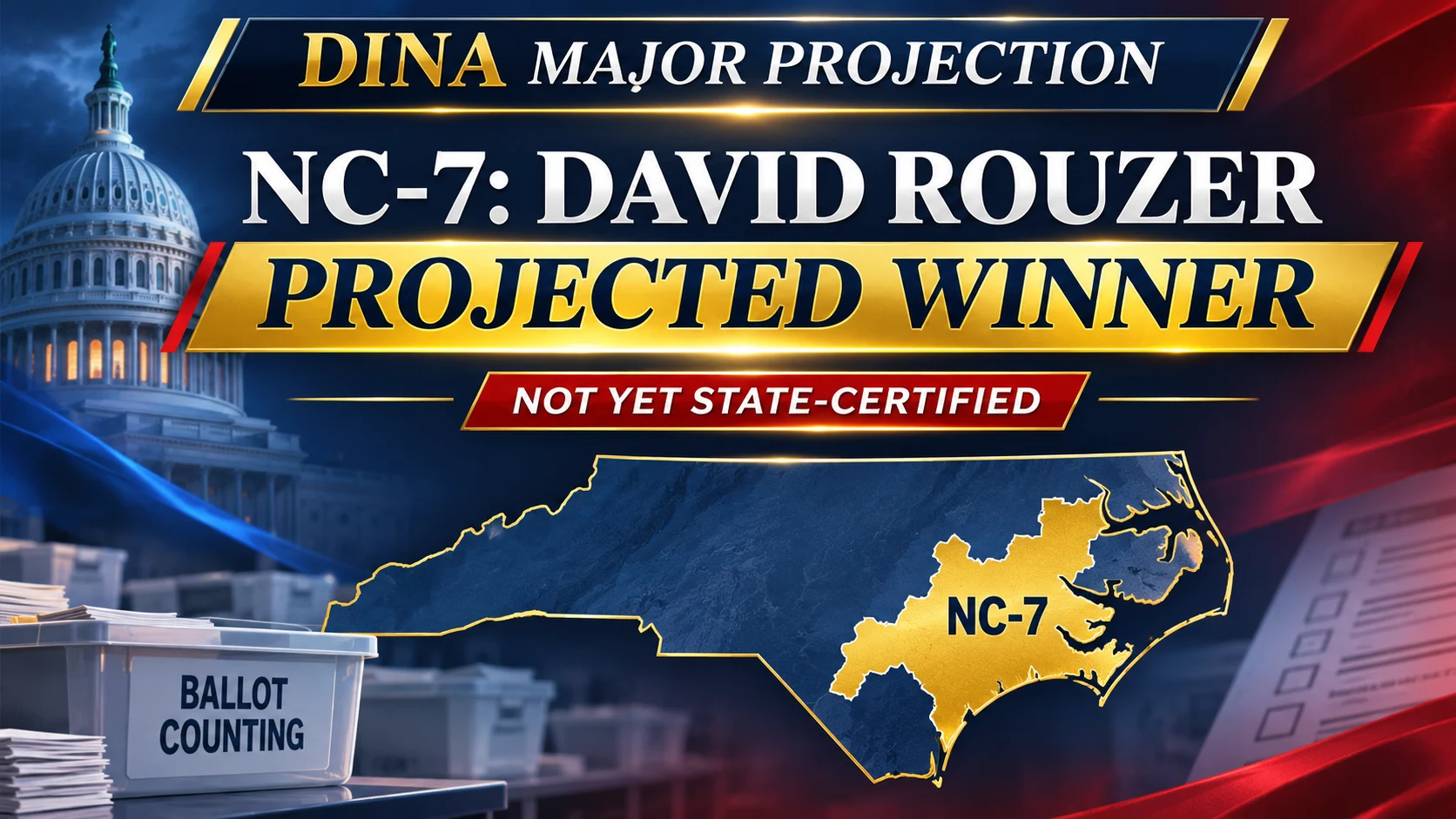
DINA MAJOR PROJECTION — PROJECTED WINNER, NOT YET STATE-CERTIFIED. Democracy Independent News Association projects Republican incumbent David Rouzer will retain North Carolina’s 7th Congressional District. This projection is based on Decision Desk HQ’s November 13 race call, the post-canvass vote count, and Democratic nominee Kimberly Hardy’s November 15 concession and decision not to seek a recount. It is not a certification by the State of North Carolina.
The count at publication
| Candidate | Party | Votes | Share |
|---|---|---|---|
| David Rouzer | Republican | 160,702 | 49.87% |
| Kimberly Hardy | Democratic | 158,391 | 49.15% |
| Maad Abu-Ghazalah | Libertarian | 3,173 | 0.98% |
Raw margin: Rouzer +2,311 votes. Percentage-point margin: approximately 0.72 points. Total votes shown: 322,266. Precinct reporting: 183 of 183 in the post-canvass tally.
Decision Desk HQ lists its decision at 8:04 p.m. Eastern on November 13, with a confidence level above 95 percent; its displayed count was updated at 7:23 a.m. Eastern on November 16. DINA is identifying the decision desk and timestamp because a media projection is analytically important but legally different from a state canvass.
What changed
Hardy conceded in a campaign video posted November 15 and said she would not pursue a recount. WECT reported November 16 that the campaign did not believe a recount could produce the more than 2,200 additional votes required to overtake Rouzer. The Wilmington StarNews likewise reported the concession and the final post-canvass totals.
A concession is a political acknowledgment, not the legal instrument that certifies an election. It is nevertheless material: Hardy was eligible to request a recount because the margin was within North Carolina’s one-percent threshold for a non-statewide contest. By declining that remedy, she removed the principal ordinary mechanism that could have retabulated every ballot in the district before certification.
Exact legal status
County boards completed their canvass work on November 13, but the 7th District spans multiple counties. The North Carolina State Board of Elections says U.S. House results remain within the State Board’s jurisdiction and are scheduled for statewide certification on November 24. The deadline for a candidate-requested recount in a congressional contest is noon November 17.
Accordingly, DINA’s status line is precise: Rouzer is the projected winner; Hardy has conceded and declined a recount; the State Board has not yet certified the result. DINA found no announced election protest or court order that changes this status as of 10:40 a.m. Eastern on November 16. A protest, correction or other lawful proceeding could still affect the administrative record before certification, but no currently identified batch of outstanding ballots presents a plausible path to reverse a 2,311-vote lead.
A Republican hold—and a warning written in the margin
Rouzer survived. The old political comfort surrounding this seat did not. A district that gave Donald Trump a double-digit presidential margin in 2024 came within roughly seven-tenths of a point of changing hands two years later. Decision Desk HQ’s comparison shows Hardy running about 13 points ahead of the district’s 2024 presidential Democratic performance. That is not a Democratic victory, but it is a political alarm that no honest analysis should dismiss.
The result reflects two realities at once. Republicans retained a coastal and southeastern North Carolina seat through a coalition that remained strong in Brunswick, Columbus, Pender, Robeson, Sampson and Bladen counties. Hardy countered with large advantages in New Hanover and Cumberland. The map reveals a district divided between rapidly changing population centers and communities where Republican margins still withstand a punishing national environment.
For Democrats, the lesson is not to romanticize a narrow defeat. A moral argument without durable rural organization, candidate recruitment, year-round field infrastructure and relentless economic messaging still leaves seats on the table. Hardy’s performance demonstrates that the district is contestable. Her concession demonstrates that contestability is not the same as winning.
For Rouzer, the lesson is sharper. A 2,311-vote escape from a 322,266-vote electorate is not a mandate for business as usual. It is a demand for humility from an incumbent returning to Washington after his party suffered historic losses nationally. Coastal resilience, affordable insurance, veterans’ services, health access, clean water, agricultural security and working-family costs cannot remain campaign-season vocabulary. A representative who wins by less than one percentage point inherits an obligation to hear the half of the district that tried to replace him.
The democratic meaning of a concession
Hardy’s decision deserves to be understood without mythology. A recount is a lawful safeguard, not an act of disloyalty. Declining one is not proof that the election system is flawless. It is a judgment that the verified margin, the available evidence and the likely effect of retabulating ballots do not justify prolonging the contest.
That distinction matters in an era when losing candidates are too often pressured either to surrender legitimate procedural rights or to manufacture suspicion where the evidence does not support it. Democratic legitimacy depends on both halves of the rule: use lawful review when facts warrant it, and accept a verified outcome when the arithmetic and the record close the door.
DINA projection
DINA PROJECTS DAVID ROUZER THE WINNER OF NORTH CAROLINA’S 7TH CONGRESSIONAL DISTRICT.
The basis is Decision Desk HQ’s November 13 call, the 160,702–158,391 post-canvass advantage, the full precinct count, and Hardy’s November 15 concession and waiver of a recount request. DINA will update the article if the State Board changes the official totals, receives a material protest, or certifies the contest on November 24.
Projection is not certification. Vote totals may be amended by election officials before the state canvass. DINA reports the status of the count; only the North Carolina State Board of Elections can certify this congressional result.