
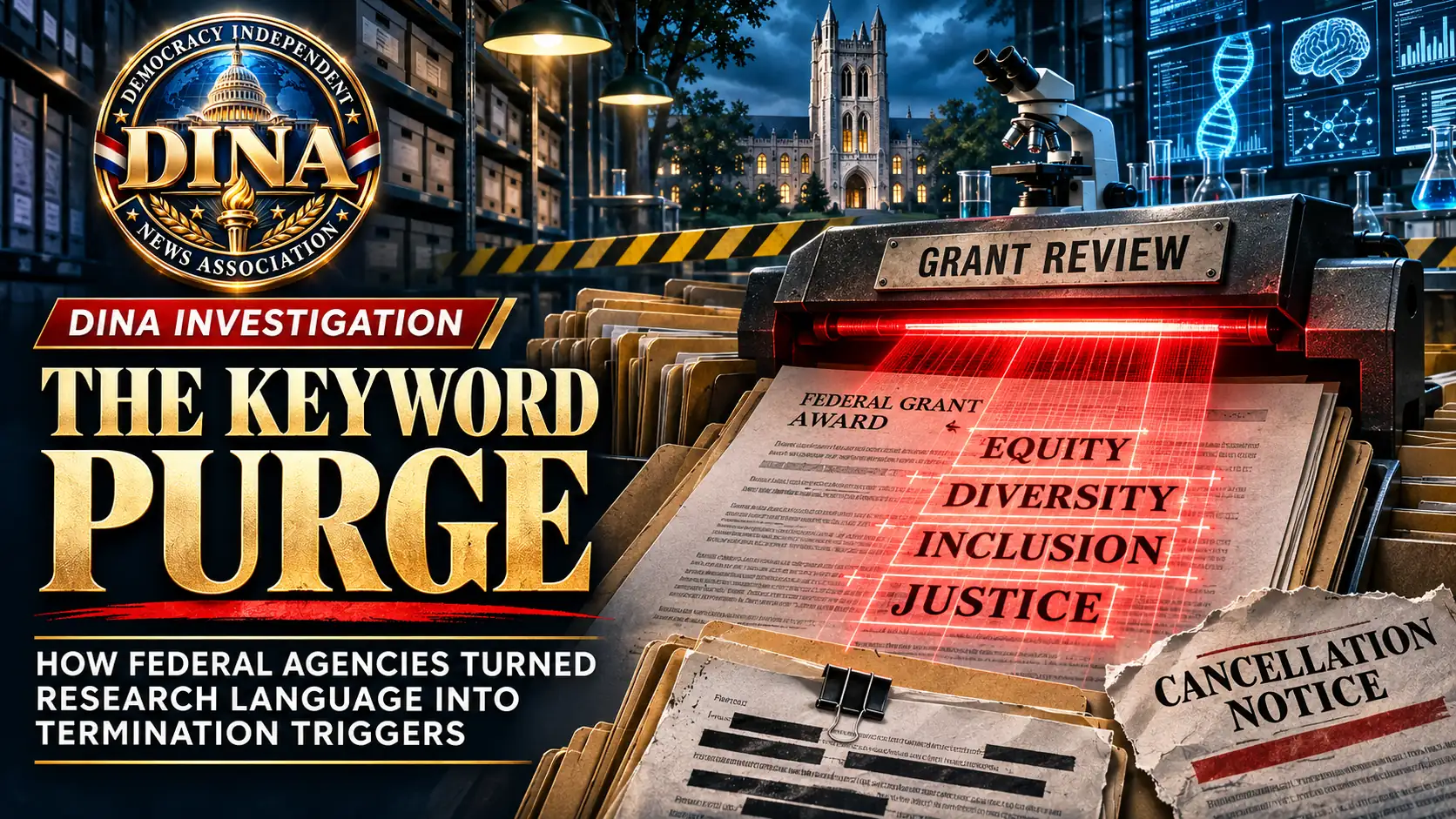
The Supreme Court’s November 16 refusal to hear Trump v. Thakur leaves intact a federal appellate ruling that exposes a consequential feature of the Trump administration’s campaign against diversity-related programs: federal research grants were not merely reviewed for performance or cost. They were screened for language associated with ideas the administration opposed.
The documented mechanism was blunt. The National Science Foundation used “keyword searches and analytics” to identify grants for termination. The National Endowment for the Humanities adopted a policy that first identified open grants associated with environmental justice, diversity, equity and inclusion, accessibility, or so-called gender ideology. The Environmental Protection Agency publicly announced hundreds of grant and contract cancellations tied to DEI and environmental justice before later reaching a settlement in principle with the plaintiffs in this litigation.
The Ninth Circuit concluded that the agencies likely crossed a constitutional boundary: rather than eliminating whole grant programs, they selected individual awards across existing programs based on the recipients’ perceived viewpoints.
This DINA investigation reconstructs the paper trail, separates what has been established from what remains alleged, and identifies the records Congress and the public still need.
The chronology
January–February 2025: the directives
President Donald Trump issued a series of executive orders directing agencies to eliminate DEI and DEIA policies from federal operations, identify grantees advancing DEI or environmental-justice work, and review grants for termination as part of a broader spending-reduction campaign.
The Ninth Circuit identified at least eight orders invoked in the litigation, including Executive Order 14151, Ending Radical and Wasteful Government DEI Programs and Preferencing, and Executive Order 14173, Ending Illegal Discrimination and Restoring Merit-Based Opportunity. One directive ordered the excision of DEI and DEIA references, “under whatever name they may appear,” including in grants. Another required agencies to list federal grantees that had provided or advanced DEI, DEIA or environmental-justice programs since January 20, 2021.
These directives supplied the political objective. Agency implementation supplied the targeting machinery.
April 2025: the form letters
EPA, NSF and NEH sent termination letters to University of California researchers. The letters relied on standardized language rather than individualized findings of fraud, nonperformance or scientific deficiency.
EPA said the awards no longer served program goals or funding priorities. NSF said certain awards no longer aligned with current priorities. NEH said it was redirecting money in furtherance of the president’s agenda.
Behind those generalized explanations, the litigation record documented a content-screening process. NEH’s selection policy focused on grants tied to specified viewpoints. NSF used keyword searches and analytics, and a review of terminated grants strongly suggested targeting of words such as “equity,” “diversity,” “inclusion” and “justice,” according to the Ninth Circuit.
June 2025: the researchers sue
Six UC researchers filed a class action in the Northern District of California. Their work spanned medicine, climate policy, water management, environmental research, history and the Mark Twain Project. They alleged violations of free speech, due process, separation-of-powers principles and the Administrative Procedure Act.
District Judge Rita F. Lin provisionally certified two classes and ordered grants reinstated. One class addressed form-letter terminations without grant-specific explanations. The second addressed grants terminated under the anti-DEI directives.
May 26, 2026: the Ninth Circuit draws a line
The Ninth Circuit split the case rather than accepting every theory.
It reversed preliminary relief for the form-letter class, concluding that its APA claim was essentially contractual because it sought payment under grant agreements and therefore likely fell within the Tucker Act and the Court of Federal Claims.
But it affirmed preliminary relief for the DEI-termination class. The panel found the class likely to succeed on its First Amendment claim because agencies selected particular awards for termination based on perceived DEI, DEIA or environmental-justice viewpoints.
The court emphasized that government may define a funding program’s boundaries. What it likely may not do is keep a program in place and use subsidy power as a penalty against disfavored viewpoints within it.
August–November 2026: the administration seeks Supreme Court review
Solicitor General D. John Sauer filed a petition on August 18. The administration asked whether the First Amendment prohibits government from considering the viewpoints advanced by academic research when deciding whether to continue funding it.
The petition disclosed that, when terminated, the NSF and NEH grants at issue had approximately $59 million remaining and expiration dates extending as late as November 2029. It also acknowledged that the researchers had reached a settlement in principle with EPA, leaving NSF and NEH at the center of the Supreme Court request.
On November 16, the Supreme Court denied the petition. No justice publicly noted a dissent. The denial does not resolve the merits, but it leaves the Ninth Circuit’s preliminary-injunction ruling in force while the district-court case continues.
What the money figures mean
The case has produced two figures that must not be conflated.
First, the administration reported approximately $59 million remaining on the NSF and NEH grants involved in the class at the time of termination. That is the amount identified in the government’s Supreme Court petition, not a fresh award announced by the Court.
Second, attorneys for the UC researchers told CBS News that the administration cut off more than $324 million in grants across the University of California system from January through June 2025. That broader number is an assertion by the plaintiffs’ lawyers reported by CBS; it is not the amount directly placed at issue in the administration’s certiorari petition.
An honest public accounting must identify, award by award, how much money was obligated, disbursed, frozen, terminated, restored or lost to delay. Aggregate numbers alone cannot show whether laboratories closed, staff were dismissed, field seasons were missed or community partnerships collapsed.
The human work behind the search terms
The words used as political triggers were attached to real research questions. Reporting on the litigation has identified work involving racial equity in science education and efforts to expand science access for Indigenous youth. The named plaintiffs’ fields included environmental conditions, public health, climate policy, water management and historical scholarship.
A keyword sweep cannot determine scientific merit. It cannot assess methodology, ethical safeguards, peer-review quality, cost controls or whether a project is achieving its stated objectives. It can only identify language. When language becomes a proxy for disfavored ideas, the review process ceases to be about performance and becomes a method of ideological classification.
This creates predictable distortions. Researchers learn to avoid accurate terms. Universities build compliance systems around political euphemism. Agencies waste time forcing serious inquiry through partisan filters. Communities whose conditions require careful study become less visible in the official record.
The unanswered questions
The litigation has revealed enough to justify aggressive oversight, but not enough to provide a complete account. DINA identifies at least eight unresolved areas:
- The full keyword dictionaries. What words, phrases, abbreviations and semantic variants did each agency use?
- The analytical tools. Were searches conducted manually, through spreadsheets, with commercial software or with artificial-intelligence systems?
- Error rates. How many grants were flagged because words appeared in citations, demographic descriptions, historical quotations or legally required language?
- Human review. Which career officials or political appointees validated automated or keyword-generated lists?
- DOGE’s role. What data did DOGE personnel access, what recommendations did they issue and what authority did agencies believe those recommendations carried?
- Award-by-award justifications. Did any termination rest on documented performance failure independent of viewpoint, and if so, where is that record?
- The cost of disruption. How much did the government lose through shutdown expenses, restart costs, contract disputes and abandoned work?
- The national scope. How many institutions outside the University of California were subjected to similar searches, and how much research remains affected?
These questions require records, not slogans.
The oversight agenda
Congress should compel production of termination lists, search protocols, source code or model documentation where automated systems were used, internal legal opinions, OMB directives, DOGE communications and agency decision memoranda. Hearings should include career grant officers, inspectors general, affected researchers, community partners and administration officials who approved the process.
Agency inspectors general should audit not only legal compliance but the integrity of the review methods. A politically selected keyword can generate the appearance of efficiency while concealing a high rate of false positives and arbitrary outcomes.
The Government Accountability Office should assess whether the terminations impaired Congress’s appropriations choices and whether agencies complied with federal grant regulations, statutory missions and notification duties. The public also deserves a searchable, award-level database showing each termination’s date, stated reason, legal status and financial effect.
DINA’s findings
The available record supports five findings:
- The administration’s anti-DEI executive directives were operationalized through agency grant reviews.
- At least NSF and NEH used viewpoint-associated language to help identify existing awards for termination.
- The termination notices relied on broad priority language rather than disclosed grant-specific performance findings.
- The Ninth Circuit treated the evidence as likely viewpoint discrimination and kept reinstatement relief in place for the DEI-termination class.
- The Supreme Court’s denial of review preserved that preliminary status but did not issue a merits ruling or final certification of liability.
The larger conclusion is unavoidable. The federal research system was used as a front in a political campaign against named ideas. The method reduced complex scholarship to trigger words and treated inquiry into inequality as presumptively suspect.
Public institutions are entitled to demand rigor from researchers. Researchers are equally entitled to demand that public institutions judge rigor through evidence—not through a partisan vocabulary list.
Until the administration discloses the complete targeting process, the keyword purge remains not merely a constitutional controversy but an unfinished accountability investigation.