
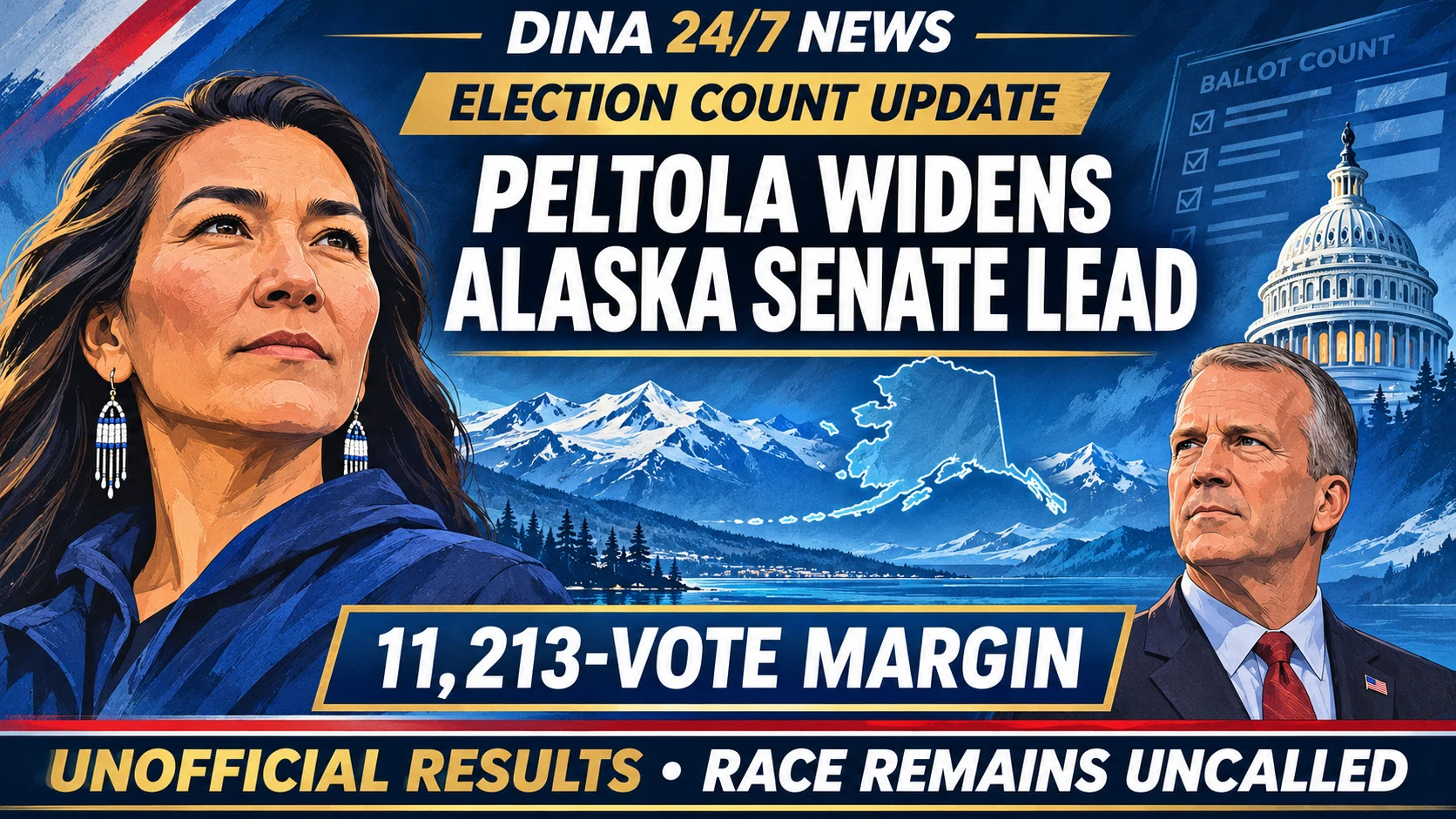
DINA MAJOR PROJECTION — ASSOCIATED PRESS CALL; UNOFFICIAL RESULTS; NOT CERTIFIED. Democracy Independent News Association projects Democrat Mary Peltola the winner of Alaska’s 2026 U.S. Senate election. The Associated Press issued its race call at approximately 10:21 p.m. Eastern on November 17, 2026, after a late state update moved Peltola above the first-round majority threshold. This is a news-organization projection—not certification by Alaska election officials.
The latest unofficial count
| Candidate | Ballot label | First-choice votes | Share of candidate votes |
|---|---|---|---|
| Mary Peltola | Democratic | 144,302 | 50.3% |
| Dan S. Sullivan | Republican | 131,844 | 45.9% |
| Gerald L. Heikes | Republican | 6,105 | 2.1% |
| Daniel J. Sullivan Jr. | No party listed | 4,760 | 1.7% |
Peltola’s lead over the incumbent: 12,458 votes. Total first-choice candidate votes: 287,011. AP reported 287,896 ballots counted, a figure that also encompasses ballots without a valid first-choice vote in this contest. The lead is approximately 4.3 percentage points over incumbent Republican Sen. Dan Sullivan. DINA independently totaled the candidate rows in Alaska’s official summary file after the Division’s November 17, 6:16 p.m. Alaska-time update.[1][2]
Why AP called the race
Alaska uses ranked-choice voting in federal general elections. A candidate who wins a majority in the first round prevails without transfers. AP said the November 17 update pushed Peltola above that threshold. Only a small number of ballots remained, mostly absentee mail ballots, and Peltola had performed strongly among the late-counted vote. AP concluded that her share was overwhelmingly likely to remain above 50 percent.[2]
AP also examined the contingency that Peltola’s first-choice share could slip just under a majority. Its analysis of the ballot data found that Sullivan would then need essentially every transferable vote from the two lower-finishing candidates to overcome her—an outcome the decision desk determined was not plausible. A race call is therefore a statistical judgment about the remaining pathways. It is not a state declaration.
What remains outstanding
Alaska’s Division of Elections still labels the 2026 results unofficial. November 18 is both the deadline for eligible overseas absentee ballots to arrive and the date of the final regional count of absentee and questioned ballots. Ranked-choice tabulation begins that day for contests that require it. The Division lists November 25 as its target certification date.[1]
Those remaining steps are not ceremonial. Officials must finish accepting eligible ballots, resolve questioned ballots, complete any required tabulations, reconcile the count and certify the record. The present status is exact: AP has projected Peltola the winner; Alaska has not certified her election.
The final Senate race changes the national ledger
Alaska was the last unresolved U.S. Senate contest of the 2026 midterms. AP’s call places the incoming Senate at 56 Democrats and 44 Republicans. Democrats flipped nine Republican-held seats, according to AP—the party’s largest Senate pickup since 1958.[3]
That scale of change is not a license for complacency. A majority earned in a cost-of-living election will be judged by whether it restrains corporate price-setting, protects healthcare and voting rights, strengthens labor, investigates executive misconduct and delivers for communities that have been treated as distant from Washington until their votes were needed. Alaska’s result helps give Democrats the institutional power to act. It also removes the excuse that governing ambition must be surrendered to a one-vote margin.
An Alaska-first coalition defeats a two-term incumbent
Peltola’s victory represents a striking comeback. She became the first Alaska Native to serve in Congress when she won the state’s House seat in 2022, lost that seat in 2024 and returned in 2026 to challenge a two-term senator. She campaigned on the pressures that feel immediate in Alaska: high fuel costs, housing scarcity, fisheries, food security and the extraordinary expense of life in remote communities accessible only by air or water.[3]
That emphasis matters politically. Peltola did not win by pretending Alaska is simply a smaller version of a national partisan map. She assembled a coalition around local material interests, cultural knowledge and a plain demand that public power serve families instead of corporate extraction. In a state Donald Trump carried repeatedly and comfortably, voters chose an Alaska Native Democrat over an incumbent closely aligned with the president.
The legal shadow did not erase the voters
The campaign’s final days were marked by allegations that people associated with Peltola’s campaign helped recruit an unaffiliated candidate with a name similar to the incumbent’s. The Trump Justice Department sued in an effort to block certification if Sullivan lost, pending an investigation. A federal judge dismissed that case; the department appealed. Peltola denied wrongdoing and described the lawsuit as political corruption, while Alaska argued that officials should be allowed to administer the election without unwarranted federal interference.[4]
Those allegations and proceedings should be reported, investigated and adjudicated from evidence—not converted into a presumption that voters may be discarded. The unofficial count places Peltola more than twelve thousand votes ahead of the incumbent, while the similarly named unaffiliated candidate received fewer than five thousand first-choice votes. AP’s call rests on ballots and remaining-vote analysis, not on campaign declarations.
DINA analysis: mandate and obligation
The arithmetic carries a broader democratic message. Alaska voters rejected the assumption that a conservative presidential history permanently belongs to one party. They also demonstrated why late-counted absentee, questioned, rural and overseas ballots deserve patience rather than suspicion. A ballot does not become less legitimate because it is counted after election night; it becomes part of the result when election law says it is eligible.
Peltola’s projected win joins a Democratic gubernatorial victory in Alaska and a national congressional rebuke of Trump-era governance. But electoral victory is only the transfer of responsibility. The incoming majority must now protect the separation of powers, use oversight with discipline, lower household costs and prove that democracy can produce consequences for concentrated power. If it retreats into procedural caution while families remain squeezed, the coalition that delivered this majority will have every right to demand better.
DINA projection
DINA PROJECTS MARY PELTOLA THE WINNER OF ALASKA’S 2026 U.S. SENATE ELECTION.
The basis is the Associated Press race call issued November 17 and the Alaska Division of Elections’ unofficial first-choice file showing Peltola at 144,302 votes to incumbent Dan Sullivan’s 131,844—a 12,458-vote advantage.
Projection is not certification. DINA will update this report if the remaining eligible ballots, a court order, an official tabulation or Alaska’s certification materially changes the status or totals.
Sources and reporting record
- Alaska Division of Elections — 2026 General Election results, page updated November 17, 2026 at 6:16 p.m. Alaska time: results labeled unofficial; summary CSV provides first-choice candidate totals; November 18 overseas-ballot deadline and final regional count; November 25 target certification date.
- Associated Press — “Why AP called the Alaska Senate race for Democrat Mary Peltola”, November 17, 2026: 12,458-vote lead, 287,896 ballots counted, approximately 4.3 percentage points, and decision-desk analysis of the remaining ballots and ranked-choice contingency.
- Associated Press — “Democrat Mary Peltola wins US Senate race in Alaska, beating incumbent Republican Dan Sullivan”, November 17, 2026: winner bulletin, Peltola statement, campaign context and projected 56–44 Senate division.
- Associated Press — federal judge dismisses lawsuit seeking to block Alaska Senate certification, November 1, 2026: legal posture, competing allegations and Alaska’s response.